Synthetic Fragrance Market Trends 2025 | Growth & Insights

2025 Synthetic Fragrance Market — Comprehensive Trend Analysis

Introduction

Synthetic fragrances remain the backbone of modern perfumery, personal care and home-care formulations because they deliver consistency, cost-efficiency and design freedom that natural extracts alone cannot provide. This article analyzes the 2025 market landscape for synthetic fragrances — size and regional dynamics, drivers and risks, competitive moves, and concrete strategic recommendations for suppliers and brand owners.Synthetic Fragrance Market Trends 2025
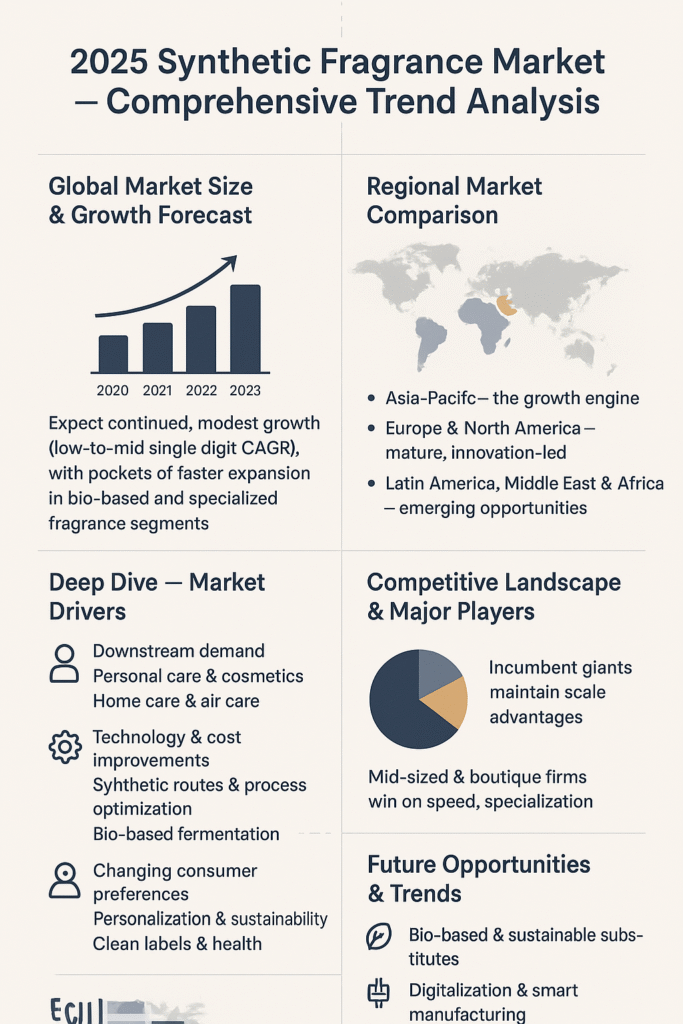

Global Market Size & Growth Forecast

Multiple market reports place the broader fragrance and flavors-and-fragrances complex on steady growth through the mid-2020s. One leading estimate values the global fragrance market in the mid-$50 billions and projects steady expansion driven by premiumization and new downstream applications. (Grand View Research) Another industry forecast for the combined flavors & fragrances sector indicates a mid-single digit CAGR in the immediate 2025 horizon, reflecting both food/beverage and home & personal care demand. (商业研究公司)

Key takeaway: expect continued, modest growth (low-to-mid single digit CAGR), with pockets of faster expansion in bio-based and specialized fragrance segments.


Regional Market Comparison

Asia-Pacific — the growth engine

APAC continues to outpace mature markets due to rising disposable incomes, rapid expansion of beauty & personal care, and local brands scaling quickly across e-commerce and modern retail. Investment in local production and regional formulation labs supports faster time-to-market for tailored scents.

Europe & North America — mature, innovation-led

These markets emphasize regulation, sustainability and premiumization. R&D and brand storytelling (clean labels, provenance) drive value rather than volume.

Latin America, Middle East & Africa — emerging opportunities

Growing urbanization, expanding retail distribution and localized fragrance preferences create attractive niches, particularly for affordable personal care and household fragrance formats.

(Regional patterns above align with general market-growth breakdowns from industry reports.) (商业研究公司)


Deep Dive — Market Drivers

1. Downstream demand

  • Personal care & cosmetics: fragrances remain central to product differentiation across moisturizers, deodorants, haircare and prestige perfumes.
  • Home care & air-care: growth in liquid detergents, fabric softeners, reed diffusers and scented consumer goods expands volumes for synthetic ingredients due to stability and cost advantages.

These application demands are consistent with the broader flavors & fragrances growth narrative. (商业研究公司)

2. Technology & cost improvements

Advances in synthetic routes, process intensification and catalytic chemistry lower unit costs and expand the palette of available molecules. Parallel improvements in biotechnology (fermentation, precision fermentation) are enabling new ingredient classes that mimic natural molecules at scale and lower environmental footprints. Industry reporting on bio-innovation underscores biotech’s rising role in beauty and ingredient sourcing. (Vogue Business)

3. Changing consumer preferences

Consumers — especially younger cohorts — want personalization, ethical sourcing, and transparency. This fuels demand for both customized synthetic accords (created rapidly and affordably) and bio-based/sustainable alternatives that deliver similar olfactory profiles with lower ecological impact. Market estimates for bio-based fragrance segments show higher growth rates compared to legacy synthetic segments. (Dataintelo)


Competitive Landscape & Major Players

The fragrance sector remains consolidated at the top, with global leaders (creation houses and ingredient manufacturers) commanding meaningful share while nimble specialists and regional houses capture niche opportunities. Strategic M&A and local acquisitions continue to reshape portfolios — notably the creation of DSM-Firmenich through the DSM/Firmenich combination (creating a large innovation-led player) and ongoing acquisitions by other multinationals to strengthen regional presence and capabilities. (DSM Firmenich Investors, 吉伟公司)

What this means: incumbent giants maintain scale advantages (R&D, global distribution), but mid-sized and boutique firms can win on speed, specialization, and local knowledge.


Industry Challenges & Risks

  • Raw material volatility & supply chain risk: crop yields, trade policy and logistics can spike costs or limit access to key natural precursors — pushing formulators toward synthetics or biotech alternatives.
  • Regulatory pressure & compliance costs: tightening environmental and safety standards increase testing, documentation and reformulation demands — especially in Europe.
  • Market access & certification hurdles: green claims, “natural” labeling and certifications carry both opportunity and compliance burdens.

Future Opportunities & Trends

  1. Bio-based & sustainable substitutes: demand for bio-sourced fragrance molecules (fermentation-derived or biocatalyzed) is accelerating and represents a high-growth subsegment. (Dataintelo)
  2. Digitalization & smart manufacturing: formulation software, AI-driven scent design and Industry 4.0 production yield faster iteration and cost control.
  3. Multi-functional scents & wellness integration: fragrances that claim mood, sleep or antimicrobial benefits (paired with substantiated claims) will gain attention.
  4. Regional product segmentation: targeted accords for local culture/markets will continue to outperform one-size-fits-all global SKUs.

Strategic Recommendations (for suppliers & brands)

  1. Invest in R&D & biotech partnerships — accelerate access to bio-based molecules and predictive fragrance design tools. (Vogue Business)
  2. Diversify supply chains — dual sourcing and regional production mitigate price and logistics risk.
  3. Differentiate via sustainability credentials and storytelling — transparently document lifecycle impacts to capture premium buyers.
  4. Pursue selective M&A or alliances — acquire regional houses or tech startups to gain local market knowledge and new capabilities. (吉伟公司)

Conclusion

The synthetic fragrance market in 2025 is one of steady baseline growth with higher-velocity pockets in bio-based ingredients, digitalized formulation and regionally tailored solutions. Market leaders will combine scale and innovation; challengers will win through agility and specialization. For participants, the winning playbook is clear: invest in sustainable synthesis (including biotech), diversify supply chains, and use data + storytelling to capture premium positioning.


References & Data Sources

  1. Grand View Research — Fragrance Market Size And Share | Industry Report, 2030. (Grand View Research)
  2. The Business Research Company — Flavors And Fragrances Market Report 2025-2034. (商业研究公司)
  3. DataIntelo — Bio-based Fragrance Market Report. (Dataintelo)
  4. DSM-Firmenich investor pages — merger & corporate information. (DSM Firmenich Investors)
  5. Givaudan — acquisitions and regional growth activities (June 2025 example). (吉伟公司)
 

Similar Posts

  • Top 10 Fragrance Trends Shaping 2025 | FY Flavors & Fragrances

    Top 10 Fragrance Trends Shaping 2025 How culture, science & sustainability are rewriting the scent rule‑book — and what it means for FY’s next creations. 1. Neo Gourmand 2.0 – Dessert Gets Sophisticated Classic cupcake sweetness is out; think roasted hazelnut praline laced with saffron or salty caramel spiked with black sesame. Search interest for “gourmand perfume” is…

  • Exploring the World of Aroma Chemicals

    Exploring the World of Aroma Chemicals Aroma chemicals are everywhere, yet often go unnoticed. They are the unsung heroes behind the scents and flavors we love. These compounds are crucial in creating fragrances and flavors in countless products. From perfumes to food, they play a vital role. Aroma chemicals can be natural or synthetic. Synthetic versions are more common due to their consistency and cost-effectiveness. The fragrance industry relies heavily on these chemicals. They ensure that scents are long-lasting and consistent across products. Flavoring agents, another type of aroma chemical, enhance the taste of food and beverages. They make our favorite treats even more enjoyable. The history of aroma chemicals is rich and fascinating. Ancient civilizations used natural extracts for scenting, laying the groundwork for modern perfumery. Today, the balance between natural and synthetic ingredients is key. This balance creates unique fragrance profiles that captivate our senses. As we explore the world of aroma chemicals, we uncover their impact on our daily lives. They shape our experiences and evoke emotions, making them indispensable.   What Are Aroma Chemicals? Aroma chemicals are specialized compounds used in creating scents and flavors. They are the building blocks of fragrance and flavor industries, essential in many products. These compounds can be derived from both natural and synthetic sources. Natural aroma compounds are extracted from plants or animal products, while synthetic ones are manufactured in labs. Synthetic aroma chemicals offer several advantages. They provide consistency, purity, and often a more cost-effective solution than their natural counterparts. Aroma chemicals are utilized in various applications. This includes perfumes, cosmetics, food products, and even cleaning supplies. They are selected based on their ability to enhance the user experience. Common uses of aroma chemicals include: Perfumes: creating distinctive and lasting scents. Food and beverages: enhancing flavors. Household products: masking odors. Cosmetics: adding pleasant fragrances. The science behind aroma chemicals is complex, involving intricate molecule interactions. This fascinating chemistry allows them to mimic natural scents effectively. A key aspect of their success lies in their ability to evoke emotions and trigger memories. This emotional connection is why aroma chemicals are so effective in marketing.   The History and Evolution of Aroma Chemicals The use of aroma chemicals can be traced back to ancient civilizations. Early societies used natural extracts for incense and personal scenting. During the Renaissance, advances in distillation improved the extraction of aromatic compounds. This period saw the rise of perfumery in Europe, laying the groundwork for modern developments. The 19th century marked a significant shift. Synthetic production techniques expanded the palette of available scents. This innovation revolutionized the industry, leading to mass-market fragrances. In the 20th century, chemistry and technology advanced further. New methods allowed for complex fragrance compositions, combining both natural and synthetic ingredients. Key milestones in aroma chemicals’ evolution include: Ancient times: Use of natural extracts. Renaissance: Improved distillation techniques. 19th century: Introduction of synthetic aroma compounds. 20th century: Complex fragrance formulations. The evolution of aroma chemicals reflects broader trends in science and technology. It has continually adapted to consumer preferences and industry demands. Today, the focus is on sustainability and innovation. Efforts are underway to create eco-friendly processes and new, sustainable aroma compounds. by Emile Mbunzama (https://unsplash.com/@emilembunzama) Natural vs. Synthetic Aroma Chemicals Aroma chemicals can be either natural or synthetic. Each type offers unique attributes and advantages in fragrance and flavor production. Natural aroma compounds are derived from plant and animal sources. Essential oils and extracts provide natural scent profiles. These compounds are often favored for their purity and aromatic qualities. Synthetic aroma chemicals, however, are created in laboratories. They replicate both familiar and novel scents. This method allows for cost-effective production and greater scent variety. Choosing between natural and synthetic aromas involves several considerations. Factors include cost, availability, scent longevity, and consumer preferences. Many products today blend both types for optimal results. Key differences between natural and synthetic aroma chemicals include: Natural: Sourced from plants and animals. Synthetic: Lab-created, often more consistent and durable. Scent Profile: Natural for purity, synthetic for variety. Cost: Natural can be pricier; synthetic is more economical. Availability: Natural sources can be limited. The balance between these two forms of aroma chemicals is crucial. It influences fragrance formulation and appeals to diverse consumer needs. Ultimately, the choice depends on the desired product attributes and market trends. Both natural and synthetic types continue to play vital roles in the industry. by Ela De Pure (https://unsplash.com/@eladepure) Key Types of Fragrance Compounds and Flavoring Agents Fragrance compounds are essential elements in perfumery and flavoring. They provide unique scent and taste profiles, enhancing product appeal. Esters are a common type of fragrance compound. They offer fruity and floral scents. Widely used in perfumes, they provide fresh, sweet aromas. Aldehydes are another vital group. They contribute to fresh and citrusy scents. Found in many household and personal care products, they bring a lively aroma. Ketones are notable for their versatility. They range from sweet to woody scents. Ketones add depth and complexity to many fragrances and flavors….

  • Where Does Vanilla Flavoring Come From?

    🌿 Where Does Vanilla Flavoring Come From? A Deep Dive Into Natural, Synthetic, and Everything In Between 🧭 Introduction: Why It Matters Vanilla is one of the most loved and widely used flavors in the world—found in ice cream, cookies, beverages, perfumes, and even soaps. But when you read “vanilla flavoring” on a label, do…

  • The Evolution of Fragrances: Tracing the Aromatic Journey Through Time

    The world of fragrances has experienced a remarkable transformation over the centuries, evolving from ancient rituals to sophisticated products in the modern beauty industry. This article explores the rich history and dynamic changes in the art of perfumery, reflecting cultural, technological, and artistic shifts. Ancient Beginnings and Royal Decrees Fragrances date back to ancient civilizations…

  • Synthetic vs. Natural Aroma Chemicals: Key Differences, Benefits & How to Choose

    Synthetic vs. Natural Aroma Chemicals: Key Differences, Benefits & How to Choose When formulating fragrances and flavors for perfumes, personal care, home care, or food & beverage products, one of the first strategic choices a brand or formulator must make is: use natural aroma chemicals, synthetic ones, or a blend of both? Each path has…

  • The Art of Flavor Pairing: Creating Sensational Taste Experiences

    Flavor Pairing: A Culinary Delight Flavor pairing is an art that chefs and food enthusiasts alike have mastered over centuries. It’s the skill of combining different ingredients to create a harmonious blend of flavors that excite the palate. From sweet and savory to spicy and tangy, the possibilities are endless when it comes to creating…

ใส่ความเห็น