Synthetic vs. Natural Aroma Chemicals: Key Differences, Benefits & How to Choose
Synthetic vs. Natural Aroma Chemicals: Key Differences, Benefits & How to Choose
When formulating fragrances and flavors for perfumes, personal care, home care, or food & beverage products, one of the first strategic choices a brand or formulator must make is: use natural aroma chemicals, synthetic ones, or a blend of both? Each path has distinct sensory, technical, regulatory, cost and sustainability implications.
This guide walks you through the differences, the advantages and limitations of synthetic vs. natural aroma chemicals, practical selection criteria, regulatory considerations, market trends, and actionable recommendations — with real-world tips from FY Fragrance & Flavor Solutions, a company supporting product teams worldwide.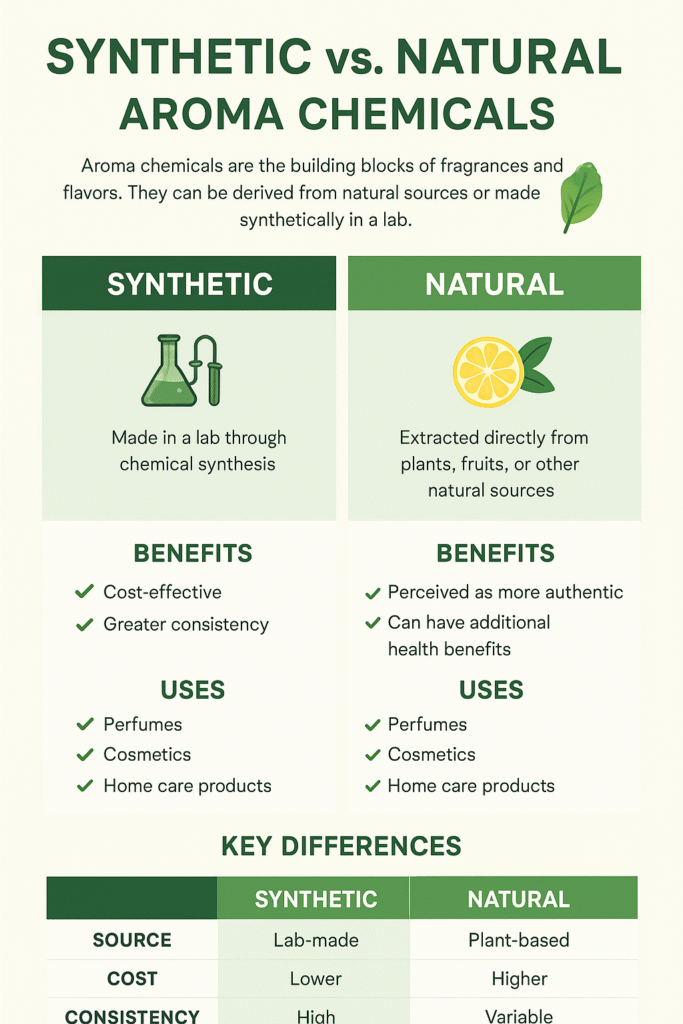
1. Quick definitions
- Aroma chemical — a single chemical compound that produces a recognizable scent or flavor (e.g., linalool, limonene, vanillin).
- Natural aroma chemicals — molecules extracted or concentrated from botanical/animal sources (essential oils, absolutes, resins).
- Synthetic aroma chemicals — molecules manufactured via chemical synthesis or biotechnology; may be nature-identical (chemically the same as natural molecules) or novel (not found in nature).
2. How natural and synthetic aroma chemicals are produced
Natural routes
- Steam distillation — common for essential oils (lavender, eucalyptus).
- Cold pressing — citrus peel oils (orange, bergamot).
- Solvent extraction / enfleurage / absolutes — for delicate flowers like jasmine, tuberose.
- Supercritical CO₂ extraction — solvent-free, high-purity extracts used for high-value botanicals.
Natural extracts typically produce complex mixtures of dozens to hundreds of aroma chemicals plus non-volatile components.
Synthetic routes
- Classical organic synthesis — building molecules from petrochemical or bio-based feedstocks.
- Biotechnological production — fermentation or enzyme catalysis to generate aroma molecules (e.g., fermentation-derived vanillin).
- Nature-identical synthesis — making the exact same molecule as found in nature, but in a controlled factory process.
Synthetics give tight control over purity, batch consistency and supply scale.
3. Sensory & performance differences
| Atributo | Natural Aroma Chemicals | Synthetic Aroma Chemicals |
|---|---|---|
| Complexity | Highly complex, multi-component aroma profiles | Can be single, clean, precise notes or engineered accords |
| Consistência | Batch variability due to terroir/harvest | High batch-to-batch consistency |
| Longevity / tenacity | Some naturals have short volatility | Many synthetics are designed for longevity and diffusion |
| Creative range | Limited to what nature provides | Virtually unlimited; novel accords possible |
| Estabilidade | Some sensitive to oxidation/heat | Many synthetics are more stable under processing conditions |
| Cost | Often higher (rarity, extraction yield) | Generally lower and scalable |
Practical note: Good perfumery and product fragrance blends usually combine both — naturals for complexity and authenticity, synthetics for stability, performance, and cost management.
4. Regulatory, safety & allergen considerations
Regulations & standards
- IFRA (International Fragrance Association) issues usage limits and prohibitions for fragrance ingredients.
- REACH (EU) requires registration and safety data for many chemicals sold in Europe.
- FDA / FEMA govern flavor ingredients and safety in the U.S. for food uses.
Both natural and synthetic aroma chemicals are subject to regulation. A “natural” label does not bypass safety limits — many naturals contain components that are allergenic or restricted at certain concentrations.
Allergenicity
- Some natural molecules oxidize and form allergens (e.g., certain terpenes).
- Synthetics can be designed to avoid known allergens or to replace restricted naturals.
Supply-chain transparency & documentation
- Buyers should require IFRA certificates, Safety Data Sheets (SDS), technical specs, and where relevant, traceability documentation. FY provides regulatory documentation and compliance guidance for global markets.
5. Sustainability and ethical sourcing
Natural concerns
- Overharvesting and habitat pressure (e.g., sandalwood, agarwood) can create ecological and social problems.
- Natural extraction can be energy and land intensive.
Synthetic opportunities
- When produced responsibly, synthetics (especially fermentation-derived molecules) can reduce pressure on natural resources and offer improved carbon footprints compared with some wild-harvested naturals.
Middle path: responsible sourcing
- Certifications (organic, fair-trade, RSPO for palm derivatives) and traceability matter.
- Upcycling agricultural by-products (citrus peel → limonene) is a growing practice.
FY works with suppliers and biotech partners to expand bio-based and upcycled aroma chemical options for clients.
6. Cost, availability & scalability
- Naturals: Prices fluctuate seasonally and geographically; rare absolutes can be expensive.
- Synthetics: Manufactured at scale with predictable pricing and lead times.
- Hybrid approach: Use naturals as signature accents while leveraging synthetics for bulk lift and longevity — a cost-effective model for many consumer products.
FY offers flexible MOQ and sourcing strategies to accommodate both emerging brands and large manufacturers.
7. Typical use cases: where each shines
Best uses for natural aroma chemicals:
- Premium/niche perfumery where authenticity and storytelling matter.
- Products marketed on “natural” or botanical claims (with appropriate compliance).
- Situations where regional or cultural authenticity is key (e.g., real oud, patchouli).
Best uses for synthetic aroma chemicals:
- High-volume household products (detergents, air fresheners) requiring stability and low cost.
- Food flavors where FEMA/FDA-approved synthetics provide consistency and safety.
- Novel scent concepts and accords not available in nature.
8. Quality and technical performance factors
When selecting aroma chemicals, evaluate:
- Volatility & evaporation profile — determines top/heart/base function.
- Oxidation propensity — impacts shelf life and allergen potential.
- Solubility — oil, alcohol, water compatibility.
- Interaction with matrix — surfactants, emollients, alcohols can alter scent perception.
- Stability under processing — heat, pH, shear.
FY offers stability and compatibility testing to ensure aroma chemicals perform in real formulations.
9. Market & consumer trends affecting choice
- Clean & transparent labeling: consumers demand clarity — more brands disclose fragrance components or offer “allergen-reduced” lines.
- Sustentabilidade: increased interest in bio-based, upcycled or fermentation-derived aroma chemicals.
- Gourmand and novel accords: demand for edible, warm gourmand notes and intriguing hybrid flavors.
- Personalized and mood-focused scents: driving interest in targeted aroma molecules (calming vs energizing).
Brands should weigh consumer perception (some segments prefer “natural”) versus technical performance and sustainability realities.
10. How to choose: a practical decision framework
- Define product positioning — premium natural brand vs. mass-market functional product.
- List critical performance needs — longevity, spray diffusion, wash durability.
- Check regulatory landscape in target markets (IFRA/REACH/FDA/FEMA).
- Evaluate supply risk — seasonal naturals vs. synthetic reliability.
- Assess sustainability goals — life cycle impacts, traceability.
- Prototype and sensory test — always test aroma chemicals in the final product matrix.
- Cost modeling — include raw material and processing costs, plus impact on shelf life and returns.
FY’s consultative services help brands run trials, predict costs, and build compliant formulas that meet sensory and business goals.
11. Case examples (illustrative)
- Fabric softener: Use synthetic musks and amber bases for long-lasting smell, with a touch of natural lavender absolute for authenticity in a “calm” variant. Microencapsulation can add wear-activated release.
- Premium perfume: Blend natural jasmine absolute with a nature-identical hedione or Iso E Super to add diffusion and modernity while keeping cost manageable.
- Flavored beverage: Use FDA/FEMA-approved flavor synthetics (e.g., nature-identical vanillin) for consistency and safety; supplement with natural fruit extracts for marketing claims.
12. Working with suppliers: what to require
Ask suppliers for:
- IFRA certificates and recommended maximum use levels.
- SDS and technical datasheets detailing purity, solvent residues, and storage.
- Traceability & sustainability documentation for naturals.
- Stability data in your product matrix.
- Sample & scale-up support; FY provides tailored sampling and technical R&D support.
13. Emerging technologies and the future landscape
- Precision fermentation producing high-value aroma molecules at scale.
- Green chemistry for low-impact synthesis.
- Encapsulation & intelligent release systems for controlled scent delivery.
- AI in fragrance design to speed blend optimization and predict consumer preferences.
FY invests in biotech partnerships and digital formulation tools to keep client formulations future-ready.
14. Conclusion — balance, not dogma
There’s no categorical “better” between synthetic and natural aroma chemicals. The right choice depends on product goals, technical requirements, regulatory constraints, sustainability priorities, price targets and brand positioning.
A pragmatic, blended approach — using naturals for signature authenticity and synthetics for performance and scalability — is the industry standard. Work with technical partners who can deliver compliant, stable, and sensorially successful solutions.
FY Fragrance & Flavor Solutions offers end-to-end support: ingredient sourcing, regulatory guidance, customized blends, stability testing and scalable supply for both natural and synthetic aroma chemicals. Contact FY to discuss your product brief, request samples, or run application trials.
FAQ (quick answers)
Q: Are natural aroma chemicals always safer than synthetics?
A: No. Safety depends on the specific molecule and its use level. Many naturals contain allergenic components; synthetics can be engineered to avoid them. Regulatory limits apply to both.
Q: Can synthetic aroma chemicals replicate natural scents exactly?
A: Nature-identical synthetics can be chemically identical to natural molecules; combined synthetics and naturals can recreate perceptually equivalent scents. However, some consumers value the “natural” provenance.
Q: Which is more sustainable — synthetic or natural aroma chemicals?
A: Sustainability depends on sourcing and production. Some synthetics (especially fermentation-derived) have lower environmental impact than pressure on wild-harvested naturals. Certification and LCA help determine true impact.
Q: How do I decide for my product?
A: Define your sensory goals, regulatory markets, cost constraints, and sustainability targets. Prototype, test in matrix, and consult a technical partner (like FY) for regulatory and stability guidance.
Q: What documentation should a responsible supplier provide?
A: IFRA compliance, SDS, technical data sheet, origin/traceability info for naturals, COA (Certificate of Analysis), and guidance on recommended maximum use levels.