O que são aromas naturais?

O que são aromas naturais? | Verdade, definição e o que você deve saber

🌿 O que são aromas naturais? | Verdade, definição e o que você deve saber

Na era atual de "rótulos limpos" e consumo consciente, um rótulo de ingrediente aparece mais do que a maioria: sabores naturais. Parece inofensivo - talvez até saudável - mas o que significa exatamente?

Vamos detalhar a definição, como os aromas naturais são produzidos, de que são feitos e como se comparam aos aromas artificiais. A verdade pode surpreendê-lo.O que são aromas naturais?

🧭 O que significa "sabor natural"?

À primeira vista, "natural" pode sugerir algo diretamente da natureza: óleo de limão espremido na hora, fava de baunilha moída ou ervas secas. Porém, na rotulagem de alimentos, não é tão simples assim.

🧾 Definição da FDA (EUA)

Sabor natural significa substâncias aromatizantes derivadas de fontes vegetais ou animais e obtidas por meio de processos físicos, enzimáticos ou microbianos."

Isso inclui frutas, vegetais, temperos, ervas, carnes, aves, frutos do mar e laticínios. O sabor deve ser extraído sem solventes sintéticos ou modificações químicas agressivasMas é permitido outro tipo de processamento, como fermentação, destilação ou torrefação.

🇪🇺 Definição da UE (EFSA)

A União Europeia define "substâncias aromatizantes naturais" como materiais identificados na natureza e obtidos por métodos naturais-ligeiramente mais rigoroso em algumas áreas, mas ainda permitindo uma ampla variedade de técnicas.


Do que são feitos os aromas naturais?

Os aromas naturais podem vir de plantas, animaisou fermentação microbiana. Eles podem incluir:

  • Óleos essenciais (por exemplo, laranja, hortelã, cravo)
  • Extratos de frutas (por exemplo, óleo de limão, destilado de framboesa)
  • Compostos derivados de fermentação (por exemplo, vanilina natural de arroz)
  • Derivados de animais (por exemplo, enzimas de laticínios, extratos à base de carne)

No entanto, eles também podem incluir:

  • Transportadoras (álcool, glicerina, propilenoglicol)
  • Conservantes (conforme permitido legalmente)
  • Solubilizantes ou emulsificantes

⚠️ Esses "aditivos incidentais" nem sempre estão listados no rótulo, tornando os "aromas naturais" menos transparentes do que os consumidores esperam.


⚖️ Aromas naturais versus artificiais: Qual é a diferença?

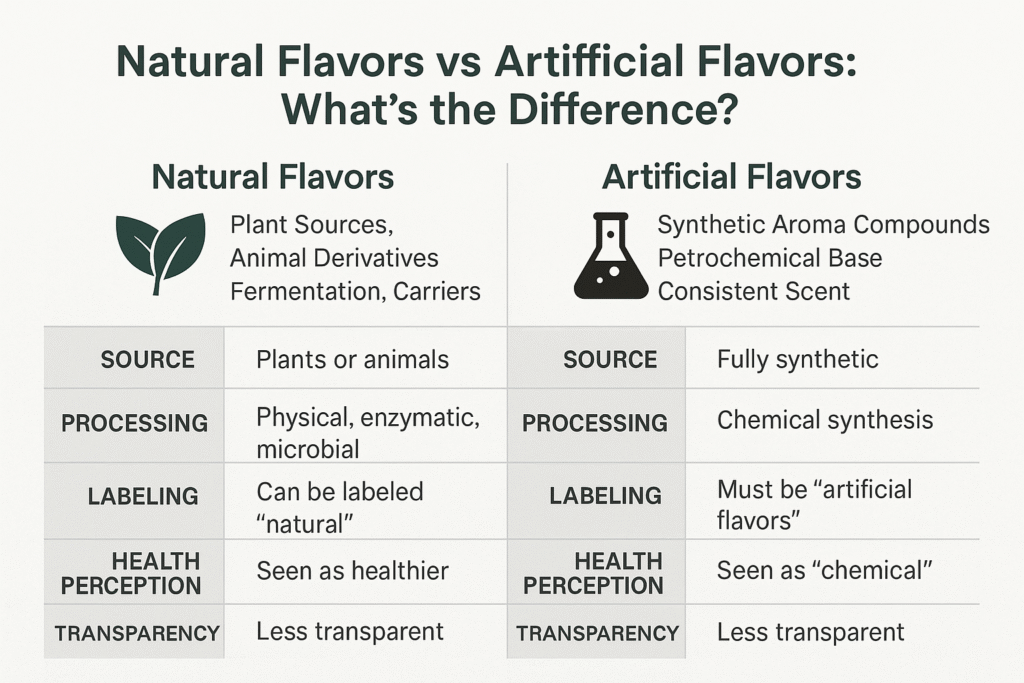
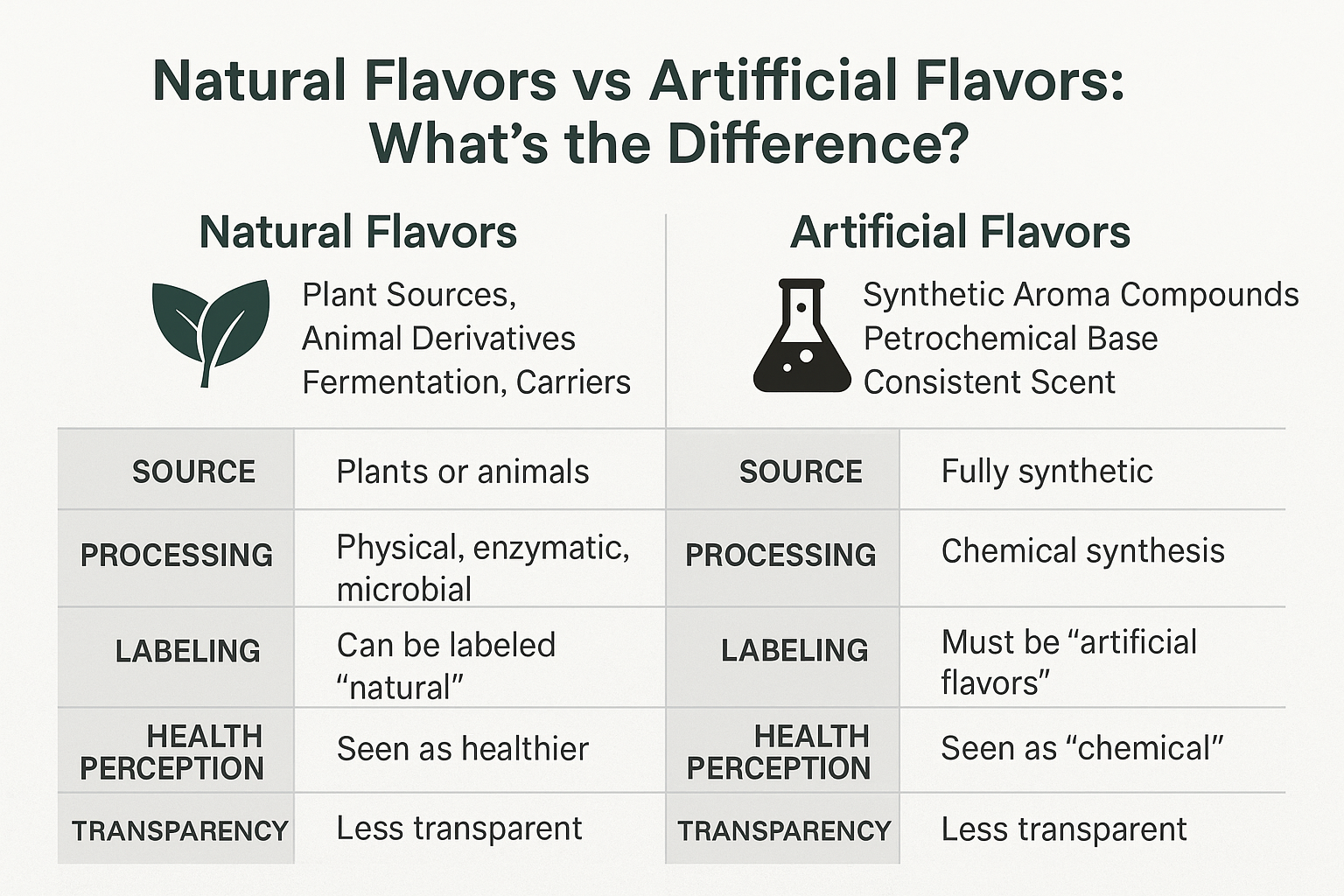
Atributo Aromas naturais Aromas artificiais
Fonte Plantas ou animais Totalmente sintetizado em um laboratório
Método de produção Físico, enzimático, microbiano Síntese química
Etiquetagem "Sabores naturais" Devem ser rotulados como "sabores artificiais"
Consistência Pode variar de lote para lote Altamente consistente
Preço Geralmente mais caro Geralmente mais barato
Percepção do consumidor Visto como mais saudável Visto como "químico" ou sintético

🧠 Principais percepções:
Os sabores naturais e artificiais podem ser quimicamente idênticosmas diferem em suas fonte e como são processados. Por exemplo, a vanilina (aroma de baunilha) pode ser extraída da fava de baunilha ou sintetizada a partir da lignina, mas tem o mesmo cheiro e funciona da mesma forma.


⚠️ Os aromas naturais são realmente saudáveis?

Não necessariamente.

Embora "natural" signifique segurança, aqui está o que você deve saber:

  • Natural ≠ Integral - A maioria dos aromas naturais são compostos altamente refinados e isolados.
  • Eles podem incluir alérgenos - Como laticínios ou soja, mas geralmente não são rotulados como tal, a menos que seja necessário.
  • Eles podem não ser veganos - Sabores derivados de animais são comuns.
  • Eles são adicionados para dar sabor, não para nutrir - Não há vitaminas, minerais ou fibras envolvidos.

Em essência, Os aromas naturais são projetados para melhorar o apelo sensoriale não o valor para a saúde.


🍹 Onde os aromas naturais são comumente encontrados?

Você encontrará "aromas naturais" no rótulo de quase todos os produtos processados comercializados como tal:

  • Saudável
  • Orgânico
  • Totalmente natural
  • À base de plantas
  • Rótulo limpo

Os exemplos incluem:

  • Água com gás aromatizada (por exemplo, LaCroix, Spindrift)
  • Pós e barras de proteína
  • Lanches embalados
  • Cereais matinais
  • Refeições congeladas
  • Iogurtes e vitaminas

Até mesmo os produtos alimentícios premium usam "sabores naturais" para aumentar o aroma, mascarar o amargor ou simular o frescor.


🧴 Os aromas naturais são melhores do que os artificiais?

Nem sempre. Embora os sabores naturais parecem mais atraentesas diferenças estão em origem, não função.

  • Os aromas naturais geralmente são menos estávelO custo é maior e a qualidade pode variar.
  • Os aromas artificiais podem ser mais sustentável e precisoembora tenham uma percepção negativa por parte do consumidor.
  • Ambos podem conter produtos químicos não aromatizantes que nem sempre são divulgados (por exemplo, transportadores, solventes).

Conclusão: O termo "natural" não garante que o produto seja melhor, mais saudável ou mais seguro.


🏷️ Como ler rótulos e fazer escolhas mais inteligentes

Quer fazer escolhas mais informadas? Veja como:

  1. Verifique se há detalhes adicionais - Algumas marcas descrevem voluntariamente a fonte do aroma natural (por exemplo, "óleo de limão natural").
  2. Pesquisar a marca - Marcas transparentes geralmente explicam a origem de seus ingredientes.
  3. Procure por certificações - Os projetos USDA Organic, Non-GMO, Vegan ou Clean Label podem fornecer informações adicionais.
  4. Cuidado com afirmações vagas - Se "sabor natural" for o único descritor, você não sabe realmente o que há nele.

✅ Conclusão: "Sabor natural" é um termo legal, não uma promessa

Apesar da vibração calorosa e terrena que a palavra "natural" transmite, os aromas naturais geralmente são compostos produzidos industrialmente projetados para causar impacto no sabor, não na saúde.

Isso não significa que sejam prejudiciais, mas sim que são não é o mesmo que uma laranja espremida ou uma erva picada.

Se a transparência for importante para você, escolha marcas que vão além do rótulo para mostrar o que realmente está lá dentro - e não tenha medo de perguntar: "De que é feito o seu sabor natural?"
Posts Similares

  • Fragrance Matching: How We Replicate World-Class Perfume Notes

    Fragrance Matching: How We Replicate World-Class Perfume Notes Turning iconic inspiration into cost-effective B2B scent solutions. 1️⃣ Introduction: Why Fragrance Matching Matters Fragrance is more than a pleasant scent — it’s a powerful emotional trigger and brand signature. In industries like home care, personal hygiene, and fine fragrance, the scent alone can define a product’s…

  • Exploring the World of Aroma Chemicals

    Exploring the World of Aroma Chemicals Aroma chemicals are everywhere, yet often go unnoticed. They are the unsung heroes behind the scents and flavors we love. These compounds are crucial in creating fragrances and flavors in countless products. From perfumes to food, they play a vital role. Aroma chemicals can be natural or synthetic. Synthetic versions are more common due to their consistency and cost-effectiveness. The fragrance industry relies heavily on these chemicals. They ensure that scents are long-lasting and consistent across products. Flavoring agents, another type of aroma chemical, enhance the taste of food and beverages. They make our favorite treats even more enjoyable. The history of aroma chemicals is rich and fascinating. Ancient civilizations used natural extracts for scenting, laying the groundwork for modern perfumery. Today, the balance between natural and synthetic ingredients is key. This balance creates unique fragrance profiles that captivate our senses. As we explore the world of aroma chemicals, we uncover their impact on our daily lives. They shape our experiences and evoke emotions, making them indispensable.   What Are Aroma Chemicals? Aroma chemicals are specialized compounds used in creating scents and flavors. They are the building blocks of fragrance and flavor industries, essential in many products. These compounds can be derived from both natural and synthetic sources. Natural aroma compounds are extracted from plants or animal products, while synthetic ones are manufactured in labs. Synthetic aroma chemicals offer several advantages. They provide consistency, purity, and often a more cost-effective solution than their natural counterparts. Aroma chemicals are utilized in various applications. This includes perfumes, cosmetics, food products, and even cleaning supplies. They are selected based on their ability to enhance the user experience. Common uses of aroma chemicals include: Perfumes: creating distinctive and lasting scents. Food and beverages: enhancing flavors. Household products: masking odors. Cosmetics: adding pleasant fragrances. The science behind aroma chemicals is complex, involving intricate molecule interactions. This fascinating chemistry allows them to mimic natural scents effectively. A key aspect of their success lies in their ability to evoke emotions and trigger memories. This emotional connection is why aroma chemicals are so effective in marketing.   The History and Evolution of Aroma Chemicals The use of aroma chemicals can be traced back to ancient civilizations. Early societies used natural extracts for incense and personal scenting. During the Renaissance, advances in distillation improved the extraction of aromatic compounds. This period saw the rise of perfumery in Europe, laying the groundwork for modern developments. The 19th century marked a significant shift. Synthetic production techniques expanded the palette of available scents. This innovation revolutionized the industry, leading to mass-market fragrances. In the 20th century, chemistry and technology advanced further. New methods allowed for complex fragrance compositions, combining both natural and synthetic ingredients. Key milestones in aroma chemicals’ evolution include: Ancient times: Use of natural extracts. Renaissance: Improved distillation techniques. 19th century: Introduction of synthetic aroma compounds. 20th century: Complex fragrance formulations. The evolution of aroma chemicals reflects broader trends in science and technology. It has continually adapted to consumer preferences and industry demands. Today, the focus is on sustainability and innovation. Efforts are underway to create eco-friendly processes and new, sustainable aroma compounds. by Emile Mbunzama (https://unsplash.com/@emilembunzama) Natural vs. Synthetic Aroma Chemicals Aroma chemicals can be either natural or synthetic. Each type offers unique attributes and advantages in fragrance and flavor production. Natural aroma compounds are derived from plant and animal sources. Essential oils and extracts provide natural scent profiles. These compounds are often favored for their purity and aromatic qualities. Synthetic aroma chemicals, however, are created in laboratories. They replicate both familiar and novel scents. This method allows for cost-effective production and greater scent variety. Choosing between natural and synthetic aromas involves several considerations. Factors include cost, availability, scent longevity, and consumer preferences. Many products today blend both types for optimal results. Key differences between natural and synthetic aroma chemicals include: Natural: Sourced from plants and animals. Synthetic: Lab-created, often more consistent and durable. Scent Profile: Natural for purity, synthetic for variety. Cost: Natural can be pricier; synthetic is more economical. Availability: Natural sources can be limited. The balance between these two forms of aroma chemicals is crucial. It influences fragrance formulation and appeals to diverse consumer needs. Ultimately, the choice depends on the desired product attributes and market trends. Both natural and synthetic types continue to play vital roles in the industry. by Ela De Pure (https://unsplash.com/@eladepure) Key Types of Fragrance Compounds and Flavoring Agents Fragrance compounds are essential elements in perfumery and flavoring. They provide unique scent and taste profiles, enhancing product appeal. Esters are a common type of fragrance compound. They offer fruity and floral scents. Widely used in perfumes, they provide fresh, sweet aromas. Aldehydes are another vital group. They contribute to fresh and citrusy scents. Found in many household and personal care products, they bring a lively aroma. Ketones are notable for their versatility. They range from sweet to woody scents. Ketones add depth and complexity to many fragrances and flavors….

  • O que significa Aroma? Definição, origens e exemplos cotidianos

    🌿 What Does Aroma Mean? Definition, Origins, and Everyday Examples Aroma is more than just a pleasant smell—it’s a powerful sensory experience that connects memory, mood, taste, and perception. From the scent of freshly brewed coffee to the fragrance of spring flowers, aromas play a critical role in how we perceive the world around us….

  • Microcapsule Technology and Its Application in Laundry

    Microcapsule Technology and Its Application in Laundry 1. Fundamentals of Microencapsulation Technology 1.1 Definition of Microcapsules Microcapsules are microscopic containers (size range: 10 nm–1000 μm) that encapsulate active ingredients (core materials) within polymeric walls via physical or chemical methods. Core value propositions include: Isolation & Protection: Prevent oxidation, volatilization, or degradation of core materials (e.g.,…

  • Fragrância microencapsulada - F&Y (Guangdong) Biotechnology Co.,LTD

    Company Profile We provide high-end functional fragrance products and technical services. Technology and creativity are the core of F&Y, and we are willing to promote industry upgrading with a comprehensive market perspective. Main business: Perfume Fragrance, Functional Fragrance, and Microencapsulated Fragrance. Principle Of Microencapsulated Fragrance Microencapsulated Fragrance is a kind of microencapsulated product of fragrance…

  • Discover the future of fragrance formulation as we explore the balance between natural and synthetic ingredients. Learn how these choices affect scent and sustainability.

    Discover the future of fragrance formulation as we explore the balance between natural and synthetic ingredients. Learn how these choices affect scent and sustainability. Fragrance formulation is an art and science. It blends natural and synthetic ingredients to create unique scents. The balance between these ingredients is crucial. It affects not only the scent but…

Deixe um comentário