什么是天然香料?

什么是天然香料?| 真相、定义和您应该知道的事

🌿 什么是天然香料?| 真相、定义和您应该知道的事

In today’s era of “clean labels” and conscious consumption, one ingredient label shows up more than most: natural flavors. It sounds harmless—maybe even healthy—but what exactly does it mean?

Let’s break down the definition, how natural flavors are made, what they’re made from, and how they compare to artificial flavors. The truth may surprise you.什么是天然香料?

🧭 What Does “Natural Flavor” Mean?

At first glance, “natural” might suggest something directly from nature: fresh-squeezed lemon oil, ground vanilla bean, or dried herbs. But in food labeling, it’s not that simple.

🧾 FDA Definition (U.S.)

Natural flavor means flavoring substances derived from plant or animal sources and obtained via physical, enzymatic, or microbial processes.”

This includes fruit, vegetables, spices, herbs, meat, poultry, seafood, and dairy. The flavor must be extracted without synthetic solvents or harsh chemical modification, but other processing like fermentation, distillation, or roasting is permitted.

🇪🇺 EU Definition (EFSA)

The European Union defines “natural flavoring substances” as materials identified in nature and obtained by natural methods—slightly stricter in some areas, but still allowing a wide range of techniques.


🌿 What Are Natural Flavors Made Of?

Natural flavors can come from plants, animalsmicrobial fermentation. They can include:

  • Essential oils (e.g. orange, mint, clove)
  • Fruit extracts (e.g. lemon oil, raspberry distillate)
  • Fermentation-derived compounds (e.g. natural vanillin from rice)
  • Animal derivatives (e.g. dairy enzymes, meat-based extracts)

However, they may also include:

  • Carriers (alcohol, glycerin, propylene glycol)
  • Preservatives (as legally allowed)
  • Solubilizers or emulsifiers

⚠️ These “incidental additives” aren’t always listed on the label—making “natural flavors” less transparent than consumers might expect.


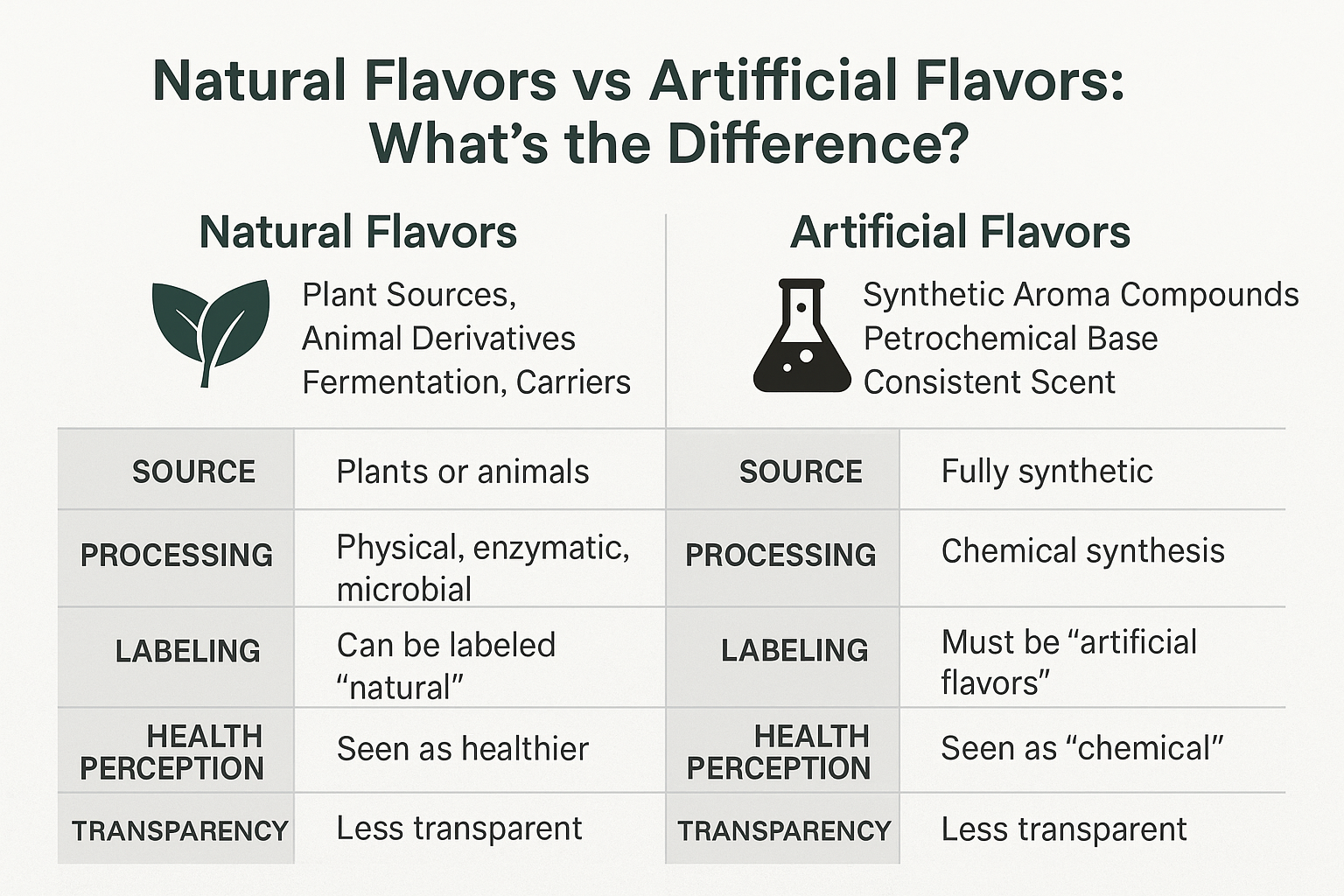
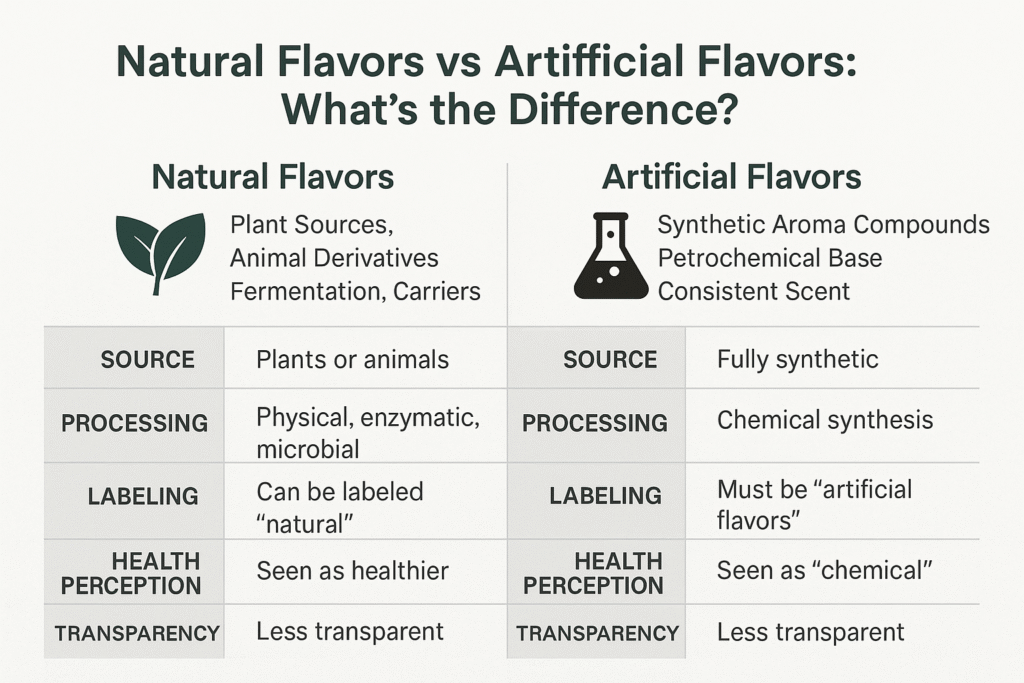
⚖️ Natural vs Artificial Flavors: What’s the Difference?

属性 Natural Flavors Artificial Flavors
资料来源 Plants or animals Fully synthesized in a lab
Production Method Physical, enzymatic, microbial Chemical synthesis
Labeling “Natural flavors” Must be labeled as “artificial flavors”
一致性 Can vary batch to batch Highly consistent
价格 Often more expensive Usually cheaper
Consumer Perception Viewed as healthier Viewed as “chemical” or synthetic

🧠 Key Insight:
Natural and artificial flavors can be chemically identical, but differ in their source and how they’re processed. For example, vanillin (vanilla aroma) can be extracted from vanilla beans or synthesized from lignin—yet it smells and functions the same.


⚠️ Are Natural Flavors Actually Healthy?

Not necessarily.

While “natural” implies safety, here’s what you should know:

  • Natural ≠ Whole — Most natural flavors are highly refined and isolated compounds.
  • They can include allergens — Like dairy or soy, but often not labeled as such unless required.
  • They may not be vegan — Animal-derived flavors are common.
  • They’re added for taste, not nutrition — No vitamins, minerals, or fiber are involved.

In essence, natural flavors are designed to improve sensory appeal, not health value.


🍹 Where Are Natural Flavors Commonly Found?

You’ll find “natural flavors” on the label of nearly every processed product marketed as:

  • Healthy
  • Organic
  • All-natural
  • Plant-based
  • Clean-label

Examples include:

  • Flavored sparkling water (e.g. LaCroix, Spindrift)
  • Protein powders and bars
  • Packaged snacks
  • Breakfast cereals
  • Frozen meals
  • Yogurts and smoothies

Even premium food products use “natural flavors” to boost aroma, mask bitterness, or simulate freshness.


🧴 Are Natural Flavors Better Than Artificial Flavors?

Not always. While natural flavors sound more appealing, the differences lie in origin, not function.

  • Natural flavors are often less stable, cost more, and may vary in quality.
  • Artificial flavors can be more sustainableprecise, though they carry negative consumer perception.
  • Both can contain non-flavor chemicals that are not always disclosed (e.g., carriers, solvents).

Bottom line: The term “natural” doesn’t guarantee the product is better, healthier, or safer.


🏷️ How to Read Labels & Choose Smarter

Want to make more informed choices? Here’s how:

  1. Check for added detail – Some brands voluntarily describe the natural flavor source (e.g., “natural lemon oil”).
  2. Research the brand – Transparent brands often explain their ingredient sourcing.
  3. Look for certifications – USDA Organic, Non-GMO, Vegan, or Clean Label Project can provide added insight.
  4. Beware of vague claims – If “natural flavor” is the only descriptor, you don’t really know what’s in it.

✅ Conclusion: “Natural Flavor” Is a Legal Term, Not a Promise

Despite the warm, earthy vibe the word “natural” conveys, natural flavors are often industrially produced compounds designed for flavor impact, not health.

That doesn’t mean they’re harmful—but it does mean they’re not the same as a squeezed orange or chopped herb.

If transparency matters to you, choose brands that go beyond the label to show what’s really inside—and don’t be afraid to ask, “What’s your natural flavor made from?”
类似文章

  • Synthetic vs. Natural Aroma Chemicals: Key Differences, Benefits & How to Choose

    Synthetic vs. Natural Aroma Chemicals: Key Differences, Benefits & How to Choose When formulating fragrances and flavors for perfumes, personal care, home care, or food & beverage products, one of the first strategic choices a brand or formulator must make is: use natural aroma chemicals, synthetic ones, or a blend of both? Each path has…

  • 什么是瓯柑香水?起源、香味特征及为何如此昂贵

    🌿 What Is Oud Fragrance? Origins, Scent Profile & Why It’s So Expensive 🧭 Introduction: Oud — The Liquid Gold of Perfumery If you’ve ever browsed high-end perfumes or niche fragrances, chances are you’ve come across the word “oud.” Revered as one of the most luxurious and mysterious scent ingredients in the world, oud fragrance…

  • 合成-天然-香料

    🌿 Synthetic vs. Natural Fragrances: Pros, Cons & Industry Trends In the world of modern perfumery, cosmetics, and personal care, the debate between natural and synthetic fragrances is louder than ever. Some consumers look for labels that say “all-natural,” while others are more focused on safety, longevity, and performance. But what exactly is the difference…

  • Microcapsule Technology and Its Application in Laundry

    Microcapsule Technology and Its Application in Laundry 1. Fundamentals of Microencapsulation Technology 1.1 Definition of Microcapsules Microcapsules are microscopic containers (size range: 10 nm–1000 μm) that encapsulate active ingredients (core materials) within polymeric walls via physical or chemical methods. Core value propositions include: Isolation & Protection: Prevent oxidation, volatilization, or degradation of core materials (e.g.,…

  • 东南亚芒果果汁粉风味饮料的变革:聚焦泰国市场

    Unleash the sweet, succulent essence of tropical mangoes with our Mango Juice Powder Flavour. Designed for beverage manufacturers, this innovative solution infuses your products with the vibrant flavors of fresh mango juice, perfect for capturing the tropical zest of Southeast Asia. 1. Applications in Beverage Manufacturing Our Mango Juice Powder Flavour is specially formulated to…

  • Exploring the World of Aroma Chemicals

    Exploring the World of Aroma Chemicals Aroma chemicals are everywhere, yet often go unnoticed. They are the unsung heroes behind the scents and flavors we love. These compounds are crucial in creating fragrances and flavors in countless products. From perfumes to food, they play a vital role. Aroma chemicals can be natural or synthetic. Synthetic versions are more common due to their consistency and cost-effectiveness. The fragrance industry relies heavily on these chemicals. They ensure that scents are long-lasting and consistent across products. Flavoring agents, another type of aroma chemical, enhance the taste of food and beverages. They make our favorite treats even more enjoyable. The history of aroma chemicals is rich and fascinating. Ancient civilizations used natural extracts for scenting, laying the groundwork for modern perfumery. Today, the balance between natural and synthetic ingredients is key. This balance creates unique fragrance profiles that captivate our senses. As we explore the world of aroma chemicals, we uncover their impact on our daily lives. They shape our experiences and evoke emotions, making them indispensable.   What Are Aroma Chemicals? Aroma chemicals are specialized compounds used in creating scents and flavors. They are the building blocks of fragrance and flavor industries, essential in many products. These compounds can be derived from both natural and synthetic sources. Natural aroma compounds are extracted from plants or animal products, while synthetic ones are manufactured in labs. Synthetic aroma chemicals offer several advantages. They provide consistency, purity, and often a more cost-effective solution than their natural counterparts. Aroma chemicals are utilized in various applications. This includes perfumes, cosmetics, food products, and even cleaning supplies. They are selected based on their ability to enhance the user experience. Common uses of aroma chemicals include: Perfumes: creating distinctive and lasting scents. Food and beverages: enhancing flavors. Household products: masking odors. Cosmetics: adding pleasant fragrances. The science behind aroma chemicals is complex, involving intricate molecule interactions. This fascinating chemistry allows them to mimic natural scents effectively. A key aspect of their success lies in their ability to evoke emotions and trigger memories. This emotional connection is why aroma chemicals are so effective in marketing.   The History and Evolution of Aroma Chemicals The use of aroma chemicals can be traced back to ancient civilizations. Early societies used natural extracts for incense and personal scenting. During the Renaissance, advances in distillation improved the extraction of aromatic compounds. This period saw the rise of perfumery in Europe, laying the groundwork for modern developments. The 19th century marked a significant shift. Synthetic production techniques expanded the palette of available scents. This innovation revolutionized the industry, leading to mass-market fragrances. In the 20th century, chemistry and technology advanced further. New methods allowed for complex fragrance compositions, combining both natural and synthetic ingredients. Key milestones in aroma chemicals’ evolution include: Ancient times: Use of natural extracts. Renaissance: Improved distillation techniques. 19th century: Introduction of synthetic aroma compounds. 20th century: Complex fragrance formulations. The evolution of aroma chemicals reflects broader trends in science and technology. It has continually adapted to consumer preferences and industry demands. Today, the focus is on sustainability and innovation. Efforts are underway to create eco-friendly processes and new, sustainable aroma compounds. by Emile Mbunzama (https://unsplash.com/@emilembunzama) Natural vs. Synthetic Aroma Chemicals Aroma chemicals can be either natural or synthetic. Each type offers unique attributes and advantages in fragrance and flavor production. Natural aroma compounds are derived from plant and animal sources. Essential oils and extracts provide natural scent profiles. These compounds are often favored for their purity and aromatic qualities. Synthetic aroma chemicals, however, are created in laboratories. They replicate both familiar and novel scents. This method allows for cost-effective production and greater scent variety. Choosing between natural and synthetic aromas involves several considerations. Factors include cost, availability, scent longevity, and consumer preferences. Many products today blend both types for optimal results. Key differences between natural and synthetic aroma chemicals include: Natural: Sourced from plants and animals. Synthetic: Lab-created, often more consistent and durable. Scent Profile: Natural for purity, synthetic for variety. Cost: Natural can be pricier; synthetic is more economical. Availability: Natural sources can be limited. The balance between these two forms of aroma chemicals is crucial. It influences fragrance formulation and appeals to diverse consumer needs. Ultimately, the choice depends on the desired product attributes and market trends. Both natural and synthetic types continue to play vital roles in the industry. by Ela De Pure (https://unsplash.com/@eladepure) Key Types of Fragrance Compounds and Flavoring Agents Fragrance compounds are essential elements in perfumery and flavoring. They provide unique scent and taste profiles, enhancing product appeal. Esters are a common type of fragrance compound. They offer fruity and floral scents. Widely used in perfumes, they provide fresh, sweet aromas. Aldehydes are another vital group. They contribute to fresh and citrusy scents. Found in many household and personal care products, they bring a lively aroma. Ketones are notable for their versatility. They range from sweet to woody scents. Ketones add depth and complexity to many fragrances and flavors….

发表回复