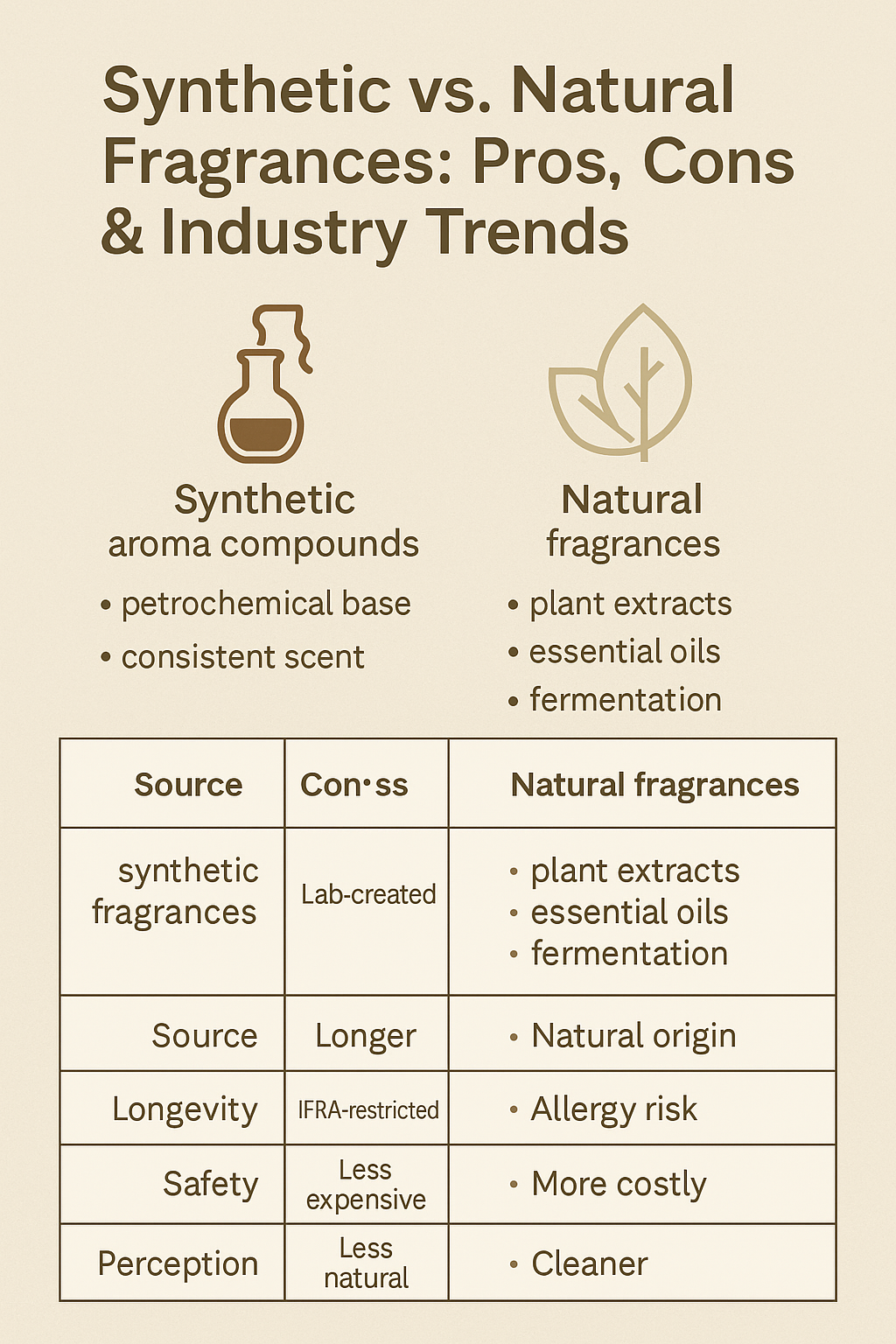
Synthetic-vs-Natural-Fragrances

fragancias sintéticas-vs-naturales

🌿 Synthetic vs. Natural Fragrances: Pros, Cons & Industry Trends

In the world of modern perfumery, cosmetics, and personal care, the debate between natural y sintético fragrances is louder than ever. Some consumers look for labels that say “all-natural,” while others are more focused on safety, longevity, and performance.

But what exactly is the difference between natural and synthetic fragrances? Are natural scents always safer? Are synthetic fragrances harmful—or more sustainable?

Let’s explore the pros, cons, differences, and emerging trends that are shaping how brands and consumers choose fragrances in 2025 and beyond.Synthetic-vs-Natural-Fragrances
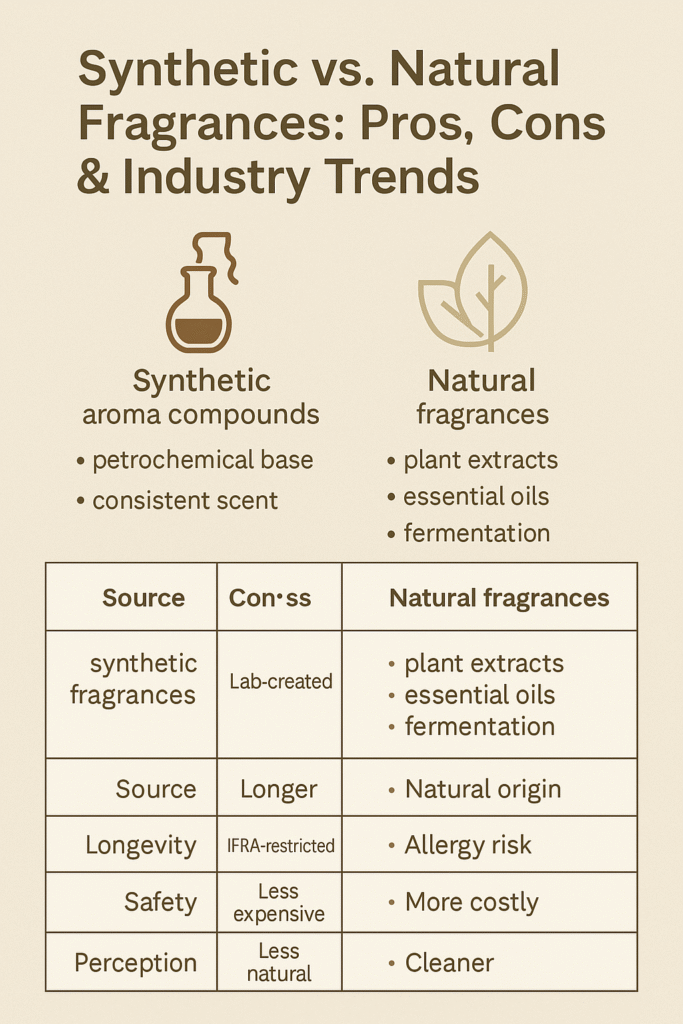

🌿 What Are Natural Fragrances?

Natural fragrances are composed entirely of aromatic substances derived from plant or animal sources, typically through:

  • Steam distillation (e.g. lavender, rose oil)
  • Cold pressing (e.g. citrus peels)
  • Enzymatic or microbial fermentation (e.g. natural vanillin)

These fragrances must not include synthetic chemicals, and often come with labels like “100% natural,” “essential oil-based,” or “organic certified.”

✅ Common natural sources:

  • Essential oils (e.g. peppermint, bergamot, eucalyptus)
  • Absolutes (e.g. jasmine, tuberose)
  • CO₂ extracts and natural isolates (e.g. vanillin from rice)

While natural fragrances appeal to clean beauty movements and eco-conscious consumers, they also come with limitations—cost, availability, and allergenic potential.


🧪 What Are Synthetic Fragrances?

Synthetic fragrances are made from aroma molecules that are chemically synthesized—often from petroleum derivatives o bio-based intermediates. They may replicate compounds found in nature or create entirely new scent profiles.

These are not necessarily “harmful chemicals”—in fact, many are molecularly identical to natural ones and strictly regulated by organizations like IFRA (International Fragrance Association).

🔬 Examples of synthetic fragrance molecules:

  • Iso E Super – woody/amber scent
  • Hedione – jasmine-like, fresh
  • Ethyl vanillin – sweet, creamy vanilla scent
  • Methyl anthranilate – grape-like aroma

Synthetic scents are especially prevalent in perfumes, lotions, hair care, detergents, and air fresheners.


⚖️ Natural vs Synthetic Fragrances: Key Differences

Atributo Fragancias naturales Fragancias sintéticas
Source Plants or animals Laboratory synthesis
Estabilidad Unstable (light, heat sensitive) Highly stable and long-lasting
Consistency Varies with climate and harvest Uniform from batch to batch
Price More expensive Lower cost, more scalable
Scent profile Complex but subtle Sharper, more intense or customized
Allergen risk May trigger reactions (essential oils) Often formulated allergen-free
Label appeal “Natural,” “clean,” “organic” Viewed as “chemical” or “synthetic”

✅ Pros & Cons of Each Type

🌱 Pros of Natural Fragrances

  • Derived from renewable sources
  • Appeal to “green” and “clean-label” consumers
  • Biodegradable and minimally processed

Cons of Natural Fragrances

  • Expensive, and production may be unsustainable (e.g., rose oil, sandalwood)
  • Subject to batch inconsistency
  • Shorter shelf life
  • Potential allergens like linalool, limonene

🔬 Pros of Synthetic Fragrances

  • Consistent and long-lasting
  • Broader creative palette for perfumers
  • Can mimic endangered or unethical sources (e.g. musk, oud)
  • Lower environmental impact when sustainably manufactured

Cons of Synthetic Fragrances

  • Public perception as “unnatural” or “toxic”
  • May include controversial ingredients if not IFRA-compliant
  • Not allowed in “certified natural” products

🧾 What Do Regulations Say?

  • IFRA (International Fragrance Association) provides global standards for both natural and synthetic fragrance safety.
  • EU (REACH) & US (FDA) require allergens like limoneno o citral to be listed if above certain thresholds—even in natural products.
  • “Fragrance” on a label can legally contain dozens of components, regardless of origin, unless the brand chooses to disclose fully.

🌍 Industry Trends in 2025 & Beyond

🔄 Hybrid Formulas

Many fragrance houses now combine natural and synthetic ingredients for balance: stability + authenticity.

🌱 Clean Fragrance Movement

Retailers like Sephora, Credo, and Ulta are promoting “clean fragrance” standards—free from phthalates, parabens, and undisclosed allergens.

🧬 Biotech-Based Fragrances

Companies like Givaudan, Firmenich, and Symrise are using white biotechnology—fermentation and enzyme catalysis—to produce natural-identical ingredients sustainably.

♻️ Sustainability Focus

  • Natural: Risk of overharvesting (e.g. sandalwood, rose)
  • Synthetic: Can reduce environmental impact if responsibly produced
  • Biodegradability, low carbon footprint, and renewable feedstocks are top concerns

🛒 How to Choose: Brand & Consumer Guidance

Choose natural fragrances if:

  • You prioritize botanical ingredients and label transparency
  • You’re targeting sensitive skin, wellness, or certified organic markets

Choose synthetic or hybrid fragrances if:

  • You want consistent performance, strong sillage, and better cost control
  • Your product needs fragrance stability under heat or light
  • You require allergen-free or hypoallergenic options

🔍 Best Practice for Brands:
Communicate clearly—whether your product uses natural, synthetic, or bio-engineered fragrance, transparency builds trust.


✅ Final Thoughts: Science + Nature = The Future of Scent

Rather than asking “natural vs synthetic?”, the better question may be:
“Which solution is safest, most effective, and most sustainable for the user and the planet?”

Modern fragrance innovation is no longer about one being good and the other bad—it’s about how both can coexist to create high-performing, ethically sound, and emotionally resonant scents.


Similar Posts

  • Exploring the World of Aroma Chemicals

    Exploring the World of Aroma Chemicals Aroma chemicals are everywhere, yet often go unnoticed. They are the unsung heroes behind the scents and flavors we love. These compounds are crucial in creating fragrances and flavors in countless products. From perfumes to food, they play a vital role. Aroma chemicals can be natural or synthetic. Synthetic versions are more common due to their consistency and cost-effectiveness. The fragrance industry relies heavily on these chemicals. They ensure that scents are long-lasting and consistent across products. Flavoring agents, another type of aroma chemical, enhance the taste of food and beverages. They make our favorite treats even more enjoyable. The history of aroma chemicals is rich and fascinating. Ancient civilizations used natural extracts for scenting, laying the groundwork for modern perfumery. Today, the balance between natural and synthetic ingredients is key. This balance creates unique fragrance profiles that captivate our senses. As we explore the world of aroma chemicals, we uncover their impact on our daily lives. They shape our experiences and evoke emotions, making them indispensable.   What Are Aroma Chemicals? Aroma chemicals are specialized compounds used in creating scents and flavors. They are the building blocks of fragrance and flavor industries, essential in many products. These compounds can be derived from both natural and synthetic sources. Natural aroma compounds are extracted from plants or animal products, while synthetic ones are manufactured in labs. Synthetic aroma chemicals offer several advantages. They provide consistency, purity, and often a more cost-effective solution than their natural counterparts. Aroma chemicals are utilized in various applications. This includes perfumes, cosmetics, food products, and even cleaning supplies. They are selected based on their ability to enhance the user experience. Common uses of aroma chemicals include: Perfumes: creating distinctive and lasting scents. Food and beverages: enhancing flavors. Household products: masking odors. Cosmetics: adding pleasant fragrances. The science behind aroma chemicals is complex, involving intricate molecule interactions. This fascinating chemistry allows them to mimic natural scents effectively. A key aspect of their success lies in their ability to evoke emotions and trigger memories. This emotional connection is why aroma chemicals are so effective in marketing.   The History and Evolution of Aroma Chemicals The use of aroma chemicals can be traced back to ancient civilizations. Early societies used natural extracts for incense and personal scenting. During the Renaissance, advances in distillation improved the extraction of aromatic compounds. This period saw the rise of perfumery in Europe, laying the groundwork for modern developments. The 19th century marked a significant shift. Synthetic production techniques expanded the palette of available scents. This innovation revolutionized the industry, leading to mass-market fragrances. In the 20th century, chemistry and technology advanced further. New methods allowed for complex fragrance compositions, combining both natural and synthetic ingredients. Key milestones in aroma chemicals’ evolution include: Ancient times: Use of natural extracts. Renaissance: Improved distillation techniques. 19th century: Introduction of synthetic aroma compounds. 20th century: Complex fragrance formulations. The evolution of aroma chemicals reflects broader trends in science and technology. It has continually adapted to consumer preferences and industry demands. Today, the focus is on sustainability and innovation. Efforts are underway to create eco-friendly processes and new, sustainable aroma compounds. by Emile Mbunzama (https://unsplash.com/@emilembunzama) Natural vs. Synthetic Aroma Chemicals Aroma chemicals can be either natural or synthetic. Each type offers unique attributes and advantages in fragrance and flavor production. Natural aroma compounds are derived from plant and animal sources. Essential oils and extracts provide natural scent profiles. These compounds are often favored for their purity and aromatic qualities. Synthetic aroma chemicals, however, are created in laboratories. They replicate both familiar and novel scents. This method allows for cost-effective production and greater scent variety. Choosing between natural and synthetic aromas involves several considerations. Factors include cost, availability, scent longevity, and consumer preferences. Many products today blend both types for optimal results. Key differences between natural and synthetic aroma chemicals include: Natural: Sourced from plants and animals. Synthetic: Lab-created, often more consistent and durable. Scent Profile: Natural for purity, synthetic for variety. Cost: Natural can be pricier; synthetic is more economical. Availability: Natural sources can be limited. The balance between these two forms of aroma chemicals is crucial. It influences fragrance formulation and appeals to diverse consumer needs. Ultimately, the choice depends on the desired product attributes and market trends. Both natural and synthetic types continue to play vital roles in the industry. by Ela De Pure (https://unsplash.com/@eladepure) Key Types of Fragrance Compounds and Flavoring Agents Fragrance compounds are essential elements in perfumery and flavoring. They provide unique scent and taste profiles, enhancing product appeal. Esters are a common type of fragrance compound. They offer fruity and floral scents. Widely used in perfumes, they provide fresh, sweet aromas. Aldehydes are another vital group. They contribute to fresh and citrusy scents. Found in many household and personal care products, they bring a lively aroma. Ketones are notable for their versatility. They range from sweet to woody scents. Ketones add depth and complexity to many fragrances and flavors….

  • Dominar la reacción de caramelización: Una guía completa del pardeamiento

    Caramelization is more than just a culinary process; it’s a transformation that elevates flavors, tantalizes taste buds, and adds depth to dishes. In this definitive guide, we delve into the science behind the caramelization reaction, exploring its intricacies, applications, and culinary implications. Whether you’re a seasoned chef or an amateur enthusiast, join us on a…

  • Mercado mundial de fragancias: Tendencias, tamaño, crecimiento, oportunidades y previsiones

    Global Fragrance Market: Trends, Size, Growth, Opportunities, and Forecast The global fragrance industry is experiencing significant growth, driven by evolving consumer preferences, technological advancements, and expanding applications across various sectors. This article provides a comprehensive overview of the current state of the fragrance market, highlighting key trends, market size, growth drivers, challenges, and future opportunities….

  • La Guía Definitiva de la Fragancia de Velas: Todo lo que necesitas saber Capítulos 1-5

    The Ultimate Guide to Candle Fragrance: Everything You Need to Know Chapters 1-5 Candles have long been cherished for their ability to transform a room’s ambiance and create a comforting, soothing atmosphere. But beyond their soft glow, the fragrance of a candle is a key component of its appeal. The right scent can evoke emotions,…

  • Navegar por el mundo de las fragancias al por mayor: Consideraciones clave

    The wholesale fragrance market offers enticing opportunities for businesses and entrepreneurs looking to venture into the world of scents. Whether you aim to stock your retail store, start your own fragrance line, or simply expand your existing product offerings, understanding the nuances of purchasing wholesale fragrance is essential. This article will guide you through the…

  • ¿Qué significa aroma? Definición, orígenes y ejemplos cotidianos

    🌿 What Does Aroma Mean? Definition, Origins, and Everyday Examples Aroma is more than just a pleasant smell—it’s a powerful sensory experience that connects memory, mood, taste, and perception. From the scent of freshly brewed coffee to the fragrance of spring flowers, aromas play a critical role in how we perceive the world around us….

Deja un comentario