Comparación de fragancias: cómo reproducimos notas de perfumes de primera clase

Comparación de fragancias: cómo reproducimos notas de perfumes de primera clase

Turning iconic inspiration into cost-effective B2B scent solutions.fragrance matching
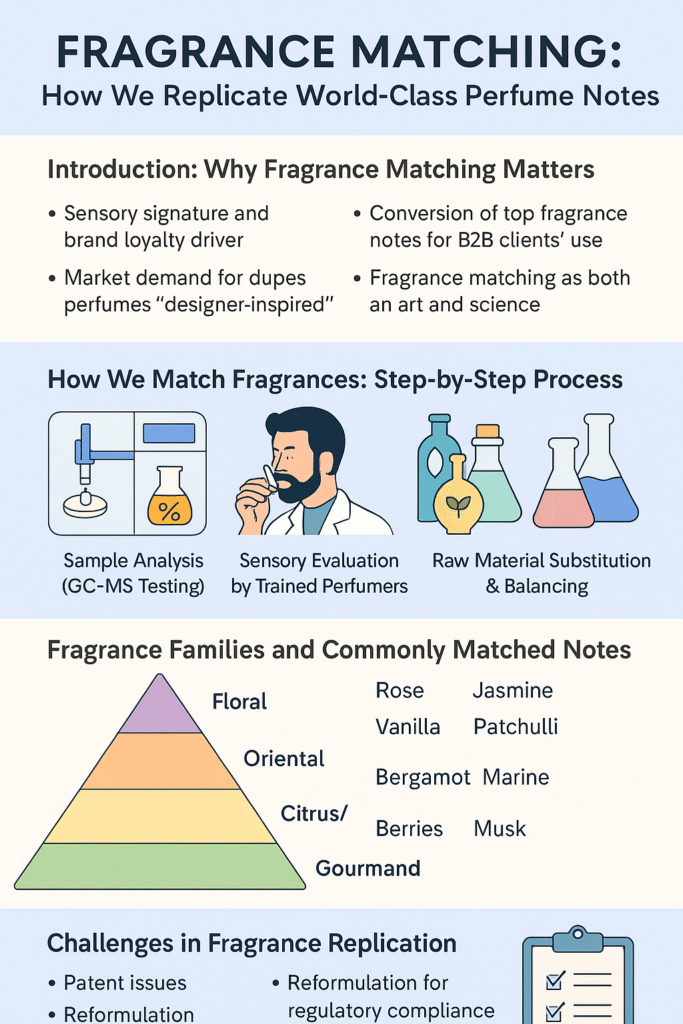

1️⃣ Introduction: Why Fragrance Matching Matters

Fragrance is more than a pleasant scent — it’s a powerful emotional trigger and brand signature. In industries like home care, personal hygiene, and fine fragrance, the scent alone can define a product’s identity. With global consumers familiar with luxury perfume brands like Dior, Chanelo YSL, it’s no surprise that B2B clients increasingly demand similar olfactive experiences in their own product lines.

That’s where fragrance matching comes in — a scientific and artistic process that enables companies to replicate or reinterpret high-end fragrance notes for use in detergents, fabric softeners, candles, and more.


2️⃣ Who Needs Fragrance Matching – and Why

Fragrance matching isn’t just for perfumers. It’s a practical, strategic tool for a wide range of clients:

  • Private-label brands want luxury-style scents without luxury budgets.
  • Cosmetic and home care manufacturers need recognizable fragrance accords in functional products.
  • Retailers & lifestyle brands look to expand into new scented categories with familiar olfactive appeal.

✅ FY Fragrance Matching Services

At FY, we provide high-fidelity fragrance matching for B2B use across categories like fabric care, body care, home fragrancey air fresheners. Our services include:

  • GC-MS based analysis of your reference scent
  • Creative reconstitution by expert perfumers
  • Regulatory-compliant reformulation (IFRA, REACH)
  • Base compatibility testing (ethanol, surfactant, powder, microcapsule)
  • Fast sampling + scalable production (20kg to tons)

3️⃣ How We Match Fragrances: Step-by-Step

🔬 Step 1: GC-MS Analysis

Using gas chromatography-mass spectrometry, we deconstruct your reference scent into its volatile components. This reveals the fragrance’s chemical composition across top, middle, and base notes.

👃 Step 2: Sensory Matching

Our trained perfumers evaluate both the analytical and aromatic aspects of the fragrance. They balance exactness with emotional accuracy — making sure the final match “feels” just right to the nose.

🧪 Step 3: Material Substitution

We reformulate using safe, accessible raw materials, sometimes replacing rare or non-compliant ingredients without altering the core structure.

🔁 Step 4: Testing & Adjustment

We test performance in your product’s base — whether liquid, powder, alcohol, or microencapsulated format — and iterate to ensure olfactive fidelity, pH stability, and heat resistance.


4️⃣ Fragrance Families and Commonly Matched Notes

Fragrance Family Inspired Perfumes Common Notes Replicated
Floral Chanel No.5, Gucci Bloom Rose, jasmine, aldehydes
Oriental Black Opium, Shalimar Vanilla, amber, coffee
Citrus/Fresh Dior Sauvage, Acqua Di Gio Bergamot, marine notes
Gourmand BR540, Ariana Cloud Candy, caramel, musk

These accords are widely reused in fabric care, personal care, and candles — adapted for affordability and mass-market appeal.


5️⃣ Challenges in Fragrance Replication

Fragrance matching is not always a one-to-one recreation. Common challenges include:

  • Regulatory Restrictions – Some original ingredients may exceed IFRA safety limits.
  • Ingredient Access – Rare naturals or patented synthetics may not be usable.
  • Perceptual Differences – GC-MS matches chemistry, but humans match emotion.
  • Base Interference – A fragrance in ethanol smells different in a surfactant or fabric base.

This is where expert adaptation matters — delivering a scent that’s close enough to be familiar, while still stable and compliant.


6️⃣ Applications Across Industries

  • 🧺 Laundry products – Add luxury scents to detergents or softeners
  • 🚿 Body washes and shampoos – Replicate high-end olfactory profiles
  • 🕯️ Home fragrance – Scented candles, reed diffusers, and sprays
  • 🧴 Fine fragrance – Eau de toilette or perfume dupes for private-label retail
  • 🧼 Hard surface cleaners – Functional products with emotional scent value

7️⃣ FY’s Advantage: Why Brands Choose Us

FY stands out as a trusted fragrance matching partner because of our ability to deliver:

  • 🎯 Fast turnaround with in-house GC-MS and formulation team
  • ✅ IFRA-compliant, globally acceptable formulas
  • 🧪 Compatibility with diverse product formats
  • 🌍 Experience in tropical markets (Asia, Africa, South America)
  • 📦 Scalable manufacturing: from 20kg to 1000kg+
  • 🔬 Technical support for scent retention, pH, and microcapsule systems

We don’t just match a scent — we make it work in your product.


8️⃣ Conclusion: The Art and Science of Fragrance Matching

Fragrance matching merges science, sensory insight, and formulation expertise. At FY, we help brands evoke the elegance of world-class perfume houses — adapted for everyday products that connect emotionally with consumers.

✨ Ready to transform your product with a signature scent?
👉 Contact FY to start your custom fragrance matching project today.

Similar Posts

  • La guía definitiva para un champú con fragancia duradera: Consejos y trucos

    The Ultimate Guide to Long-Lasting Shampoo Fragrance: Tips and Tricks Introduction Fragrance is an essential part of our daily grooming routines, and nothing feels as satisfying as running your fingers through soft, fragrant hair. A pleasant, long-lasting shampoo scent can not only elevate your confidence but also make you feel fresh throughout the day. Whether…

  • Explicación de 7 tipos de métodos de producción de fragancias y aromas

    🌿 7 Types of Modern Fragrance & Flavor Production Explained In today’s fast-evolving world of flavors and fragrances, the term “natural” is no longer the only benchmark of quality. Whether it’s the soothing aroma in a luxury perfume, the fruity burst in your favorite candy, or the comforting flavor of vanilla in a dessert —…

  • La Feria de Cantón y la industria de las fragancias: Oportunidades y retos de la globalización

    Canton Fair and the Fragrance Industry: Opportunities and Challenges in Globalization The Canton Fair (China Import and Export Fair) is a key event in global trade, providing an excellent platform for fragrance companies to showcase their products and expand their markets. This article explores the role of fragrance manufacturers in the Canton Fair, analyzes global…

  • Exploring the World of Aroma Chemicals

    Exploring the World of Aroma Chemicals Aroma chemicals are everywhere, yet often go unnoticed. They are the unsung heroes behind the scents and flavors we love. These compounds are crucial in creating fragrances and flavors in countless products. From perfumes to food, they play a vital role. Aroma chemicals can be natural or synthetic. Synthetic versions are more common due to their consistency and cost-effectiveness. The fragrance industry relies heavily on these chemicals. They ensure that scents are long-lasting and consistent across products. Flavoring agents, another type of aroma chemical, enhance the taste of food and beverages. They make our favorite treats even more enjoyable. The history of aroma chemicals is rich and fascinating. Ancient civilizations used natural extracts for scenting, laying the groundwork for modern perfumery. Today, the balance between natural and synthetic ingredients is key. This balance creates unique fragrance profiles that captivate our senses. As we explore the world of aroma chemicals, we uncover their impact on our daily lives. They shape our experiences and evoke emotions, making them indispensable.   What Are Aroma Chemicals? Aroma chemicals are specialized compounds used in creating scents and flavors. They are the building blocks of fragrance and flavor industries, essential in many products. These compounds can be derived from both natural and synthetic sources. Natural aroma compounds are extracted from plants or animal products, while synthetic ones are manufactured in labs. Synthetic aroma chemicals offer several advantages. They provide consistency, purity, and often a more cost-effective solution than their natural counterparts. Aroma chemicals are utilized in various applications. This includes perfumes, cosmetics, food products, and even cleaning supplies. They are selected based on their ability to enhance the user experience. Common uses of aroma chemicals include: Perfumes: creating distinctive and lasting scents. Food and beverages: enhancing flavors. Household products: masking odors. Cosmetics: adding pleasant fragrances. The science behind aroma chemicals is complex, involving intricate molecule interactions. This fascinating chemistry allows them to mimic natural scents effectively. A key aspect of their success lies in their ability to evoke emotions and trigger memories. This emotional connection is why aroma chemicals are so effective in marketing.   The History and Evolution of Aroma Chemicals The use of aroma chemicals can be traced back to ancient civilizations. Early societies used natural extracts for incense and personal scenting. During the Renaissance, advances in distillation improved the extraction of aromatic compounds. This period saw the rise of perfumery in Europe, laying the groundwork for modern developments. The 19th century marked a significant shift. Synthetic production techniques expanded the palette of available scents. This innovation revolutionized the industry, leading to mass-market fragrances. In the 20th century, chemistry and technology advanced further. New methods allowed for complex fragrance compositions, combining both natural and synthetic ingredients. Key milestones in aroma chemicals’ evolution include: Ancient times: Use of natural extracts. Renaissance: Improved distillation techniques. 19th century: Introduction of synthetic aroma compounds. 20th century: Complex fragrance formulations. The evolution of aroma chemicals reflects broader trends in science and technology. It has continually adapted to consumer preferences and industry demands. Today, the focus is on sustainability and innovation. Efforts are underway to create eco-friendly processes and new, sustainable aroma compounds. by Emile Mbunzama (https://unsplash.com/@emilembunzama) Natural vs. Synthetic Aroma Chemicals Aroma chemicals can be either natural or synthetic. Each type offers unique attributes and advantages in fragrance and flavor production. Natural aroma compounds are derived from plant and animal sources. Essential oils and extracts provide natural scent profiles. These compounds are often favored for their purity and aromatic qualities. Synthetic aroma chemicals, however, are created in laboratories. They replicate both familiar and novel scents. This method allows for cost-effective production and greater scent variety. Choosing between natural and synthetic aromas involves several considerations. Factors include cost, availability, scent longevity, and consumer preferences. Many products today blend both types for optimal results. Key differences between natural and synthetic aroma chemicals include: Natural: Sourced from plants and animals. Synthetic: Lab-created, often more consistent and durable. Scent Profile: Natural for purity, synthetic for variety. Cost: Natural can be pricier; synthetic is more economical. Availability: Natural sources can be limited. The balance between these two forms of aroma chemicals is crucial. It influences fragrance formulation and appeals to diverse consumer needs. Ultimately, the choice depends on the desired product attributes and market trends. Both natural and synthetic types continue to play vital roles in the industry. by Ela De Pure (https://unsplash.com/@eladepure) Key Types of Fragrance Compounds and Flavoring Agents Fragrance compounds are essential elements in perfumery and flavoring. They provide unique scent and taste profiles, enhancing product appeal. Esters are a common type of fragrance compound. They offer fruity and floral scents. Widely used in perfumes, they provide fresh, sweet aromas. Aldehydes are another vital group. They contribute to fresh and citrusy scents. Found in many household and personal care products, they bring a lively aroma. Ketones are notable for their versatility. They range from sweet to woody scents. Ketones add depth and complexity to many fragrances and flavors….

  • La relación entre los aceites esenciales y los compuestos de fragancia: Una guía completa

    The Relationship Between Essential Oils and Fragrance Compounds: A Complete Guide Quick Summary: Essential oils are natural volatile extracts from plants that offer a sense of authenticity and complexity. Fragrance compounds (commonly referred to as fragrances or flavors), on the other hand, are carefully crafted blends of natural and/or synthetic ingredients designed for consistency, stability,…

  • Perfumers: The Art and Science Behind Every Scent

    Perfumers: The Art and Science Behind Every Scent How creativity, chemistry, and compliance shape modern fragrances Introduction A perfumer—often called a nose—designs fragrances that are emotionally resonant, technically robust, and legally compliant. Beyond poetic accords and brand storytelling, modern perfumers operate at the intersection of sensory art, analytical chemistry, and regulatory science. They balance natural…

Deja un comentario