Sustainable Fragrance Solutions

可持续香氛解决方案:品牌的正确做法

🌿 可持续香氛解决方案:品牌的正确做法

Sustainability has become a defining force in the fragrance industry. With growing environmental concerns, consumer awareness, and regulatory pressure, fragrance brands and suppliers are reimagining how scents are created—from ingredient sourcing to production, formulationpackaging.

In this article, we explore what “sustainable fragrance” actually means, what top brands are doing right, and how fragrance innovation is aligning with the future of clean, ethical, and eco-conscious product development
Sustainable Fragrance Solutions


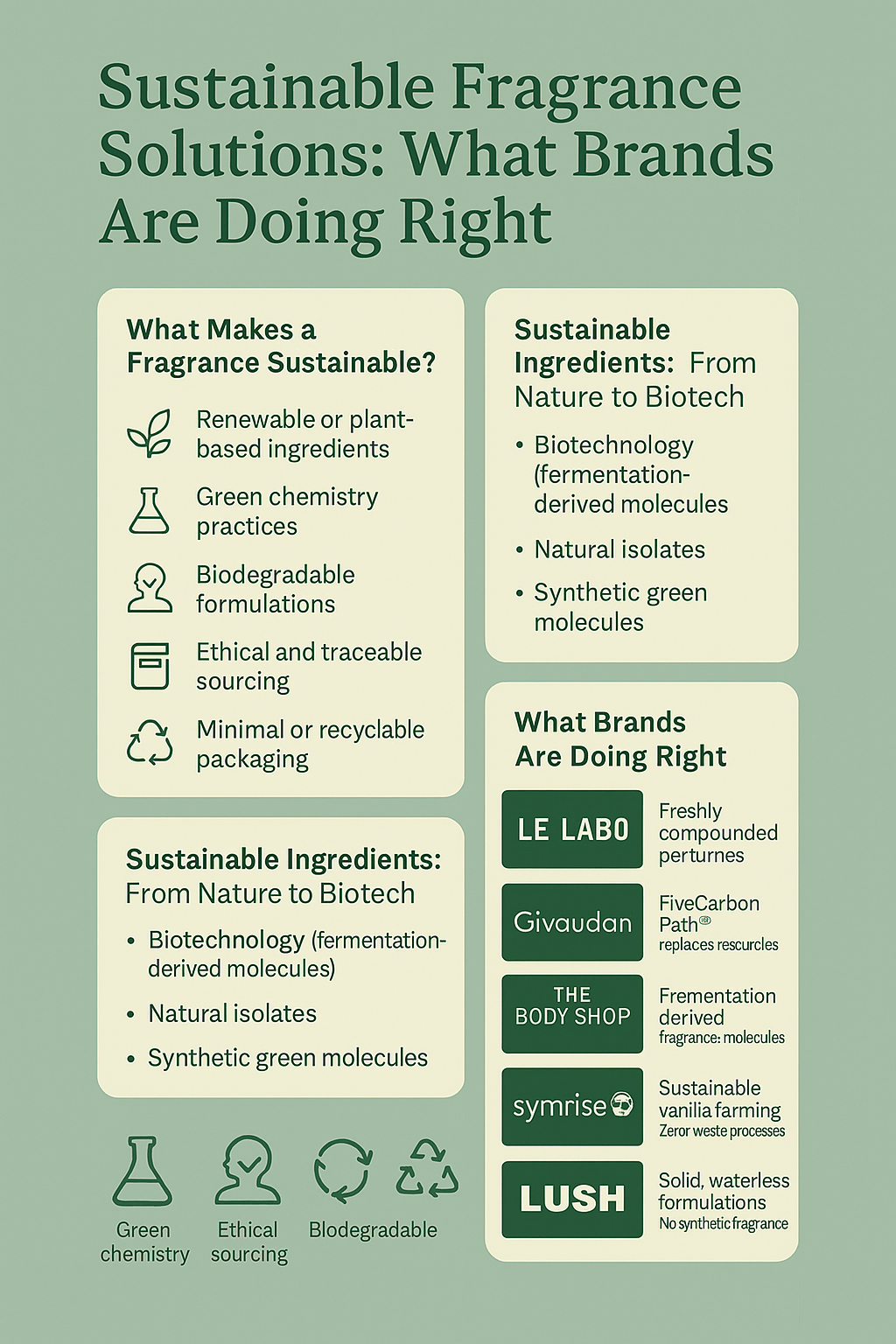
✅ What Makes a Fragrance “Sustainable”?

Sustainability in fragrance involves reducing environmental and ethical impacts across the entire lifecycle of a scent. A fragrance can be considered sustainable if it features:

  • 🌱 Renewable or plant-based ingredients
  • 🧪 Green chemistry practices (low-energy synthesis, solvent-free processes)
  • ♻️ Biodegradable formulations
  • 👩‍🌾 Ethical and traceable sourcing
  • 📦 Minimal or recyclable packaging
  • Compliance with safety and environmental certifications (e.g. IFRA, Ecocert, COSMOS)

💡 Importantly, “natural” does not always equal “sustainable.” Some natural ingredients (e.g., rose oil, sandalwood) require large volumes of plant matter or are tied to endangered ecosystems.


🔬 Sustainable Ingredients: From Nature to Biotech

As demand for sustainable fragrances rises, formulators are moving beyond traditional methods like distillationsolvent extraction. Today’s innovation focuses on:

🔁 Biotechnology (White Biotech)

Fragrance molecules are now being produced via fermentation of sugar, yeast, or plant-based feedstocks, mimicking compounds found in nature. For example:

  • Vanillin from rice bran instead of petrochemicals or vanilla pods
  • Civet, musk, or ambergris mimics without harming animals

🌿 Natural Isolates

Extracting single aromatic molecules from essential oils without using whole plant matter, reducing waste and enhancing stability.

🧬 Synthetic Green Molecules

Eco-friendly synthetics designed to degrade easily in nature and reduce toxicity, especially in home care applications.


🌍 What Brands Are Doing Right: Industry Leaders in Action

Let’s look at real-world examples of brands implementing sustainable fragrance solutions:


1. Le Labo

  • Offers freshly compounded perfumes to reduce overproduction and waste.
  • Uses minimalist, refillable packaging and emphasizes vegan & cruelty-free practices.
  • Partners with Grasse-based artisans for responsibly sourced ingredients.

2. Givaudan

  • Introduced FiveCarbon Path™ to replace fossil fuel–based raw materials with renewable carbon sources.
  • Invests in white biotechnology, such as fermentation-derived fragrance molecules.
  • Launched the Scentaurus™ platform for biodegradable aroma technologies.

3. The Body Shop

  • Sources ethically from community trade programs for fragrance components like coconut and moringa.
  • Ensures all ingredients are 符合 IFRA 标准, vegan, and cruelty-free.
  • Introduced fragrance-free and allergy-friendly product lines in response to sensitive skin demands.

4. Symrise

  • Operates sustainable vanilla farms in Madagascar to ensure full traceability.
  • Pioneers zero-waste processes using citrus by-products in fragrance creation.
  • Focuses on biodegradable, nature-identical molecules through enzyme catalysis.

5. Lush

  • Known for its commitment to solid perfumes and waterless formulations.
  • Avoids synthetic fragrance altogether, relying solely on essential oils and absolutes.
  • Reduces plastic and uses recyclable tins for all solid scent products.

📦 Packaging & Lifecycle Innovation

Sustainability isn’t just about what’s inside the bottle. Brands are also focusing on:

  • Microencapsulation using biodegradable shells
  • Solid fragrance formats that eliminate the need for bottles and sprayers
  • Carbon-efficient local sourcing and short supply chains
  • QR-code traceability for ingredient origins

⚠️ Challenges in Building Truly Sustainable Fragrances

Even with progress, brands face key obstacles:

  • Greenwashing risk: Vague terms like “clean fragrance” are not regulated and often misused.
  • Sourcing limitations: Natural doesn’t always scale, especially for mass production.
  • Consumer perception: Many consumers still fear synthetic ingredients, even if they’re greener.

To overcome these challenges, transparency and education are vital.


🛒 What Buyers and Brands Should Look For

When assessing a sustainable fragrance offering, look for:

✅ Clear ingredient sourcing and carbon footprint disclosure
✅ Certifications like IFRA, RSPO, COSMOS, or USDA Organic
✅ Use of biodegradable, vegan, and cruelty-free components
✅ Brands that publish Life Cycle Assessment (LCA) data
✅ Partnerships with biotech or green chemistry fragrance houses


🔮 Future Trends in Sustainable Fragrance Innovation

As sustainability continues to influence purchasing decisions, expect to see:

  • AI-optimized fragrance formulations to reduce energy and raw material use
  • Blockchain traceability for full transparency from field to bottle
  • Solvent-free natural scent capture via CO₂ extraction or headspace tech
  • Fragrance as function: combining scent with antimicrobial or mood-enhancing effects

✅ Final Thoughts: Sustainability Is a Scent Strategy

Fragrance is no longer just about luxury or identity—it’s a statement of responsibility. Brands that embrace sustainable fragrance innovation are not only meeting consumer demands but also leading the industry toward a more ethical and resilient future.

Whether it’s through green chemistry, ethical sourcingbiotech innovation, sustainable fragrance is here to stay—and it smells like progress.


类似文章

  • 芝麻粉风味:提升东南亚及其他地区的亚洲风味

    Unleashing the Aroma of Sesame Our Sesame Powder Flavour expertly captures the complex, toasted notes of sesame seeds, providing food manufacturers with an innovative solution to infuse their creations with the classic taste of Asian cuisine. Application in Food Manufacturing Adding Depth to a Variety of Foods Our Sesame Powder Flavour is meticulously formulated for…

  • 全球香水市场:趋势、规模、增长、机会和预测

    Global Fragrance Market: Trends, Size, Growth, Opportunities, and Forecast The global fragrance industry is experiencing significant growth, driven by evolving consumer preferences, technological advancements, and expanding applications across various sectors. This article provides a comprehensive overview of the current state of the fragrance market, highlighting key trends, market size, growth drivers, challenges, and future opportunities….

  • 多样化的香水世界:从高级香水到香味营销

    Fragrances have the power to evoke emotions, trigger memories, and create a lasting impression. From luxurious fine perfumes to the fresh scents in household detergents, fragrances play a crucial role in our daily lives. This article explores the various types of fragrances, their characteristics, and their applications in different industries. A. Fine Perfumery Description and…

  • Exploring the World of Aroma Chemicals

    Exploring the World of Aroma Chemicals Aroma chemicals are everywhere, yet often go unnoticed. They are the unsung heroes behind the scents and flavors we love. These compounds are crucial in creating fragrances and flavors in countless products. From perfumes to food, they play a vital role. Aroma chemicals can be natural or synthetic. Synthetic versions are more common due to their consistency and cost-effectiveness. The fragrance industry relies heavily on these chemicals. They ensure that scents are long-lasting and consistent across products. Flavoring agents, another type of aroma chemical, enhance the taste of food and beverages. They make our favorite treats even more enjoyable. The history of aroma chemicals is rich and fascinating. Ancient civilizations used natural extracts for scenting, laying the groundwork for modern perfumery. Today, the balance between natural and synthetic ingredients is key. This balance creates unique fragrance profiles that captivate our senses. As we explore the world of aroma chemicals, we uncover their impact on our daily lives. They shape our experiences and evoke emotions, making them indispensable.   What Are Aroma Chemicals? Aroma chemicals are specialized compounds used in creating scents and flavors. They are the building blocks of fragrance and flavor industries, essential in many products. These compounds can be derived from both natural and synthetic sources. Natural aroma compounds are extracted from plants or animal products, while synthetic ones are manufactured in labs. Synthetic aroma chemicals offer several advantages. They provide consistency, purity, and often a more cost-effective solution than their natural counterparts. Aroma chemicals are utilized in various applications. This includes perfumes, cosmetics, food products, and even cleaning supplies. They are selected based on their ability to enhance the user experience. Common uses of aroma chemicals include: Perfumes: creating distinctive and lasting scents. Food and beverages: enhancing flavors. Household products: masking odors. Cosmetics: adding pleasant fragrances. The science behind aroma chemicals is complex, involving intricate molecule interactions. This fascinating chemistry allows them to mimic natural scents effectively. A key aspect of their success lies in their ability to evoke emotions and trigger memories. This emotional connection is why aroma chemicals are so effective in marketing.   The History and Evolution of Aroma Chemicals The use of aroma chemicals can be traced back to ancient civilizations. Early societies used natural extracts for incense and personal scenting. During the Renaissance, advances in distillation improved the extraction of aromatic compounds. This period saw the rise of perfumery in Europe, laying the groundwork for modern developments. The 19th century marked a significant shift. Synthetic production techniques expanded the palette of available scents. This innovation revolutionized the industry, leading to mass-market fragrances. In the 20th century, chemistry and technology advanced further. New methods allowed for complex fragrance compositions, combining both natural and synthetic ingredients. Key milestones in aroma chemicals’ evolution include: Ancient times: Use of natural extracts. Renaissance: Improved distillation techniques. 19th century: Introduction of synthetic aroma compounds. 20th century: Complex fragrance formulations. The evolution of aroma chemicals reflects broader trends in science and technology. It has continually adapted to consumer preferences and industry demands. Today, the focus is on sustainability and innovation. Efforts are underway to create eco-friendly processes and new, sustainable aroma compounds. by Emile Mbunzama (https://unsplash.com/@emilembunzama) Natural vs. Synthetic Aroma Chemicals Aroma chemicals can be either natural or synthetic. Each type offers unique attributes and advantages in fragrance and flavor production. Natural aroma compounds are derived from plant and animal sources. Essential oils and extracts provide natural scent profiles. These compounds are often favored for their purity and aromatic qualities. Synthetic aroma chemicals, however, are created in laboratories. They replicate both familiar and novel scents. This method allows for cost-effective production and greater scent variety. Choosing between natural and synthetic aromas involves several considerations. Factors include cost, availability, scent longevity, and consumer preferences. Many products today blend both types for optimal results. Key differences between natural and synthetic aroma chemicals include: Natural: Sourced from plants and animals. Synthetic: Lab-created, often more consistent and durable. Scent Profile: Natural for purity, synthetic for variety. Cost: Natural can be pricier; synthetic is more economical. Availability: Natural sources can be limited. The balance between these two forms of aroma chemicals is crucial. It influences fragrance formulation and appeals to diverse consumer needs. Ultimately, the choice depends on the desired product attributes and market trends. Both natural and synthetic types continue to play vital roles in the industry. by Ela De Pure (https://unsplash.com/@eladepure) Key Types of Fragrance Compounds and Flavoring Agents Fragrance compounds are essential elements in perfumery and flavoring. They provide unique scent and taste profiles, enhancing product appeal. Esters are a common type of fragrance compound. They offer fruity and floral scents. Widely used in perfumes, they provide fresh, sweet aromas. Aldehydes are another vital group. They contribute to fresh and citrusy scents. Found in many household and personal care products, they bring a lively aroma. Ketones are notable for their versatility. They range from sweet to woody scents. Ketones add depth and complexity to many fragrances and flavors….

  • 成功的香味香水如何助推洗涤剂公司的胜利

    The Scent of Success: How Fragrance Fuels Detergent Companies’ Triumph   Fragrance is more than just a pleasant smell; it’s a powerful tool that can shape consumer preferences, build brand identities, and ultimately drive sales. In the competitive world of laundry detergents, the right scent can elevate a product from ordinary to unforgettable. This article…

  • 掌握焦糖化反应:褐变综合指南

    Caramelization is more than just a culinary process; it’s a transformation that elevates flavors, tantalizes taste buds, and adds depth to dishes. In this definitive guide, we delve into the science behind the caramelization reaction, exploring its intricacies, applications, and culinary implications. Whether you’re a seasoned chef or an amateur enthusiast, join us on a…

发表回复