What Is a Flavour or Fragrance Chemical
What Is a Flavour or Fragrance Chemical? Definition, Types, Uses & Safety
Flavour and fragrance chemicals power much of what we taste and smell — from the fruity note in a soft drink to the floral trail of a perfume. The phrase “chemical” can sound alarming to some consumers, but in the flavours & fragrances industry it’s a neutral technical term describing the individual molecules that give products their aroma or taste. This guide explains what these chemicals are, how they’re made, where they’re used, and how safety and regulation keep them fit for consumer use.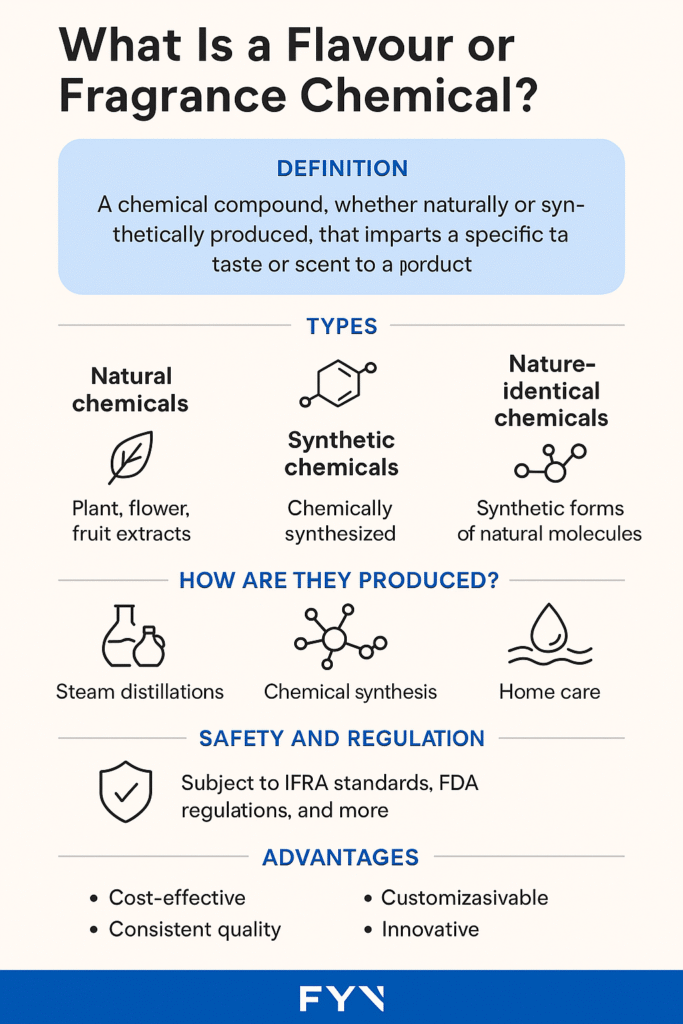
1. Clear definition: what we mean by “flavour” and “fragrance” chemicals
- Flavour chemicals are compounds used to create, enhance, or mimic taste and aroma in foods and beverages. They influence the perception of sweetness, fruitiness, creaminess, roastiness, and other taste dimensions.
- Fragrance chemicals are compounds used to create or modify the scent profile of products such as perfumes, cosmetics, household cleaners, and air care items.
- Aroma chemicals is the umbrella industry term often used to refer to either flavour or fragrance compounds depending on context.
These chemicals may be single molecules (e.g., vanillin) or complex blends engineered to recreate a multi-dimensional sensory profile.
Regulatory bodies and industry associations treat these substances as ingredients subject to safety assessment and labelling rules, not as inherently unsafe substances.
2. Natural vs. synthetic: what’s the practical difference?
- Natural aroma chemicals are isolated from biological sources — plant essential oils, fruit extracts, fermentation products, or animal-derived materials. Examples: limonene from citrus peel, eugenol from clove oil.
- Synthetic aroma chemicals are produced via chemical synthesis or biotechnology (fermentation routes) to replicate or extend naturally occurring compounds. Examples: synthetic vanillin, ethyl butyrate.
Practical trade-offs
- Cost & supply: Synthetic routes often provide more stable supply at lower cost and with easier scalability.
- Consistency: Synthetics deliver consistent chemical profiles batch-to-batch, important for large-scale food and homecare production.
- Labeling & marketing: “Natural” can be a marketing claim, but may come with higher cost and variability.
- Sustainability & traceability: Both natural and synthetic pathways can be optimized for sustainability; biotech fermentation offers a hybrid path (bio-based, consistent).
FY Chem focuses on synthetic flavours and fragrances, offering scalable, IFRA-compliant ingredients with ISO and Halal certifications and analytical support such as GC-MS for quality control.
3. How flavour & fragrance chemicals are made — common production routes
- Extraction: Steam distillation, solvent extraction, and supercritical CO₂ extraction isolate natural volatiles from plant material.
- Chemical synthesis: Traditional organic chemistry builds target molecules from basic feedstocks using catalytic, redox, and condensation reactions.
- Biotechnological routes: Engineered microbes or enzymes synthesize aroma molecules via fermentation — increasingly important for sustainable production.
- Blending & formulation: Experienced perfumers and flavorists blend multiple aroma chemicals to create a balanced, stable, and target-specific profile. Microencapsulation and delivery technologies further control release and stability.
4. Common examples and sensory roles
| Compound | Typical sensory note | Common uses |
|---|---|---|
| Vanillin | Vanilla, sweet | Confectionery, bakery, dairy |
| Limonene | Citrus, bright | Beverages, cleaners, air care |
| Linalool | Floral, lavender-like | Personal care, perfumes |
| Ethyl butyrate | Pineapple, tropical | Beverages, candies |
| Coumarin | Sweet, hay-like | Fine fragrances, air care |
Single molecules provide building blocks; skilled formulators combine them into signature accords (e.g., “fresh citrus accord,” “cream and buttery accord”) that perform reliably in different product matrices.
5. Where they’re used — cross-industry applications
- Food & beverage: Masking off-notes, enhancing fruit, bakery, dairy, or beverage profiles.
- Confectionery & snacks: Deliver intense, recognizable flavors under heat and shelf conditions.
- Personal care & cosmetics: Create perfumes, shampoos, lotions with lasting top-to-base note transitions.
- Household & industrial: Laundry, dishwashing, surface cleaners — fragrance helps convey “clean” to consumers.
- Aromatherapy & air care: Fragrance chemicals tailored for diffusion and long-term scent retention.
- Specialty uses: Pharmaceuticals (palatability), pet foods, candles, wax melts.
Each application imposes unique constraints: thermal stability for baking, volatility for perfumes, regulatory limits for ingestible products.
6. Safety, regulation and good practice
Safety is foundational. Leading regulations and industry standards guide selection and use:
- IFRA (International Fragrance Association) provides use limits for fragrance ingredients in consumer products.
- Food safety authorities (FDA, EFSA and national bodies) regulate flavouring substances for ingestible uses.
- Testing: Toxicology, sensitization studies, exposure assessments, and analytical verification (GC-MS) are routine.
- Labeling & allergen management: Transparency on ingredient lists and awareness of common sensitizers is necessary for consumer safety and legal compliance.
At FY Chem we emphasize IFRA compliance, ISO-level quality management, and GC-MS verification to ensure safe, consistent, and auditable ingredients.
7. Performance considerations for formulators
- Matrix interaction: Aroma chemicals behave differently in oil, water, fat, or alcoholic matrices. Solubility and partitioning are critical.
- Stability: Oxidation, hydrolysis, and heat can degrade some molecules; antioxidants or protected forms are options.
- Release profiles: Microencapsulation, profragrances, and controlled-release carriers can extend scent life or provide targeted flavor release during consumption.
- Cost vs. impact: High-impact molecules often allow lower usage levels; cost-effective synthetics can produce superior performance for many applications.
8. Innovations shaping the near future (forward-looking perspective)
- Biotech & fermentation-derived aroma molecules — scalable, bio-based alternatives to petrochemical feedstocks.
- Microencapsulation and precision delivery — improved shelf life and controlled sensory release.
- Data-driven formulation — AI-assisted blending prediction and GC-MS-informed optimization.
- Sustainability-by-design — sourcing and production optimized for lower carbon and waste.
- Low-dose high-impact chemistries — more potent molecules reduce material usage.
- Regulatory convergence — multi-region compliance and transparency.
These trends favor suppliers who combine robust R&D, analytical capability, and agile custom development — qualities FY Chem emphasizes.
9. Choosing between natural and synthetic for your product
Decision factors:
- Target consumer positioning: Natural claims may justify premium pricing.
- Performance needs: Heat stability and shelf life often point toward synthetic or biotech-derived.
- Supply chain resilience: Synthetics can reduce volatility in availability.
- Regulatory context: Different regions have different labeling requirements.
10. How an experienced supplier helps
- Custom development: Translating briefs into prototypes.
- Analytical verification: GC-MS and stability testing.
- Regulatory guidance: IFRA and food safety compliance.
- Consistent supply: From pilot to scale-up.
- Sample programs: Accelerated evaluation.
Conclusion
A flavour or fragrance chemical is more than a raw material — it’s a precision tool for creating sensory impact, brand identity, and consumer experience. Whether natural, synthetic, or bio-based, its success depends on matching the chemistry to product performance needs, regulatory requirements, and sustainability goals. Partnering with a technically capable, compliance-driven supplier like FY Chem ensures your flavour and fragrance solutions are safe, stable, and market-ready.
FAQ
Q1: What is a flavour or fragrance chemical?
A1: A compound, natural or synthetic, used to create or modify taste (flavours) or scent (fragrances) in products such as foods, beverages, cosmetics, and household items.
Q2: Are flavour and fragrance chemicals safe?
A2: When used within regulated limits and after appropriate toxicological testing, they are considered safe. IFRA and national food safety authorities define safe use levels.
Q3: What’s the difference between natural and synthetic aroma chemicals?
A3: Natural chemicals are extracted from biological sources; synthetic ones are made through chemical synthesis or biotechnology. Synthetics often provide supply stability and consistency.
Q4: Where are they used?
A4: In foods, drinks, personal care, household cleaning products, air care, pharmaceuticals, and even pet products.
Q5: Can I request a custom flavour or fragrance?
A5: Yes. Many suppliers, including FY Chem, offer tailored solutions with sample programs, GC-MS testing, and regulatory support.