Comprehensive Guide to Perfume Notes and Their Roles: A Deep Dive into Citrus, Floral, Woody, and More

🌸 Perfume Notes and Their Classification: A Comprehensive Guide to Fragrance Families

Perfume is an intricate art of blending various aromatic ingredients to create a sensory experience. The key to a great fragrance lies in understanding its notes. A note refers to the different layers of scent that emerge over time as the perfume settles on your skin. These notes are classified into families based on their aroma characteristics. Understanding these classifications helps both perfume lovers and manufacturers alike in selecting and blending scents for unique fragrance experiences.Perfume Notes and Their Classification
1. Introduction to fragrance Notes

In the world of perfumery, fragrance notes are categorized into three main layers: top notes, middle notes, and base notes. Each note serves a specific purpose in how a perfume is perceived, from the moment it’s applied to when it lingers on the skin.

  • Top Notes: These are the first impressions of a fragrance, providing a fresh and often light scent that evaporates quickly.
  • Middle Notes: Also known as the “heart” of the perfume, they emerge after the top notes dissipate, contributing to the main body of the fragrance.
  • Base Notes: The foundation of a perfume, base notes are the heaviest and most enduring, leaving the fragrance lasting on the skin for hours.

2. fragrance Notes: Family Classification Overview

Perfume notes are grouped into families that share similar olfactory characteristics. These families create the foundation of fragrance design and influence the overall appeal of the perfume. Let’s dive deeper into each of the major families:


3. Perfume Note Families

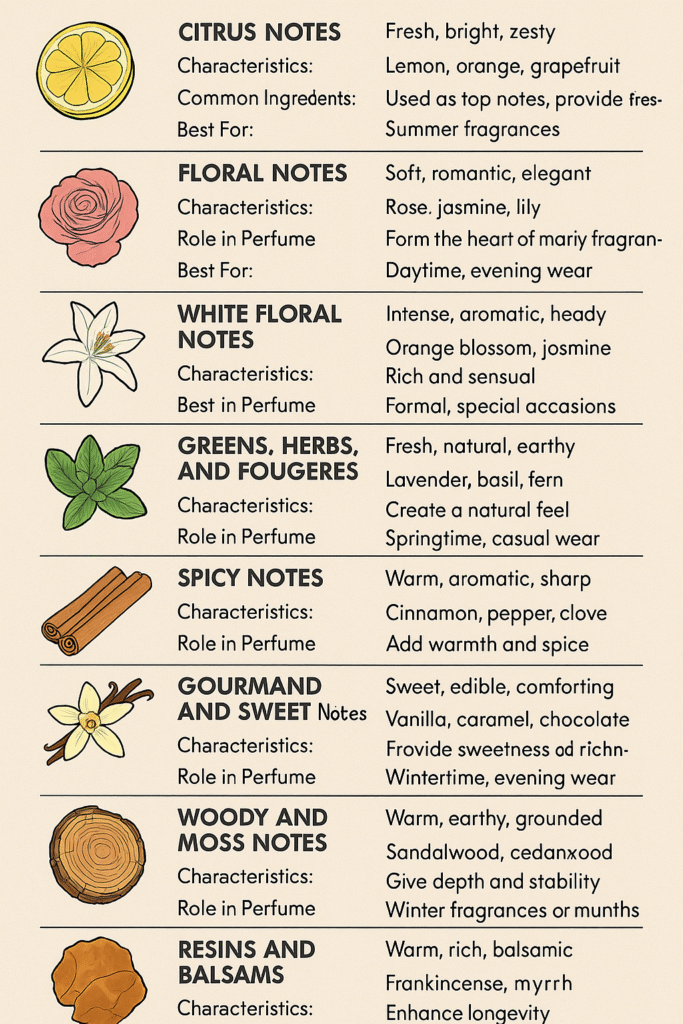
Citrus Notes

  • Characteristics: Citrus notes are known for their fresh, bright, and zesty scent profile. They are highly volatile and are often perceived as invigorating and energizing.
  • Common Ingredients: Lemon, orange, bergamot, grapefruit.
  • Role in Perfume: Typically used as top notes, citrus notes provide a fresh opening that immediately captivates the senses.
  • Best For: Summer fragrances or morning wear, as they offer a refreshing and clean sensation.

Fruits, Vegetables, and Nuts

  • Characteristics: Fruit, vegetable, and nut-based notes offer a diverse range of smells, from sweet and juicy to earthy and nutty. These notes can provide a fresh, natural feel or a warm, comforting depth.
  • Common Ingredients: Peach, plum, almond, fig.
  • Role in Perfume: These notes are often used in the middle to base notes to create complexity and fullness in a fragrance.
  • Best For: Autumn and winter fragrances, as they add warmth and depth.

Floral Notes

  • Characteristics: Floral notes are the most widely used and are often associated with elegance, femininity, and romance. They range from soft, powdery florals to heady, opulent blooms.
  • Common Ingredients: Rose, jasmine, lily, violet.
  • Role in Perfume: Floral notes are typically used as middle notes, creating the heart of the fragrance. They provide richness and emotional depth.
  • Best For: Daytime and evening wear, particularly for romantic or formal occasions.

White Floral Notes

  • Characteristics: White florals tend to be more intense and aromatic than regular floral notes, offering a strong, sweet, and often intoxicating fragrance.
  • Common Ingredients: Jasmine, orange blossom, gardenia.
  • Role in Perfume: These notes are rich and heady, often used to add sensuality and luxury to perfumes. They are also used as middle or base notes.
  • Best For: Formal events, evening wear, and special occasions where an intense floral scent is desired.

Greens, Herbs, and Fougeres

  • Characteristics: This category of notes is known for its fresh, natural, and earthy qualities. These notes often evoke the scent of fresh-cut grass, herbs, and leafy greens.
  • Common Ingredients: Lavender, basil, fern, tomato leaf.
  • Role in Perfume: These notes create a refreshing, outdoor feel and are typically used in the heart or middle notes of a fragrance.
  • Best For: Springtime and casual daytime wear, giving a natural and calming impression.

Spicy Notes

  • Characteristics: Spicy notes are warm, aromatic, and often sharp, adding complexity and a touch of heat to a fragrance.
  • Common Ingredients: Cinnamon, pepper, cardamom, cloves.
  • Role in Perfume: These notes are used in the middle and base notes to provide depth and warmth.
  • Best For: Autumn and winter fragrances, adding a cozy and inviting feel.

Gourmand and Sweet Notes

  • Characteristics: Gourmand notes are sweet, edible, and often dessert-like. These notes can evoke the scent of candy, chocolate, or other sweet treats, making them incredibly comforting and delicious.
  • Common Ingredients: Vanilla, caramel, chocolate, coffee.
  • Role in Perfume: These notes are primarily used as base notes, providing sweetness and richness that lasts long after the top notes have evaporated.
  • Best For: Wintertime and evening wear, particularly for people who enjoy sweet and comforting fragrances.

Woody and Moss Notes

  • Characteristics: Woody notes are warm, earthy, and grounded, often associated with the smell of trees, forests, and nature. These notes provide depth and a sense of stability to a fragrance.
  • Common Ingredients: Sandalwood, cedarwood, oakmoss, vetiver.
  • Role in Perfume: Used in the base notes, woody notes serve as the foundation of many perfumes, giving them a solid, enduring base.
  • Best For: Evening wear or colder months, providing a deep, sophisticated scent.

Resins and Balsams

  • Characteristics: These notes are warm, rich, and often sweet, reminiscent of tree sap or resins. They add a deep, balsamic quality to perfumes.
  • Common Ingredients: Frankincense, myrrh, benzoin.
  • Role in Perfume: Resins and balsams are used as base notes and help fix the fragrance, enhancing its longevity.
  • Best For: Winter fragrances or evening wear, where warmth and complexity are desired.

Musk, Amber, and Animalic Notes

  • Characteristics: Musk and amber are warm, sensual, and often exotic. These notes can evoke a feeling of intimacy and depth, making them some of the most sought-after base notes.
  • Common Ingredients: Musk, amber, civet, castoreum.
  • Role in Perfume: These notes are often used in the base to provide depth, warmth, and lasting power to a fragrance.
  • Best For: Evening wear or special occasions, particularly in perfumes meant to evoke sensuality.

Beverage Notes

  • Characteristics: Beverage notes are based on the scents of various drinks, adding a fresh and fun twist to fragrances.
  • Common Ingredients: Champagne, coffee, tea, cola.
  • Role in Perfume: These notes are used to create a refreshing and playful element, often adding lightness and sweetness.
  • Best For: Casual daytime wear or summer fragrances.

Natural vs. Synthetic Notes

  • Characteristics: Some notes are derived from natural sources, while others are synthetically created. Natural notes come from flowers, fruits, and woods, while synthetics can mimic rare ingredients or create entirely new scents.
  • Common Ingredients: Natural (rose, jasmine), Synthetic (Iso E Super, Hedione).
  • Role in Perfume: Both natural and synthetic notes are used to enhance fragrance composition. Synthetics allow for more stability and creativity, while naturals offer authenticity and depth.

4. Conclusion: The Diversity and Importance of Perfume Notes

The world of perfume notes is as vast and varied as the fragrances they compose. From the light zest of citrus to the deep warmth of amber, each note has a unique role in creating a balanced and captivating scent profile. Understanding these different fragrance families is key to crafting personalized perfumes that resonate with the individual preferences of consumers.

As the fragrance industry continues to evolve, the creativity and innovation within these families also expand. Perfume makers now have the flexibility to combine traditional notes with synthetic, experimental ingredients to create new and exciting fragrances for the modern market.

5. References

  • Fragrantica – The ultimate fragrance encyclopedia for perfume enthusiasts.
  • Perfume Design and Composition Techniques – Perfume creation resources from industry experts.

Similar Posts

  • Importance of flavors in the food industry

    Importance of flavors in the food industry Introduction With the rapid development of the food industry, people have put forward higher requirements for the flavor, taste and overall sensory experience of food. In this process, flavors, as an important food additive, have played an irreplaceable role in improving food flavor, enhancing appetite, extending food shelf…

  • Sesame Powder Flavour: Enhancing Asian Flavours in Southeast Asia & Beyond

    Unleashing the Aroma of Sesame Our Sesame Powder Flavour expertly captures the complex, toasted notes of sesame seeds, providing food manufacturers with an innovative solution to infuse their creations with the classic taste of Asian cuisine. Application in Food Manufacturing Adding Depth to a Variety of Foods Our Sesame Powder Flavour is meticulously formulated for…

  • The Ultimate Guide to Long-Lasting Shampoo Fragrance: Tips and Tricks

    The Ultimate Guide to Long-Lasting Shampoo Fragrance: Tips and Tricks Introduction Fragrance is an essential part of our daily grooming routines, and nothing feels as satisfying as running your fingers through soft, fragrant hair. A pleasant, long-lasting shampoo scent can not only elevate your confidence but also make you feel fresh throughout the day. Whether…

  • Premium Fragrances for Detergent and Soap — By F&Y

    Our company has successfully penetrated the daily chemical market in developing regions such as Africa and Latin America, offering high-cost performance and stable quality products. With years of experience in detergent and soap markets, our engineers excel in aroma selection and optimization, backed by comprehensive market research.     Fragrances for Detergent: 198462 Fresh Flower…

  • Perfumers: The Art and Science Behind Every Scent

    Perfumers: The Art and Science Behind Every Scent How creativity, chemistry, and compliance shape modern fragrances Introduction A perfumer—often called a nose—designs fragrances that are emotionally resonant, technically robust, and legally compliant. Beyond poetic accords and brand storytelling, modern perfumers operate at the intersection of sensory art, analytical chemistry, and regulatory science. They balance natural…

  • Exploring the World of Aroma Chemicals

    Exploring the World of Aroma Chemicals Aroma chemicals are everywhere, yet often go unnoticed. They are the unsung heroes behind the scents and flavors we love. These compounds are crucial in creating fragrances and flavors in countless products. From perfumes to food, they play a vital role. Aroma chemicals can be natural or synthetic. Synthetic versions are more common due to their consistency and cost-effectiveness. The fragrance industry relies heavily on these chemicals. They ensure that scents are long-lasting and consistent across products. Flavoring agents, another type of aroma chemical, enhance the taste of food and beverages. They make our favorite treats even more enjoyable. The history of aroma chemicals is rich and fascinating. Ancient civilizations used natural extracts for scenting, laying the groundwork for modern perfumery. Today, the balance between natural and synthetic ingredients is key. This balance creates unique fragrance profiles that captivate our senses. As we explore the world of aroma chemicals, we uncover their impact on our daily lives. They shape our experiences and evoke emotions, making them indispensable.   What Are Aroma Chemicals? Aroma chemicals are specialized compounds used in creating scents and flavors. They are the building blocks of fragrance and flavor industries, essential in many products. These compounds can be derived from both natural and synthetic sources. Natural aroma compounds are extracted from plants or animal products, while synthetic ones are manufactured in labs. Synthetic aroma chemicals offer several advantages. They provide consistency, purity, and often a more cost-effective solution than their natural counterparts. Aroma chemicals are utilized in various applications. This includes perfumes, cosmetics, food products, and even cleaning supplies. They are selected based on their ability to enhance the user experience. Common uses of aroma chemicals include: Perfumes: creating distinctive and lasting scents. Food and beverages: enhancing flavors. Household products: masking odors. Cosmetics: adding pleasant fragrances. The science behind aroma chemicals is complex, involving intricate molecule interactions. This fascinating chemistry allows them to mimic natural scents effectively. A key aspect of their success lies in their ability to evoke emotions and trigger memories. This emotional connection is why aroma chemicals are so effective in marketing.   The History and Evolution of Aroma Chemicals The use of aroma chemicals can be traced back to ancient civilizations. Early societies used natural extracts for incense and personal scenting. During the Renaissance, advances in distillation improved the extraction of aromatic compounds. This period saw the rise of perfumery in Europe, laying the groundwork for modern developments. The 19th century marked a significant shift. Synthetic production techniques expanded the palette of available scents. This innovation revolutionized the industry, leading to mass-market fragrances. In the 20th century, chemistry and technology advanced further. New methods allowed for complex fragrance compositions, combining both natural and synthetic ingredients. Key milestones in aroma chemicals’ evolution include: Ancient times: Use of natural extracts. Renaissance: Improved distillation techniques. 19th century: Introduction of synthetic aroma compounds. 20th century: Complex fragrance formulations. The evolution of aroma chemicals reflects broader trends in science and technology. It has continually adapted to consumer preferences and industry demands. Today, the focus is on sustainability and innovation. Efforts are underway to create eco-friendly processes and new, sustainable aroma compounds. by Emile Mbunzama (https://unsplash.com/@emilembunzama) Natural vs. Synthetic Aroma Chemicals Aroma chemicals can be either natural or synthetic. Each type offers unique attributes and advantages in fragrance and flavor production. Natural aroma compounds are derived from plant and animal sources. Essential oils and extracts provide natural scent profiles. These compounds are often favored for their purity and aromatic qualities. Synthetic aroma chemicals, however, are created in laboratories. They replicate both familiar and novel scents. This method allows for cost-effective production and greater scent variety. Choosing between natural and synthetic aromas involves several considerations. Factors include cost, availability, scent longevity, and consumer preferences. Many products today blend both types for optimal results. Key differences between natural and synthetic aroma chemicals include: Natural: Sourced from plants and animals. Synthetic: Lab-created, often more consistent and durable. Scent Profile: Natural for purity, synthetic for variety. Cost: Natural can be pricier; synthetic is more economical. Availability: Natural sources can be limited. The balance between these two forms of aroma chemicals is crucial. It influences fragrance formulation and appeals to diverse consumer needs. Ultimately, the choice depends on the desired product attributes and market trends. Both natural and synthetic types continue to play vital roles in the industry. by Ela De Pure (https://unsplash.com/@eladepure) Key Types of Fragrance Compounds and Flavoring Agents Fragrance compounds are essential elements in perfumery and flavoring. They provide unique scent and taste profiles, enhancing product appeal. Esters are a common type of fragrance compound. They offer fruity and floral scents. Widely used in perfumes, they provide fresh, sweet aromas. Aldehydes are another vital group. They contribute to fresh and citrusy scents. Found in many household and personal care products, they bring a lively aroma. Ketones are notable for their versatility. They range from sweet to woody scents. Ketones add depth and complexity to many fragrances and flavors….

ใส่ความเห็น