Is Fragrance in Cosmetics Safe Facts, Science & Regulations

Is Fragrance in Cosmetics Safe? Facts, Science & Regulations

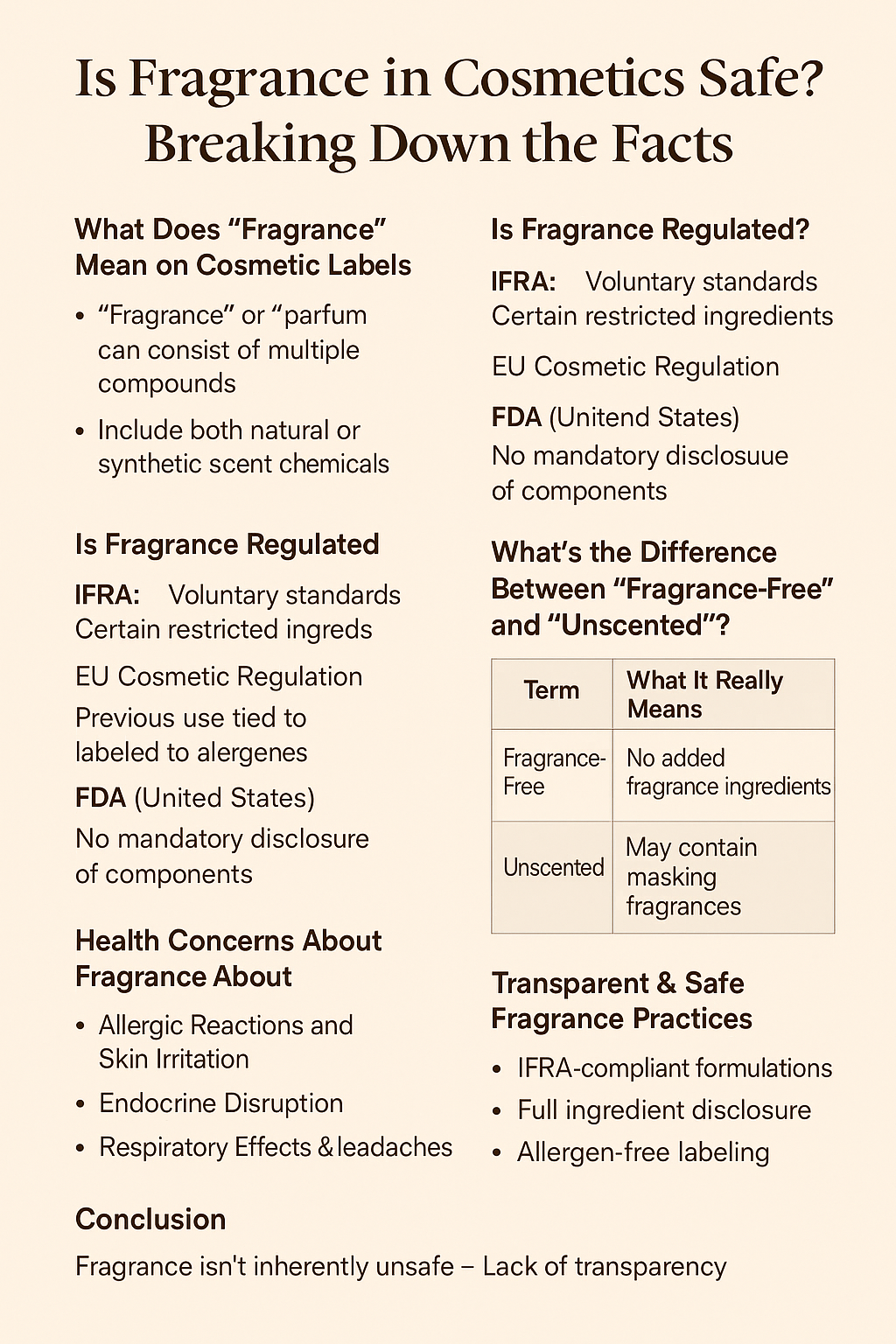
🧴 Is Fragrance in Cosmetics Safe? Breaking Down the Facts

Fragrance is found in nearly every cosmetic product—from lotions to lipsticks to serums. It enhances the sensory experience and contributes to brand identity. But increasingly, consumers are asking: Is fragrance in cosmetics actually safe?

Let’s explore what “fragrance” really means on product labels, what the science says about safety, and how industry regulations aim to protect consumers.Is Fragrance in Cosmetics Safe Facts, Science & Regulations


🧾 What Does “Fragrance” Mean on Cosmetic Labels?

In cosmetics, “fragrance” (also labeled as parfum) is not a single ingredient—it’s a complex mixture of anywhere from 10 to over 100 compounds, including aroma chemicals, essential oils, and solvents.

According to the U.S. Food and Drug Administration (FDA), fragrance formulas are considered proprietary y do not require full disclosure under current regulations [1]. That means consumers often don’t know exactly what’s in a product labeled “fragrance.”


🔍 Is Fragrance Regulated?

✅ IFRA (International Fragrance Association)

The IFRA sets globally recognized standards that restrict or ban the use of certain fragrance materials based on safety assessments by the Research Institute for Fragrance Materials (RIFM).
For example, ingredients like nitromusks y musk ketone are prohibited due to bioaccumulation and potential toxicity [2].

🇪🇺 EU Cosmetic Regulation

The European Union is stricter. Cosmetic products must label 26 specific fragrance allergens (like limonene, linalooly citral) when they exceed certain concentrations [3]. This transparency is intended to help sensitive consumers avoid allergens.

🇺🇸 FDA (United States)

The FDA does not require full disclosure of fragrance components unless a specific compound is known to be harmful or causes allergic reactions. However, companies are responsible for ensuring product safety [1].


⚠️ Health Concerns About Fragrance

1. Allergic Reactions and Skin Irritation

According to the American Academy of Dermatology (AAD), fragrance is among the top five allergens in skincare and cosmetic products [4]. Even natural essential oils (like lavender or tea tree) can cause dermatitis in sensitive individuals.

🔬 A 2021 study published in Contact Dermatitis found fragrance allergens were present in 78% of “natural” skincare products sold in the EU [5].

2. Endocrine Disruption

Some fragrance components—particularly older formulations—have been linked to hormone-disrupting effects. For example, phthalates, once used to help fragrances last longer, are suspected endocrine disruptors.

While many companies have phased out phthalates, some low-cost or imported cosmetics may still contain them. Look for labels that specify “phthalate-free”.

3. Respiratory Effects & Headaches

Fragrance particles, especially in aerosolized forms like body sprays, may trigger asthma, migraines, or sinus issues in some individuals. These reactions are not necessarily toxic but can affect sensitive users [6].


🤔 Are All Fragrances Unsafe?

Not at all.

Many fragrance compounds are safe when used at regulated concentrations. IFRA and RIFM conduct toxicological reviews to determine safe exposure levels for consumers, and most major cosmetic companies follow these voluntary standards.

Also, synthetic doesn’t mean unsafe. In fact, synthetic aroma molecules are often more stable, more sustainable, and less allergenic than unrefined natural oils.

🌱 For example, synthetic linalool (a floral scent) can be purer and less reactive than natural versions extracted from plants.


🔍 What’s the Difference Between “Fragrance-Free” and “Unscented”?

Term What It Really Means
Fragrance-Free No added fragrance ingredients—natural or synthetic.
Unscented May contain masking fragrances to cover up unpleasant raw material odors.
Naturally Scented Contains essential oils or botanical extracts; not necessarily safer or allergy-free.
Clean Fragrance Not a regulated term; varies by brand definition.

Be aware that “fragrance-free” is the only reliable claim if you are fragrance-sensitive.


🔎 Transparent & Safe Fragrance Practices

More brands are now choosing to:

  • Utilice Conformidad con IFRA fragrances
  • Offer full disclosure of fragrance components (e.g., The INCI Decoder movement)
  • Label “allergen-free” products for sensitive skin
  • Develop biodegradable fragrance capsules to reduce skin contact and increase longevity

Companies like Lush, Beautycounter, The Ordinaryy Paula’s Choice are leading with ingredient transparency and safer fragrance practices.


🛡️ What Can Consumers Do?

  • Check for “fragrance-free” o “hypoallergenic” labels
  • Review ingredient lists using tools like EWG’s Skin Deep o INCI Decoder
  • Choose brands that publish their full ingredient disclosures
  • When in doubt, patch test any product before use

✅ Final Thoughts

Fragrance in cosmetics is not inherently unsafe—but lack of transparency can be. While most formulations are regulated and safe for the general population, those with allergies or sensitivities should choose fragrance-free options or vet their products carefully.

The industry is moving toward more responsible practices, including clean-label disclosure, biotech fragrancey reduced allergenicity. As awareness grows, consumers and brands alike can push for a safer and more transparent scented future.


📚 References

  1. U.S. FDA – Fragrance Ingredients in Cosmetics
  2. IFRA – Fragrance Safety Standards
  3. European Commission – Cosmetic Regulation (EC) No 1223/2009
  4. AAD – Fragrance Allergy
  5. Lene Møller-Larsen et al., Contact Dermatitis, 2021
  6. Caress SM, Steinemann AC. Journal of Environmental Health. 2009
 

Publicaciones Similares

  • Dominar la reacción de caramelización: Una guía completa del pardeamiento

    Caramelization is more than just a culinary process; it’s a transformation that elevates flavors, tantalizes taste buds, and adds depth to dishes. In this definitive guide, we delve into the science behind the caramelization reaction, exploring its intricacies, applications, and culinary implications. Whether you’re a seasoned chef or an amateur enthusiast, join us on a…

  • What Does Aroma Mean? Definition, Origins, and Everyday Examples

    🌿 What Does Aroma Mean? Definition, Origins, and Everyday Examples Aroma is more than just a pleasant smell—it’s a powerful sensory experience that connects memory, mood, taste, and perception. From the scent of freshly brewed coffee to the fragrance of spring flowers, aromas play a critical role in how we perceive the world around us….

  • Navegar por el mundo de las fragancias al por mayor: Consideraciones clave

    The wholesale fragrance market offers enticing opportunities for businesses and entrepreneurs looking to venture into the world of scents. Whether you aim to stock your retail store, start your own fragrance line, or simply expand your existing product offerings, understanding the nuances of purchasing wholesale fragrance is essential. This article will guide you through the…

  • Exploring the World of Aroma Chemicals

    Exploring the World of Aroma Chemicals Aroma chemicals are everywhere, yet often go unnoticed. They are the unsung heroes behind the scents and flavors we love. These compounds are crucial in creating fragrances and flavors in countless products. From perfumes to food, they play a vital role. Aroma chemicals can be natural or synthetic. Synthetic versions are more common due to their consistency and cost-effectiveness. The fragrance industry relies heavily on these chemicals. They ensure that scents are long-lasting and consistent across products. Flavoring agents, another type of aroma chemical, enhance the taste of food and beverages. They make our favorite treats even more enjoyable. The history of aroma chemicals is rich and fascinating. Ancient civilizations used natural extracts for scenting, laying the groundwork for modern perfumery. Today, the balance between natural and synthetic ingredients is key. This balance creates unique fragrance profiles that captivate our senses. As we explore the world of aroma chemicals, we uncover their impact on our daily lives. They shape our experiences and evoke emotions, making them indispensable.   What Are Aroma Chemicals? Aroma chemicals are specialized compounds used in creating scents and flavors. They are the building blocks of fragrance and flavor industries, essential in many products. These compounds can be derived from both natural and synthetic sources. Natural aroma compounds are extracted from plants or animal products, while synthetic ones are manufactured in labs. Synthetic aroma chemicals offer several advantages. They provide consistency, purity, and often a more cost-effective solution than their natural counterparts. Aroma chemicals are utilized in various applications. This includes perfumes, cosmetics, food products, and even cleaning supplies. They are selected based on their ability to enhance the user experience. Common uses of aroma chemicals include: Perfumes: creating distinctive and lasting scents. Food and beverages: enhancing flavors. Household products: masking odors. Cosmetics: adding pleasant fragrances. The science behind aroma chemicals is complex, involving intricate molecule interactions. This fascinating chemistry allows them to mimic natural scents effectively. A key aspect of their success lies in their ability to evoke emotions and trigger memories. This emotional connection is why aroma chemicals are so effective in marketing.   The History and Evolution of Aroma Chemicals The use of aroma chemicals can be traced back to ancient civilizations. Early societies used natural extracts for incense and personal scenting. During the Renaissance, advances in distillation improved the extraction of aromatic compounds. This period saw the rise of perfumery in Europe, laying the groundwork for modern developments. The 19th century marked a significant shift. Synthetic production techniques expanded the palette of available scents. This innovation revolutionized the industry, leading to mass-market fragrances. In the 20th century, chemistry and technology advanced further. New methods allowed for complex fragrance compositions, combining both natural and synthetic ingredients. Key milestones in aroma chemicals’ evolution include: Ancient times: Use of natural extracts. Renaissance: Improved distillation techniques. 19th century: Introduction of synthetic aroma compounds. 20th century: Complex fragrance formulations. The evolution of aroma chemicals reflects broader trends in science and technology. It has continually adapted to consumer preferences and industry demands. Today, the focus is on sustainability and innovation. Efforts are underway to create eco-friendly processes and new, sustainable aroma compounds. by Emile Mbunzama (https://unsplash.com/@emilembunzama) Natural vs. Synthetic Aroma Chemicals Aroma chemicals can be either natural or synthetic. Each type offers unique attributes and advantages in fragrance and flavor production. Natural aroma compounds are derived from plant and animal sources. Essential oils and extracts provide natural scent profiles. These compounds are often favored for their purity and aromatic qualities. Synthetic aroma chemicals, however, are created in laboratories. They replicate both familiar and novel scents. This method allows for cost-effective production and greater scent variety. Choosing between natural and synthetic aromas involves several considerations. Factors include cost, availability, scent longevity, and consumer preferences. Many products today blend both types for optimal results. Key differences between natural and synthetic aroma chemicals include: Natural: Sourced from plants and animals. Synthetic: Lab-created, often more consistent and durable. Scent Profile: Natural for purity, synthetic for variety. Cost: Natural can be pricier; synthetic is more economical. Availability: Natural sources can be limited. The balance between these two forms of aroma chemicals is crucial. It influences fragrance formulation and appeals to diverse consumer needs. Ultimately, the choice depends on the desired product attributes and market trends. Both natural and synthetic types continue to play vital roles in the industry. by Ela De Pure (https://unsplash.com/@eladepure) Key Types of Fragrance Compounds and Flavoring Agents Fragrance compounds are essential elements in perfumery and flavoring. They provide unique scent and taste profiles, enhancing product appeal. Esters are a common type of fragrance compound. They offer fruity and floral scents. Widely used in perfumes, they provide fresh, sweet aromas. Aldehydes are another vital group. They contribute to fresh and citrusy scents. Found in many household and personal care products, they bring a lively aroma. Ketones are notable for their versatility. They range from sweet to woody scents. Ketones add depth and complexity to many fragrances and flavors….

  • ¿Cuál es la diferencia entre aceite de fragancia y aceite esencial?

    🌿 What’s the Difference Between Fragrance Oil and Essential Oil? 🧭 Introduction: Similar Names, Different Natures If you’ve ever browsed candles, diffusers, or skincare labels, you’ve probably seen both “fragrance oil” and “essential oil.” While they may seem similar—both are aromatic oils—they’re very different in terms of origin, composition, usage, and safety. In this guide,…

  • The Benefits of Synthetic Fragrances in Commercial Products

    The Benefits of Synthetic Fragrances in Commercial Products Introduction Fragrance plays a powerful role in shaping how consumers perceive and interact with products. From the refreshing scent of a citrus dishwashing liquid to the soothing aroma of a lavender-scented fabric softener, fragrance transforms ordinary products into memorable sensory experiences. For many consumers, scent is not…

Deja un comentario