what is the difference between fragrance and perfume

What’s the Difference Between Fragrance and Perfume?

Understanding Terminology, Usage, and Safety in the Scent Industryfragrance and perfume

🔍 Introduction: Why the Confusion Exists

In the world of personal care, cosmetics, and fine fragrances, the terms “fragrance” and “perfume” are often used interchangeably. You’ll find them on labels, marketing materials, and ingredient lists — but do they really mean the same thing?

The short answer: No.

While both refer to scented substances, they differ in definition, usage, concentration, and regulatory context. This article unpacks those differences to help consumers make informed decisions and brands communicate clearly.


1️⃣ Definitions: Fragrance vs. Perfume

✅ What is “Fragrance”?

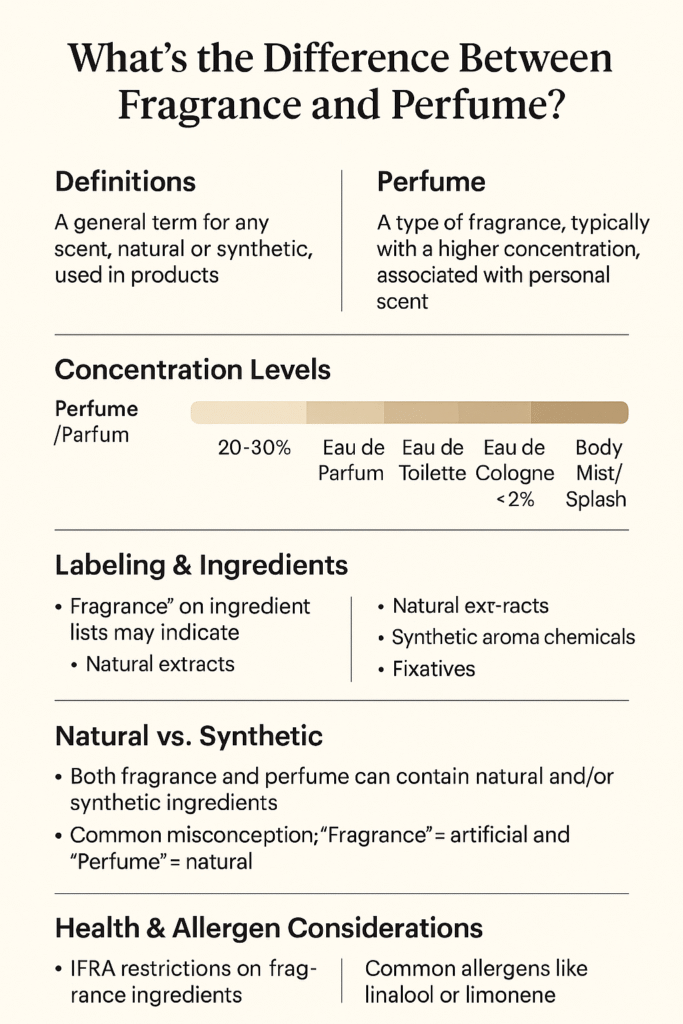
“Fragrance” is a broad, general term that refers to any scent added to a product — whether natural or synthetic. It may include essential oils, aroma chemicals, solvents, stabilizers, and fixatives. In regulatory terms (such as FDA labeling), “fragrance” is often treated as a trade secret, meaning its exact components don’t have to be disclosed.

Source: U.S. FDA – Fragrance Ingredients

✅ What is “Perfume”?

“Perfume” (or Parfum) refers more specifically to a type of fragrance with a higher concentration of aromatic compounds, typically used in personal scent products. It often carries a luxury or fine fragrance association, with carefully layered top, heart, and base notes.


2️⃣ Concentration Levels and Perfume Types

Perfume isn’t a single product — it comes in various strengths depending on the concentration of fragrance oil in the base (usually alcohol or water):

Product Type Fragrance Oil Concentration Longevity Common Use
Parfum (Perfume) 20–30% 6–8 hours Luxury fine fragrance
Eau de Parfum (EDP) 15–20% 4–6 hours Premium personal care
Eau de Toilette (EDT) 5–15% 2–4 hours Everyday use
Eau de Cologne (EDC) 2–5% ~2 hours Light, refreshing sprays
Body Mist/Splash <2% <1 hour Cosmetics, skincare

Source: Fragrance Foundation UK

The key takeaway: “Perfume” is a subcategory of fragrance, defined by concentration and purpose.


3️⃣ Labeling & Ingredients: What “Fragrance” Means in Cosmetics

On product ingredient lists, especially in skincare or household items, you’ll often see the label:

Fragrance (Parfum)

This refers to a mixture of many aromatic compounds (up to hundreds), blended to create a specific scent experience. These blends may include:

  • Essential oils (e.g., lavender, lemon, eucalyptus)
  • Synthetic aroma molecules (e.g., linalool, benzyl salicylate)
  • Fixatives to prolong scent
  • Stabilizers to enhance shelf life

According to the International Fragrance Association (IFRA), most modern fragrance formulas are 80–90% synthetic, due to consistency, safety, and cost.

Source: IFRA – Transparency and Safe Use


4️⃣ Natural vs. Synthetic: Breaking the Myth

It’s a common myth that “perfume” is always natural or luxurious, and “fragrance” is synthetic and harsh. In reality:

  • Both perfume and fragrance can be natural or synthetic.
  • High-end perfumes often include synthetics to stabilize or enhance natural notes.
  • Many “fragrance-free” products still contain masking fragrances to neutralize unwanted base odors.

Natural doesn’t always mean safe, and synthetic doesn’t always mean toxic. It’s about the specific ingredient and concentration.

Source: DermNet NZ – Fragrance Allergy


5️⃣ Health & Allergen Considerations

Fragrance is one of the top cosmetic allergens worldwide. Some components — whether natural (like limonene) or synthetic — can cause:

  • Contact dermatitis
  • Asthma reactions
  • Headaches or migraines

In the EU and under IFRA guidelines, 26 fragrance allergens must be declared if they exceed certain thresholds.

To minimize risk, sensitive consumers can choose:

  • “Fragrance-free” (note: not always truly unscented)
  • “Hypoallergenic” or “Allergen-free” labeled products
  • Products with disclosed essential oil-only formulations

Source: European Commission – Cosmetics Regulation


6️⃣ How Brands Use These Terms Strategically

In marketing, brands may strategically choose between “fragrance” and “perfume” to target specific audiences:

Term Used Brand Perception Common in
Nước hoa Luxury, elegant Fine fragrance, niche perfume
Fragrance Functional, generic Cleaning, body care, skincare

Private-label brands and OEM manufacturers should be mindful of regulatory labeling while also aligning terminology with brand positioning.


✅ Conclusion: Which Term Should You Use?

  • “Fragrance” is a technical umbrella term, used across product types.
  • “Perfume” is a specific, high-concentration type of fragrance, usually personal.
  • For sensitive users: Always read ingredient labels and watch for known allergens.
  • For brands: Know the difference — and use it strategically in product development and compliance.

🧠 Quick Recap (TL;DR)

Feature Fragrance Nước hoa
Meaning Any scent blend in products High-concentration scent for skin
Usage In cosmetics, cleaning, skincare In personal fine fragrance products
Labeling Broad, often undisclosed May be specified with concentration
Composition Natural + synthetic mix Often synthetic + essential oils
Risk of Allergy Present in both Present in both


Similar Posts

  • Top 10 Fragrance Notes for Fabric Softeners in 2025

    🧴 Top 10 Fragrance Notes for Fabric Softeners: Consumer Favorites & Trends Fabric softeners are no longer just about softness—they’re scent-driven experiences. In fact, fragrance is the #1 driver of consumer loyalty in laundry care products, according to a Nielsen Clean Home Care Report (2021). The right fragrance note can evoke freshness, comfort, elegance—or all…

  • Is Fragrance in Cosmetics Safe? Facts, Science & Regulations

    🧴 Is Fragrance in Cosmetics Safe? Breaking Down the Facts Fragrance is found in nearly every cosmetic product—from lotions to lipsticks to serums. It enhances the sensory experience and contributes to brand identity. But increasingly, consumers are asking: Is fragrance in cosmetics actually safe? Let’s explore what “fragrance” really means on product labels, what the…

  • Sustainable Fragrance Solutions: What Brands Are Doing Right

    🌿 Sustainable Fragrance Solutions: What Brands Are Doing Right Sustainability has become a defining force in the fragrance industry. With growing environmental concerns, consumer awareness, and regulatory pressure, fragrance brands and suppliers are reimagining how scents are created—from ingredient sourcing to production, formulation, and packaging. In this article, we explore what “sustainable fragrance” actually means,…

  • Perfumers: The Art and Science Behind Every Scent

    Perfumers: The Art and Science Behind Every Scent How creativity, chemistry, and compliance shape modern fragrances Introduction A perfumer—often called a nose—designs fragrances that are emotionally resonant, technically robust, and legally compliant. Beyond poetic accords and brand storytelling, modern perfumers operate at the intersection of sensory art, analytical chemistry, and regulatory science. They balance natural…

  • Exploring the World of Aroma Chemicals

    Exploring the World of Aroma Chemicals Aroma chemicals are everywhere, yet often go unnoticed. They are the unsung heroes behind the scents and flavors we love. These compounds are crucial in creating fragrances and flavors in countless products. From perfumes to food, they play a vital role. Aroma chemicals can be natural or synthetic. Synthetic versions are more common due to their consistency and cost-effectiveness. The fragrance industry relies heavily on these chemicals. They ensure that scents are long-lasting and consistent across products. Flavoring agents, another type of aroma chemical, enhance the taste of food and beverages. They make our favorite treats even more enjoyable. The history of aroma chemicals is rich and fascinating. Ancient civilizations used natural extracts for scenting, laying the groundwork for modern perfumery. Today, the balance between natural and synthetic ingredients is key. This balance creates unique fragrance profiles that captivate our senses. As we explore the world of aroma chemicals, we uncover their impact on our daily lives. They shape our experiences and evoke emotions, making them indispensable.   What Are Aroma Chemicals? Aroma chemicals are specialized compounds used in creating scents and flavors. They are the building blocks of fragrance and flavor industries, essential in many products. These compounds can be derived from both natural and synthetic sources. Natural aroma compounds are extracted from plants or animal products, while synthetic ones are manufactured in labs. Synthetic aroma chemicals offer several advantages. They provide consistency, purity, and often a more cost-effective solution than their natural counterparts. Aroma chemicals are utilized in various applications. This includes perfumes, cosmetics, food products, and even cleaning supplies. They are selected based on their ability to enhance the user experience. Common uses of aroma chemicals include: Perfumes: creating distinctive and lasting scents. Food and beverages: enhancing flavors. Household products: masking odors. Cosmetics: adding pleasant fragrances. The science behind aroma chemicals is complex, involving intricate molecule interactions. This fascinating chemistry allows them to mimic natural scents effectively. A key aspect of their success lies in their ability to evoke emotions and trigger memories. This emotional connection is why aroma chemicals are so effective in marketing.   The History and Evolution of Aroma Chemicals The use of aroma chemicals can be traced back to ancient civilizations. Early societies used natural extracts for incense and personal scenting. During the Renaissance, advances in distillation improved the extraction of aromatic compounds. This period saw the rise of perfumery in Europe, laying the groundwork for modern developments. The 19th century marked a significant shift. Synthetic production techniques expanded the palette of available scents. This innovation revolutionized the industry, leading to mass-market fragrances. In the 20th century, chemistry and technology advanced further. New methods allowed for complex fragrance compositions, combining both natural and synthetic ingredients. Key milestones in aroma chemicals’ evolution include: Ancient times: Use of natural extracts. Renaissance: Improved distillation techniques. 19th century: Introduction of synthetic aroma compounds. 20th century: Complex fragrance formulations. The evolution of aroma chemicals reflects broader trends in science and technology. It has continually adapted to consumer preferences and industry demands. Today, the focus is on sustainability and innovation. Efforts are underway to create eco-friendly processes and new, sustainable aroma compounds. by Emile Mbunzama (https://unsplash.com/@emilembunzama) Natural vs. Synthetic Aroma Chemicals Aroma chemicals can be either natural or synthetic. Each type offers unique attributes and advantages in fragrance and flavor production. Natural aroma compounds are derived from plant and animal sources. Essential oils and extracts provide natural scent profiles. These compounds are often favored for their purity and aromatic qualities. Synthetic aroma chemicals, however, are created in laboratories. They replicate both familiar and novel scents. This method allows for cost-effective production and greater scent variety. Choosing between natural and synthetic aromas involves several considerations. Factors include cost, availability, scent longevity, and consumer preferences. Many products today blend both types for optimal results. Key differences between natural and synthetic aroma chemicals include: Natural: Sourced from plants and animals. Synthetic: Lab-created, often more consistent and durable. Scent Profile: Natural for purity, synthetic for variety. Cost: Natural can be pricier; synthetic is more economical. Availability: Natural sources can be limited. The balance between these two forms of aroma chemicals is crucial. It influences fragrance formulation and appeals to diverse consumer needs. Ultimately, the choice depends on the desired product attributes and market trends. Both natural and synthetic types continue to play vital roles in the industry. by Ela De Pure (https://unsplash.com/@eladepure) Key Types of Fragrance Compounds and Flavoring Agents Fragrance compounds are essential elements in perfumery and flavoring. They provide unique scent and taste profiles, enhancing product appeal. Esters are a common type of fragrance compound. They offer fruity and floral scents. Widely used in perfumes, they provide fresh, sweet aromas. Aldehydes are another vital group. They contribute to fresh and citrusy scents. Found in many household and personal care products, they bring a lively aroma. Ketones are notable for their versatility. They range from sweet to woody scents. Ketones add depth and complexity to many fragrances and flavors….

  • Discover the future of fragrance formulation as we explore the balance between natural and synthetic ingredients. Learn how these choices affect scent and sustainability.

    Discover the future of fragrance formulation as we explore the balance between natural and synthetic ingredients. Learn how these choices affect scent and sustainability. Fragrance formulation is an art and science. It blends natural and synthetic ingredients to create unique scents. The balance between these ingredients is crucial. It affects not only the scent but…

Để lại một bình luận