What Are Fragrance Notes?

🌸 What Are Fragrance Notes?

Understanding the Building Blocks of Every PerfumeWhat Are Fragrance Notes

🧼 1. Introduction: Why Fragrance Notes Matter

Every scent tells a story. Whether it’s the sparkling freshness of citrus in the morning or the warm, sensual trail of musk in the evening, perfumes and fragrances unfold over time like chapters in a book.

This olfactory progression is made possible by fragrance notes—the carefully selected ingredients that make up a perfume or scented product’s top, middle (heart), and base layers.

For perfumers and consumers alike, understanding fragrance notes is essential to appreciating how a scent is built, how long it lasts, and how it interacts with your skin or the environment.


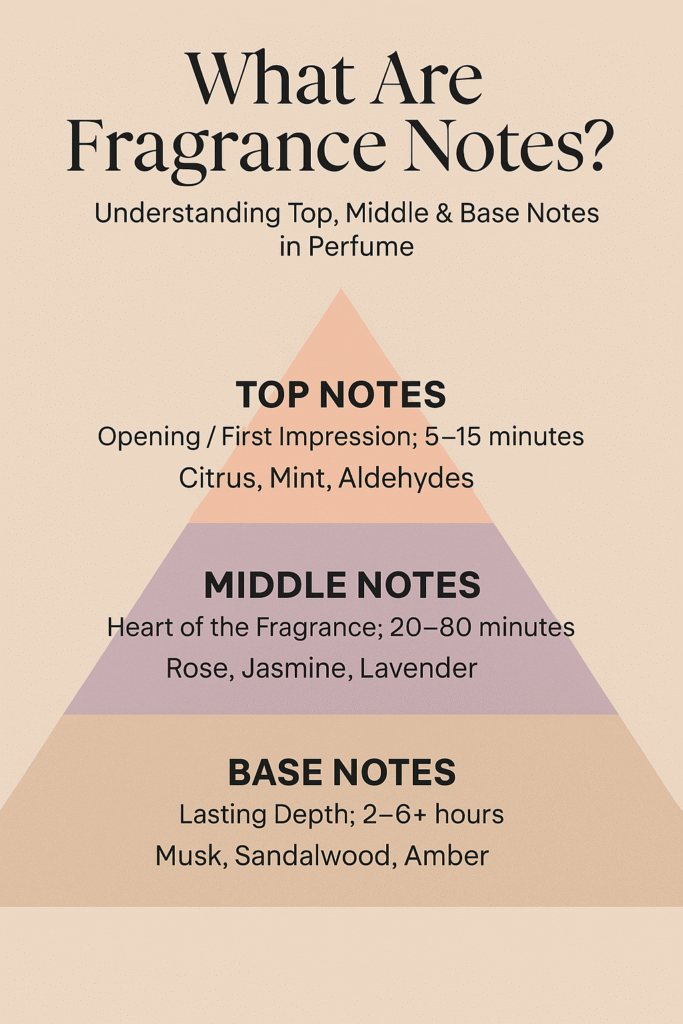
🧪 2. The Fragrance Pyramid Explained

En fragrance pyramid is the traditional way perfumers organize a perfume’s aromatic profile. Each layer of the pyramid corresponds to the evaporation rate y perception timeline of different aromatic compounds.


🔹 Top Notes: The First Impression

Top notes are the lightest and most volatile components in a fragrance. They’re the first scent you smell when applying a perfume—and often the first to fade.

  • Function: Grab attention; set the tone
  • Duration: 5–15 minutes
  • Common Ingredients:
    • Citrus oils (lemon, bergamot, grapefruit)
    • Green notes (mint, basil, eucalyptus)
    • Aldehydes (for sparkle and sharpness)

They are often bright, fresh, and uplifting, creating that “wow factor” in the opening.


🔸 Middle Notes: The Heart of the Fragrance

Also called heart notes, these emerge once the top notes evaporate. They represent the main body and theme of the fragrance.

  • Function: Carry the identity of the scent
  • Duration: 20–60 minutes
  • Common Ingredients:
    • Floral notes (rose, jasmine, ylang-ylang, lavender)
    • Fruity tones (peach, raspberry)
    • Spices (cinnamon, cardamom)

Heart notes are more complex and may soften the sharpness of top notes while bridging into deeper base notes.


🔻 Base Notes: The Long-Lasting Foundation

Base notes are heavy, slow-evaporating molecules that remain after the top and middle notes dissipate.

  • Function: Provide longevity and depth
  • Duration: Up to 6–8 hours
  • Common Ingredients:
    • Woods (cedarwood, sandalwood)
    • Resins (amber, benzoin)
    • Musks and animalic tones
    • Gourmand notes (vanilla, tonka bean)

These notes leave the “trail” o sillage that people remember. They also act as fixatives, anchoring lighter notes.


👃 3. The Role of Perfumers in Fragrance Composition

Fragrance design is a science-backed art form. Perfumers, often called “noses,” carefully balance top, middle, and base notes to achieve a fragrance that unfolds harmoniously over time.

They consider:

  • Note balance: ensuring top/middle/base ratio works for the product (perfume vs detergent vs shampoo)
  • Evaporation curve: how fast each note fades
  • Cohesion: ensuring notes complement, not compete
  • Estabilidad: ensuring fragrance doesn’t change over time or under heat/light

Some use a “chord” or “accord” approach—blending multiple notes to create a new, unified scent impression (e.g., leather accord, ocean accord).


🌿 4. Popular Fragrance Note Examples

Understanding notes is easier with real-world examples. Below are two classic structures.


Example 1: Citrus Aromatic Cologne

Bright, fresh, uplifting

  • Top: Lemon, bergamot, neroli
  • Heart: Petitgrain, rosemary, lavender
  • Base: Light musks, vetiver

Example 2: Oriental Amber Perfume

Warm, sensual, spicy

  • Top: Pink pepper, mandarin, saffron
  • Heart: Jasmine sambac, plum, rose
  • Base: Amber, vanilla, patchouli, oud

🏷 5. Fragrance Notes Across Product Categories

Fragrance notes aren’t just for fine perfumes. Different products emphasize different notes based on their function:

Product Category Focused Notes Reasoning
Perfume/EDP/EDT All three Complex scent evolution expected
Shampoo/Body Wash Top & Heart Fresh experience in short time use
Fabric Softener Base notes Long-lasting freshness on clothes
Air Freshener Top-heavy Quick burst of freshness needed
Candles Base + Heart Longer-lasting warmth and depth

🌍 6. Natural vs Synthetic Notes: A Modern Balance

Fragrance notes may come from:

Natural sources

  • Aceites esenciales
  • Absolutes (from flowers like jasmine)
  • Extracts (e.g., vanilla, coffee)

Synthetic aroma molecules

  • Created in labs to mimic or enhance natural scents
  • Used for performance, consistency, safety, cost
  • Examples: Iso E Super, Hedione, Cashmeran, Calone

Why use synthetics?

  • Natural resources may be unsustainable
  • Synthetics avoid allergens, reduce animal testing, and lower environmental impact
  • Many are Conformidad con IFRA and widely used by brands like Dior, Chanel, and FY

At FY, our in-house perfumers use both natural extracts and cutting-edge synthetic molecules to build versatile fragrance bases for cosmetics, detergents, and air care products.


🧑‍🔬 7. Choosing Fragrance Notes Based on Personality and Season

Fragrance is subjective, but here are general guidelines:

Season Recommended Notes
Summer Citrus, mint, marine, light florals
Winter Vanilla, amber, wood, gourmand
Spring Green, herbal, powdery florals
Autumn Spice, leather, patchouli, warm fruit

By personality:

Personality Type Fragrance Notes
Romantic Rose, vanilla, ylang-ylang
Adventurous Vetiver, citrus, herbs
Sophisticated Iris, musk, sandalwood
Playful Fruity, candy-like, aldehydes

Pro tip: Always test on your skin and let it settle for 20–30 minutes to experience the full evolution of notes.


🌱 8. How FY Uses Fragrance Notes in B2B Formulation

At FY, we formulate custom scents for:

  • Detergents & Fabric Softeners: encapsulated base notes for long-lasting freshness
  • Cuidado personal: top-heavy, skin-safe blends that match your brand DNA
  • Fragrance Beads: multi-phase release using top, heart, and base
  • Air Care: high-impact top notes with environmental stability
  • Perfume Bases: tailored pyramids built from regional scent preferences

We offer:

  • Scent pyramid design consulting
  • Natural/synthetic options based on market regulations (REACH, IFRA)
  • Smart encapsulation for time-release or temperature-activated delivery

📚 9. Conclusion: Notes Are the Language of Scent

Fragrance notes aren’t just ingredients — they’re building blocks of memory, mood, and identity.

Whether you’re choosing your next signature scent or developing a private-label fragrance, understanding top, middle, and base notes empowers you to design or select better.

At FY, we help brands around the world translate sensory vision into formulas that resonate — across cultures, climates, and categories.

🧴 Ready to build your own fragrance pyramid?
Contact FY for tailored fragrance solutions → [Insert Contact URL]


❓ SEO-Optimized FAQ: What Are Fragrance Notes?

Q1: What exactly are fragrance notes?

They are individual scent components (e.g., lemon, rose, sandalwood) categorized into top, middle, and base based on how quickly they evaporate and when they’re detected in a fragrance.


Q2: What’s the difference between top, heart, and base notes?

  • Top: Light, initial scents that fade fast
  • Heart: Core identity of the fragrance
  • Base: Long-lasting foundation with depth

Q3: Are all fragrance notes natural?

No. Many are synthetic aroma compounds, used for consistency, cost-effectiveness, and allergen avoidance. Most modern perfumes use a blend of natural and synthetic notes.


Q4: How long does each fragrance note last?

  • Top: 5–15 mins
  • Heart: 20–60 mins
  • Base: 2–6 hours or more

Q5: Can FY create a custom scent using specific notes?

Yes! FY’s perfumers work with clients to build custom scent pyramids, aligned with brand identity, target markets, and application needs.


Publicaciones Similares

  • ¿Cuál es la situación de las inversiones en la industria de las fragancias?

    What is the outlook for the fragrance market? The flavor industry belongs to one of the fine chemical industry sub-industries, at present, Europe, the United States, and Japan have become the world’s most advanced flavor and fragrance industry centers. After more than 100 years of development, the international has formed a leading flavor product to…

  • dominar el arte de solubilizar fragancias en el champú: una guía completa

    The Scent of Success: How Fragrance Fuels Detergent Companies’ Triumph Fragrance is more than just a pleasant smell; it’s a powerful tool that can shape consumer preferences, build brand identities, and ultimately drive sales. In the competitive world of laundry detergents, the right scent can elevate a product from ordinary to unforgettable. This article explores…

  • Exploring the World of Aroma Chemicals

    Exploring the World of Aroma Chemicals Aroma chemicals are everywhere, yet often go unnoticed. They are the unsung heroes behind the scents and flavors we love. These compounds are crucial in creating fragrances and flavors in countless products. From perfumes to food, they play a vital role. Aroma chemicals can be natural or synthetic. Synthetic versions are more common due to their consistency and cost-effectiveness. The fragrance industry relies heavily on these chemicals. They ensure that scents are long-lasting and consistent across products. Flavoring agents, another type of aroma chemical, enhance the taste of food and beverages. They make our favorite treats even more enjoyable. The history of aroma chemicals is rich and fascinating. Ancient civilizations used natural extracts for scenting, laying the groundwork for modern perfumery. Today, the balance between natural and synthetic ingredients is key. This balance creates unique fragrance profiles that captivate our senses. As we explore the world of aroma chemicals, we uncover their impact on our daily lives. They shape our experiences and evoke emotions, making them indispensable.   What Are Aroma Chemicals? Aroma chemicals are specialized compounds used in creating scents and flavors. They are the building blocks of fragrance and flavor industries, essential in many products. These compounds can be derived from both natural and synthetic sources. Natural aroma compounds are extracted from plants or animal products, while synthetic ones are manufactured in labs. Synthetic aroma chemicals offer several advantages. They provide consistency, purity, and often a more cost-effective solution than their natural counterparts. Aroma chemicals are utilized in various applications. This includes perfumes, cosmetics, food products, and even cleaning supplies. They are selected based on their ability to enhance the user experience. Common uses of aroma chemicals include: Perfumes: creating distinctive and lasting scents. Food and beverages: enhancing flavors. Household products: masking odors. Cosmetics: adding pleasant fragrances. The science behind aroma chemicals is complex, involving intricate molecule interactions. This fascinating chemistry allows them to mimic natural scents effectively. A key aspect of their success lies in their ability to evoke emotions and trigger memories. This emotional connection is why aroma chemicals are so effective in marketing.   The History and Evolution of Aroma Chemicals The use of aroma chemicals can be traced back to ancient civilizations. Early societies used natural extracts for incense and personal scenting. During the Renaissance, advances in distillation improved the extraction of aromatic compounds. This period saw the rise of perfumery in Europe, laying the groundwork for modern developments. The 19th century marked a significant shift. Synthetic production techniques expanded the palette of available scents. This innovation revolutionized the industry, leading to mass-market fragrances. In the 20th century, chemistry and technology advanced further. New methods allowed for complex fragrance compositions, combining both natural and synthetic ingredients. Key milestones in aroma chemicals’ evolution include: Ancient times: Use of natural extracts. Renaissance: Improved distillation techniques. 19th century: Introduction of synthetic aroma compounds. 20th century: Complex fragrance formulations. The evolution of aroma chemicals reflects broader trends in science and technology. It has continually adapted to consumer preferences and industry demands. Today, the focus is on sustainability and innovation. Efforts are underway to create eco-friendly processes and new, sustainable aroma compounds. by Emile Mbunzama (https://unsplash.com/@emilembunzama) Natural vs. Synthetic Aroma Chemicals Aroma chemicals can be either natural or synthetic. Each type offers unique attributes and advantages in fragrance and flavor production. Natural aroma compounds are derived from plant and animal sources. Essential oils and extracts provide natural scent profiles. These compounds are often favored for their purity and aromatic qualities. Synthetic aroma chemicals, however, are created in laboratories. They replicate both familiar and novel scents. This method allows for cost-effective production and greater scent variety. Choosing between natural and synthetic aromas involves several considerations. Factors include cost, availability, scent longevity, and consumer preferences. Many products today blend both types for optimal results. Key differences between natural and synthetic aroma chemicals include: Natural: Sourced from plants and animals. Synthetic: Lab-created, often more consistent and durable. Scent Profile: Natural for purity, synthetic for variety. Cost: Natural can be pricier; synthetic is more economical. Availability: Natural sources can be limited. The balance between these two forms of aroma chemicals is crucial. It influences fragrance formulation and appeals to diverse consumer needs. Ultimately, the choice depends on the desired product attributes and market trends. Both natural and synthetic types continue to play vital roles in the industry. by Ela De Pure (https://unsplash.com/@eladepure) Key Types of Fragrance Compounds and Flavoring Agents Fragrance compounds are essential elements in perfumery and flavoring. They provide unique scent and taste profiles, enhancing product appeal. Esters are a common type of fragrance compound. They offer fruity and floral scents. Widely used in perfumes, they provide fresh, sweet aromas. Aldehydes are another vital group. They contribute to fresh and citrusy scents. Found in many household and personal care products, they bring a lively aroma. Ketones are notable for their versatility. They range from sweet to woody scents. Ketones add depth and complexity to many fragrances and flavors….

  • ¿Es segura la fragancia en los cosméticos? Datos, ciencia y normativa

    🧴 Is Fragrance in Cosmetics Safe? Breaking Down the Facts Fragrance is found in nearly every cosmetic product—from lotions to lipsticks to serums. It enhances the sensory experience and contributes to brand identity. But increasingly, consumers are asking: Is fragrance in cosmetics actually safe? Let’s explore what “fragrance” really means on product labels, what the…

  • Dominar la reacción de caramelización: Una guía completa del pardeamiento

    Caramelization is more than just a culinary process; it’s a transformation that elevates flavors, tantalizes taste buds, and adds depth to dishes. In this definitive guide, we delve into the science behind the caramelization reaction, exploring its intricacies, applications, and culinary implications. Whether you’re a seasoned chef or an amateur enthusiast, join us on a…

  • ¿Qué papel desempeñan los saboristas en la producción alimentaria?

      🧪 What Role Do Flavorists Play in Food Production? Powered by FY Flavor & Fragrance Manufacturing In today’s competitive food industry, flavor can be the defining factor between a product that fails and one that becomes a household favorite. Behind the scenes, flavorists—also known as food flavor chemists—play a critical role in the creation,…

Deja un comentario