best-fragrances-for-detergents

Las mejores fragancias para detergentes: Cómo elegir el aroma adecuado


🧺 Las mejores fragancias para detergentes: Cómo elegir el aroma adecuado

When consumers buy laundry detergents, one factor consistently ranks among the top: fragrance. The right scent doesn’t just clean clothes—it enhances brand loyalty, evokes emotional comfort, and even shapes perceptions of cleanliness.

But with so many scent options, how do formulators, brands, and manufacturers choose the ideal fragrance? Let’s explore the most popular fragrance types for detergents, how to choose the right one for your product, and key industry trends in 2025.best-fragrances-for-detergents

🌿 Why Fragrance Matters in Detergents

Fragrance is more than just a pleasant aroma. It plays a critical role in:

  • Consumer experience: Clean-smelling clothes signal freshness and hygiene.
  • Brand identity: Signature scents help build recognition and differentiation.
  • Emotional impact: Certain aromas trigger comfort, energy, or even nostalgia.

💡 According to Nielsen, more than 65% of detergent buyers say fragrance is a primary reason for brand selection.


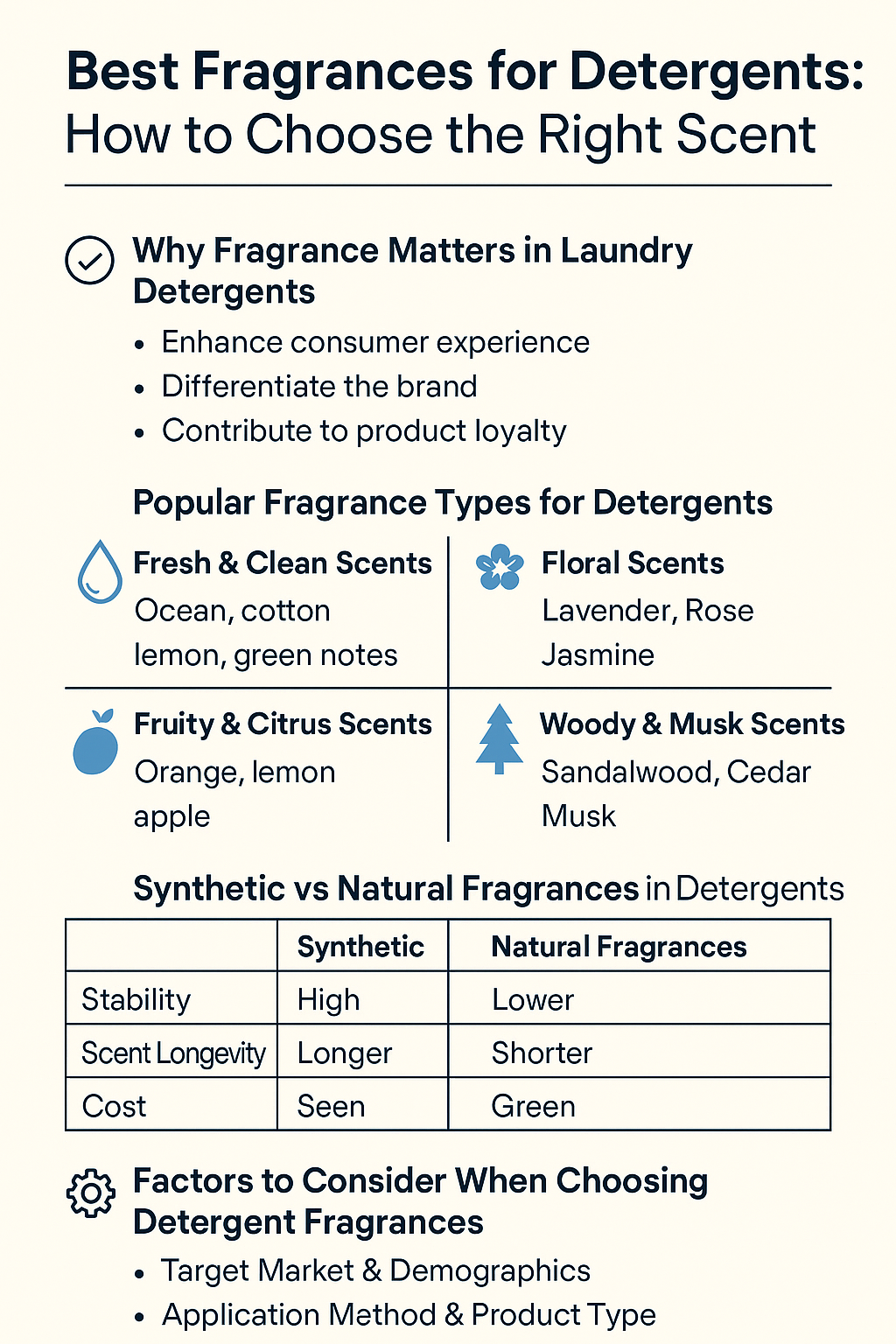
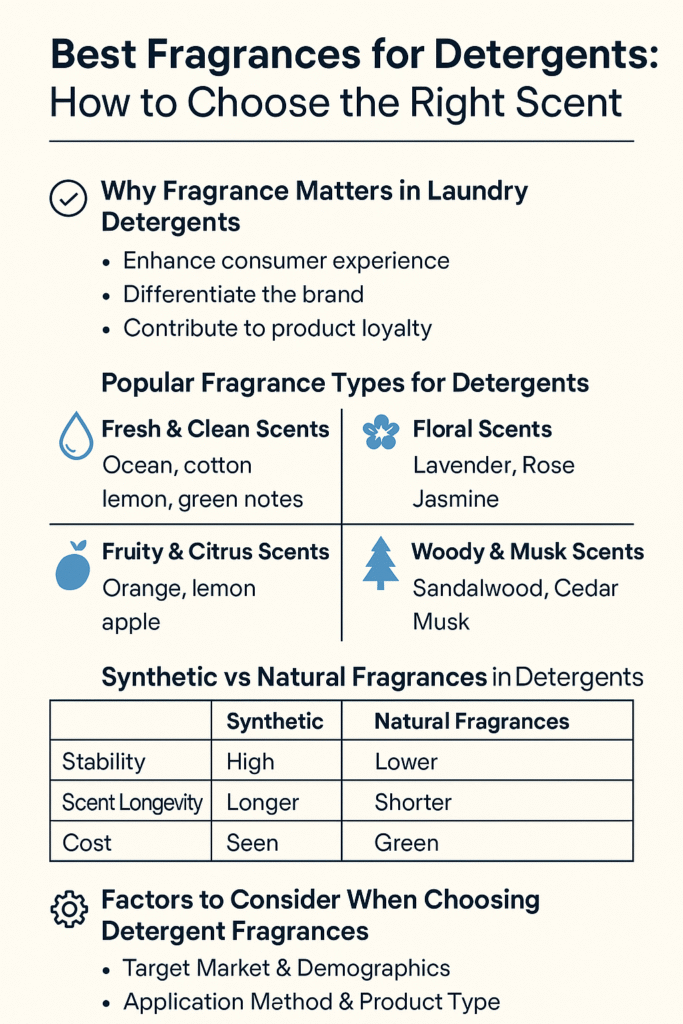
🌸 Popular Fragrance Types for Detergents

The most effective detergent fragrances are clean, fresh, long-lasting, and widely accepted. Here are the top categories:

🧼 Fresh & Clean Scents

These include linen, ocean breeze, powdery cotton, rain, and citrus. They offer a universally accepted, “clean” olfactory signature—ideal for mass-market products.

🌼 Floral Scents

Lavender, jasmine, rose, lily, and peony bring softness and sophistication. They’re popular for feminine-focused products or fabric softeners.

🍋 Fruity & Citrus Scents

Think orange zest, lemon, apple, grapefruit. These fragrances feel energizing and are common in youth- or family-oriented detergents.

🌲 Woody & Musk Scents

Sandalwood, cedarwood, white musk, and amber create a warm, comforting scent. Often used in “premium,” “for men,” or winter-themed products.


🧪 Synthetic vs Natural Fragrances: What’s Better for Detergents?

Atributo Fragancias sintéticas Fragancias naturales
Fuente Chemically synthesized Derived from plants or animals
Estabilidad Highly stable under heat, pH, wash May degrade or oxidize
Longevity Superior lasting power More subtle, less persistent
Coste Lower and more scalable Higher and resource-dependent
Regulatory Must meet IFRA compliance May still trigger allergens
Market Appeal “Safe & functional” image “Green & clean-label” image

Conclusión: Most detergent brands use synthetic or hybrid fragrances to ensure stability, cost-efficiency, and fragrance longevity.


🛠️ Factors to Consider When Choosing Detergent Fragrances

1. Target Audience

  • Young families prefer fruity or citrus.
  • Older demographics prefer floral or musk.
  • Eco-conscious users may demand natural or allergen-free formulations.

2. Product Type

  • Powder detergents may need stronger scents to withstand heat.
  • Liquid detergents support a wider fragrance profile.
  • Laundry capsules or pods often use microencapsulation to enhance longevity.

3. Performance Requirements

  • Fragrance must survive washing and drying cycles.
  • Must not interfere with surfactants or enzymes.
  • Encapsulation technologies can prolong release.

4. Regulatory & Allergen Concerns

  • Must comply with IFRA guidelines and local regulations.
  • Common fragrance allergens like limonene y linalool must be declared when above threshold.

📈 Trending Detergent Fragrances for 2025

Modern consumers want multi-sensory experiences, not just “clean”:

  • Yuzu & Green Tea – a clean, exotic citrus profile
  • White Tea & Bamboo – minimalist, spa-inspired freshness
  • Cotton Flower & Amber – soft, nostalgic, powdery-clean
  • Water Lily & Sea Minerals – aquatic, airy, and gender-neutral
  • Apple Blossom & Vanilla – comforting and family-friendly

These fragrances are often described as “clean,” “safe,” “natural-inspired,” y “long-lasting.”


🧪 How to Test Fragrances in Detergents

  1. pH and Temperature Stability Testing
    • Test how the scent performs in actual detergent formulas.
  2. Consumer Panel Evaluation
    • Blind test multiple variants for likability, intensity, and “freshness.”
  3. After-wash Longevity Trial
    • Wash and dry textiles, then evaluate lingering scent at intervals (1h, 6h, 24h).
  4. Allergen & Sensitivity Screening
    • Run patch tests or in-vitro assays to check for irritation potential.

🌍 Sustainability & Clean-Label Demands

As the clean beauty and green home movement grows, detergent fragrances face scrutiny. Here’s what’s trending:

  • Biodegradable fragrance bases
  • Vegan-certified or cruelty-free claims
  • Fragrance-free or sensitive-skin options
  • Microencapsulated essential oils

Brands like Seventh Generation, Method, and Persil are offering transparent fragrance sourcing and disclosure to build consumer trust.


✅ Conclusion: The Right Fragrance Can Define Your Brand

A detergent’s scent is more than an accessory—it’s a strategic decision. Whether you’re formulating for budget-conscious users or premium eco shoppers, the fragrance you choose should align with your performance, perception, and positioning.

Choose wisely, test carefully, and let the right scent do more than clean—it should delight, retain, and differentiate.




Publicaciones Similares

  • Guía completa de notas de perfume y sus funciones: Una inmersión profunda en los cítricos, florales, amaderados y más

    🌸 Perfume Notes and Their Classification: A Comprehensive Guide to Fragrance Families Perfume is an intricate art of blending various aromatic ingredients to create a sensory experience. The key to a great fragrance lies in understanding its notes. A note refers to the different layers of scent that emerge over time as the perfume settles…

  • Top 10 Fragrance Trends Shaping 2025 | FY Flavors & Fragrances

    Top 10 Fragrance Trends Shaping 2025 How culture, science & sustainability are rewriting the scent rule‑book — and what it means for FY’s next creations. 1. Neo Gourmand 2.0 – Dessert Gets Sophisticated Classic cupcake sweetness is out; think roasted hazelnut praline laced with saffron or salty caramel spiked with black sesame. Search interest for “gourmand perfume” is…

  • Exploring the World of Aroma Chemicals

    Exploring the World of Aroma Chemicals Aroma chemicals are everywhere, yet often go unnoticed. They are the unsung heroes behind the scents and flavors we love. These compounds are crucial in creating fragrances and flavors in countless products. From perfumes to food, they play a vital role. Aroma chemicals can be natural or synthetic. Synthetic versions are more common due to their consistency and cost-effectiveness. The fragrance industry relies heavily on these chemicals. They ensure that scents are long-lasting and consistent across products. Flavoring agents, another type of aroma chemical, enhance the taste of food and beverages. They make our favorite treats even more enjoyable. The history of aroma chemicals is rich and fascinating. Ancient civilizations used natural extracts for scenting, laying the groundwork for modern perfumery. Today, the balance between natural and synthetic ingredients is key. This balance creates unique fragrance profiles that captivate our senses. As we explore the world of aroma chemicals, we uncover their impact on our daily lives. They shape our experiences and evoke emotions, making them indispensable.   What Are Aroma Chemicals? Aroma chemicals are specialized compounds used in creating scents and flavors. They are the building blocks of fragrance and flavor industries, essential in many products. These compounds can be derived from both natural and synthetic sources. Natural aroma compounds are extracted from plants or animal products, while synthetic ones are manufactured in labs. Synthetic aroma chemicals offer several advantages. They provide consistency, purity, and often a more cost-effective solution than their natural counterparts. Aroma chemicals are utilized in various applications. This includes perfumes, cosmetics, food products, and even cleaning supplies. They are selected based on their ability to enhance the user experience. Common uses of aroma chemicals include: Perfumes: creating distinctive and lasting scents. Food and beverages: enhancing flavors. Household products: masking odors. Cosmetics: adding pleasant fragrances. The science behind aroma chemicals is complex, involving intricate molecule interactions. This fascinating chemistry allows them to mimic natural scents effectively. A key aspect of their success lies in their ability to evoke emotions and trigger memories. This emotional connection is why aroma chemicals are so effective in marketing.   The History and Evolution of Aroma Chemicals The use of aroma chemicals can be traced back to ancient civilizations. Early societies used natural extracts for incense and personal scenting. During the Renaissance, advances in distillation improved the extraction of aromatic compounds. This period saw the rise of perfumery in Europe, laying the groundwork for modern developments. The 19th century marked a significant shift. Synthetic production techniques expanded the palette of available scents. This innovation revolutionized the industry, leading to mass-market fragrances. In the 20th century, chemistry and technology advanced further. New methods allowed for complex fragrance compositions, combining both natural and synthetic ingredients. Key milestones in aroma chemicals’ evolution include: Ancient times: Use of natural extracts. Renaissance: Improved distillation techniques. 19th century: Introduction of synthetic aroma compounds. 20th century: Complex fragrance formulations. The evolution of aroma chemicals reflects broader trends in science and technology. It has continually adapted to consumer preferences and industry demands. Today, the focus is on sustainability and innovation. Efforts are underway to create eco-friendly processes and new, sustainable aroma compounds. by Emile Mbunzama (https://unsplash.com/@emilembunzama) Natural vs. Synthetic Aroma Chemicals Aroma chemicals can be either natural or synthetic. Each type offers unique attributes and advantages in fragrance and flavor production. Natural aroma compounds are derived from plant and animal sources. Essential oils and extracts provide natural scent profiles. These compounds are often favored for their purity and aromatic qualities. Synthetic aroma chemicals, however, are created in laboratories. They replicate both familiar and novel scents. This method allows for cost-effective production and greater scent variety. Choosing between natural and synthetic aromas involves several considerations. Factors include cost, availability, scent longevity, and consumer preferences. Many products today blend both types for optimal results. Key differences between natural and synthetic aroma chemicals include: Natural: Sourced from plants and animals. Synthetic: Lab-created, often more consistent and durable. Scent Profile: Natural for purity, synthetic for variety. Cost: Natural can be pricier; synthetic is more economical. Availability: Natural sources can be limited. The balance between these two forms of aroma chemicals is crucial. It influences fragrance formulation and appeals to diverse consumer needs. Ultimately, the choice depends on the desired product attributes and market trends. Both natural and synthetic types continue to play vital roles in the industry. by Ela De Pure (https://unsplash.com/@eladepure) Key Types of Fragrance Compounds and Flavoring Agents Fragrance compounds are essential elements in perfumery and flavoring. They provide unique scent and taste profiles, enhancing product appeal. Esters are a common type of fragrance compound. They offer fruity and floral scents. Widely used in perfumes, they provide fresh, sweet aromas. Aldehydes are another vital group. They contribute to fresh and citrusy scents. Found in many household and personal care products, they bring a lively aroma. Ketones are notable for their versatility. They range from sweet to woody scents. Ketones add depth and complexity to many fragrances and flavors….

  • The Role of Aroma Chemicals in Household Products Manufacturing

    The Role of Aroma Chemicals in Household Products Manufacturing Introduction — scent is product experience Scent is more than decoration. In household products—laundry detergents, fabric softeners, surface cleaners, air fresheners and dishwashing liquids—fragrance is a powerful driver of perceived cleanliness, emotional response and repeat purchase. Aroma chemicals are the molecular ingredients that create those scent…

  • El aroma del éxito: Cómo la fragancia impulsa el triunfo de las empresas de detergentes

    The Scent of Success: How Fragrance Fuels Detergent Companies’ Triumph   Fragrance is more than just a pleasant smell; it’s a powerful tool that can shape consumer preferences, build brand identities, and ultimately drive sales. In the competitive world of laundry detergents, the right scent can elevate a product from ordinary to unforgettable. This article…

  • How Aroma Chemicals Shape Consumer Perception of Scents

    How Aroma Chemicals Shape Consumer Perception of Scents Science, strategy and practical guidance for product, marketing and R&D teams Introduction — why scent matters for brands Scent is a powerful and often under-appreciated dimension of product experience. A well-designed fragrance can lift a routine task (washing dishes, doing laundry) into a small moment of pleasure,…

Deja un comentario