¿Qué significa aroma? Definición, orígenes y ejemplos cotidianos

🌿 What Does Aroma Mean? Definition, Origins, and Everyday Examples

Aroma is more than just a pleasant smell—it’s a powerful sensory experience that connects memory, mood, taste, and perception. From the scent of freshly brewed coffee to the fragrance of spring flowers, aromas play a critical role in how we perceive the world around us.

In this article, we’ll explore the definition of aroma, how it works, and how it’s used in food, fragrance, and everyday life.What Does Aroma Mean
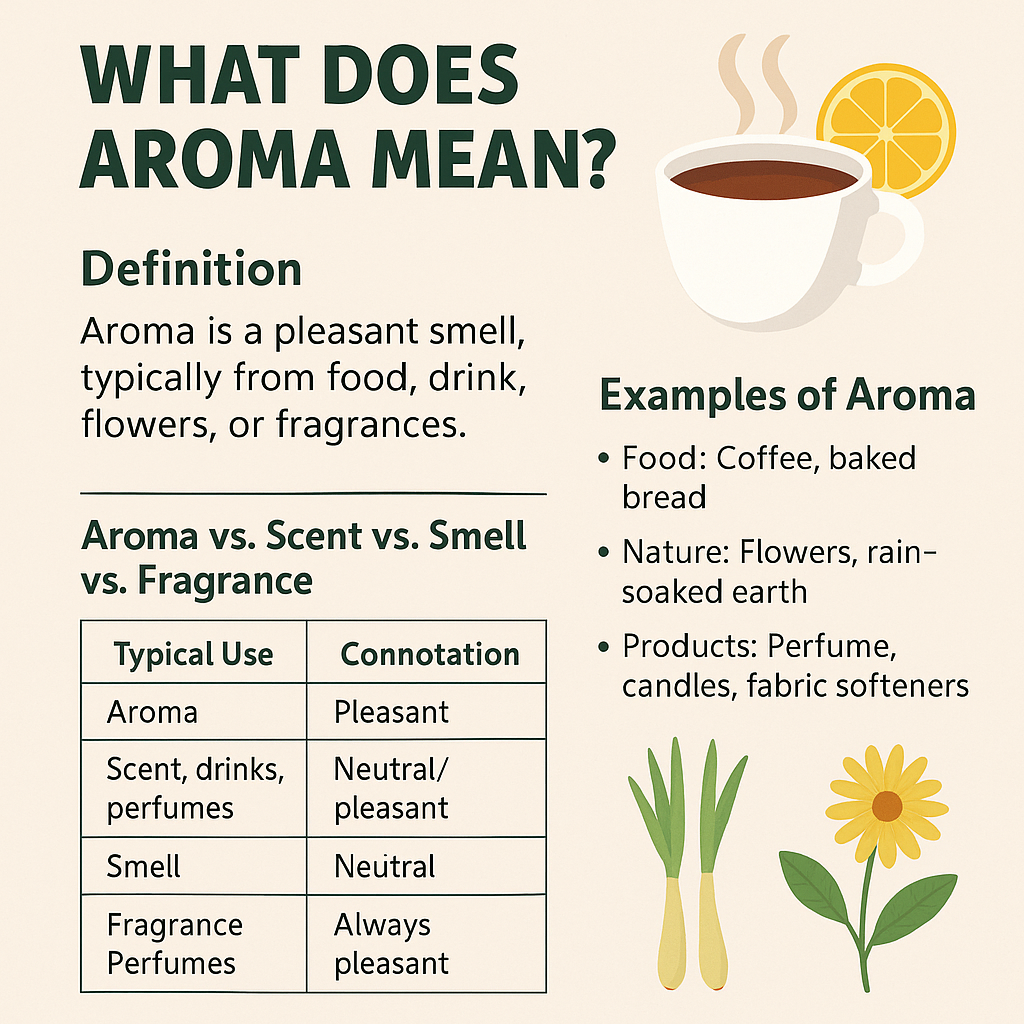

📖 What Is the Definition of Aroma?

Aroma refers to a smell or odor, especially one that is pleasant. While commonly associated with food and beverages, aroma can describe any fragrant or distinctive scent in the air.

Simple definition:
Aroma is a pleasant smell, typically from food, drink, flowers, or fragrances.

Although “aroma” and “smell” are often used interchangeably, aroma generally carries a positive or desirable connotation—whereas “odor” may imply something unpleasant.


🧬 The Origin and Etymology of “Aroma”

The word “aroma” comes from Latin “arōma”, which itself was borrowed from Greek “ἄρωμα” (arōma), meaning spice or fragrant herb. Originally, the term referred to fragrant spices used in medicine or rituals, gradually evolving into the modern usage of pleasant smells.

  • First English use: Late 14th century
  • Evolved meaning: From “fragrant spices” → “pleasant smells” → broader applications in food and fragrance

👃 Aroma vs. Scent vs. Smell vs. Fragrance

Plazo Typical Use Connotation
Aroma Food, drinks, perfumes Pleasant
Scent Animals, perfumes, flowers Neutral/pleasant
Smell General descriptor for olfactory stimuli Neutral
Fragrance Perfumes, cosmetics, personal care products Always pleasant

✅ “Aroma” is most often used in culinary, beveragey sensory evaluation contexts.


🔬 How Does Aroma Work? The Science of Smelling

Our perception of aroma begins when volatile compounds—tiny airborne molecules—enter the nose and stimulate the olfactory receptors. These signals are then transmitted to the brain’s olfactory bulb, where they’re processed and linked to memories and emotions.

🔄 Aroma & Taste Are Connected

What we perceive as “flavor” is actually a combination of:

  • Taste (sweet, salty, sour, bitter, umami)
  • Aroma (via retro-nasal olfaction)
  • Texture and temperature

That’s why food tastes bland when you have a blocked nose—you’ve lost the aroma perception.


🍒 Examples of Aroma in Everyday Life

  • Food: The warm aroma of baked bread, grilled meat, or cherry ice cream
  • Drinks: Coffee, wine, herbal teas, and citrus-based sodas
  • Nature: Flowers, fresh-cut grass, rain-soaked earth (petrichor)
  • Home Products: Fabric softeners, candles, incense, air fresheners

🧪 Aroma in Industry and Professional Use

Food & Beverage:

Flavorists design aroma profiles for ice cream, beverages, baked goods, and snacks. For example, FY Flavor & Fragrance develops high-purity, heat-stable cherry and citrus aromas for global food brands.

Fragrance Industry:

Aroma compounds are the building blocks of perfumes, room sprays, and personal care products.

Coffee & Wine:

Tasting professionals use aroma wheels to classify and describe subtle scent notes like “dark cherry,” “earthy,” or “floral.”


⚠️ Common Misunderstandings About Aroma

  • Is aroma always pleasant?
    Not necessarily. While “aroma” usually implies something pleasant, it can be subjective. Some people may dislike strong cheese or herbal aromas, even if others enjoy them.
  • Is aroma only related to food?
    No. Aroma applies to perfumes, plants, essential oils, cleaning products, and more.
  • Is aroma natural or synthetic?
    Both. Aromas can be derived naturally (from essential oils or fruit extractions) or created synthetically in labs for consistency, cost, and safety.

💬 FAQ: What People Ask About Aroma

Q1: Is aroma the same as smell?

No. “Smell” is a general term, while “aroma” usually refers to a pleasant scent, especially in food or beverages.

Q2: What are aroma compounds?

They are volatile molecules responsible for the scent of a substance. In flavor chemistry, they determine how we perceive flavor through the nose.

Q3: How is aroma used in food manufacturing?

Aroma compounds are added to enhance or simulate natural food smells—especially in flavored ice cream, snacks, and beverages. FY Flavor & Fragrance offers both synthetic and natural aroma solutions for global applications.

Q4: Why is aroma important?

Aroma influences flavor perception, appetite, mood, and even memory. It plays a major role in how we experience food, fragrance, and our environment.

Q5: Can aroma be unpleasant?

Technically, yes—but we typically use other words like “odor” or “stench” for unpleasant smells.


🧭 Summary: Why Aroma Matters

Aroma is more than just a pleasant smell—it’s a vital part of how we experience food, emotion, and memory. Whether you’re enjoying the scent of your morning coffee, evaluating cherry notes in ice cream, or choosing a fabric softener with a citrus burst, aroma enhances the way we engage with the world.

If you’re in the food, fragrance, or product development industry, understanding and using aroma effectively can elevate your product appeal, strengthen your brand identity, and influence consumer satisfaction.


Similar Posts

  • Synthetic vs. Natural Aroma Chemicals: Key Differences, Benefits & How to Choose

    Synthetic vs. Natural Aroma Chemicals: Key Differences, Benefits & How to Choose When formulating fragrances and flavors for perfumes, personal care, home care, or food & beverage products, one of the first strategic choices a brand or formulator must make is: use natural aroma chemicals, synthetic ones, or a blend of both? Each path has…

  • The Art and Science of Perfume Formulation: How Fragrances Are Created

    🧪 The Art and Science of Perfume Formulation: How Fragrances Are Created Perfume creation is an intriguing blend of artistry and scientific precision, bringing sensory joy and emotional resonance to everyday life. At its core, perfume formulation involves the skilled combination of aromatic materials that evoke feelings, memories, and individual expression. Understanding how fragrances are…

  • The Versatility and Application of Orange Flavoring Across Industries

    The Versatility and Application of Orange Flavoring Across Industries 1. Introduction Orange flavoring has become a cornerstone in food, beverage, and wellness formulations due to its vibrant, sweet-tangy citrus profile. From classic sodas to gourmet desserts and modern CBD tinctures, orange flavoring delivers a refreshing taste that resonates globally. As both natural and synthetic flavor…

  • Sabor a azúcar moreno en polvo: Cómo dar profundidad a los dulces en el Sudeste Asiático, con especial atención a Filipinas

    Sweetness with Substance Our Brown Sugar Powder Flavour artfully recreates the complex, caramelized taste of traditional brown sugar, providing food manufacturers with an innovative solution to infuse their creations with depth and warmth. Application in Food Manufacturing Transforming Taste Profiles Our Brown Sugar Powder Flavour is meticulously formulated to seamlessly blend into various formulations. It’s…

  • Understanding Flavor Perception: The Science Behind Taste

    🧪 Understanding Flavor Perception: The Science Behind Taste Flavor is one of the most important drivers of our food choices. It’s the reason we crave a specific dessert, prefer one brand of coffee over another, or instantly recall a childhood memory from a single bite. But what we casually call “taste” is far more complex…

  • Exploring the World of Aroma Chemicals

    Exploring the World of Aroma Chemicals Aroma chemicals are everywhere, yet often go unnoticed. They are the unsung heroes behind the scents and flavors we love. These compounds are crucial in creating fragrances and flavors in countless products. From perfumes to food, they play a vital role. Aroma chemicals can be natural or synthetic. Synthetic versions are more common due to their consistency and cost-effectiveness. The fragrance industry relies heavily on these chemicals. They ensure that scents are long-lasting and consistent across products. Flavoring agents, another type of aroma chemical, enhance the taste of food and beverages. They make our favorite treats even more enjoyable. The history of aroma chemicals is rich and fascinating. Ancient civilizations used natural extracts for scenting, laying the groundwork for modern perfumery. Today, the balance between natural and synthetic ingredients is key. This balance creates unique fragrance profiles that captivate our senses. As we explore the world of aroma chemicals, we uncover their impact on our daily lives. They shape our experiences and evoke emotions, making them indispensable.   What Are Aroma Chemicals? Aroma chemicals are specialized compounds used in creating scents and flavors. They are the building blocks of fragrance and flavor industries, essential in many products. These compounds can be derived from both natural and synthetic sources. Natural aroma compounds are extracted from plants or animal products, while synthetic ones are manufactured in labs. Synthetic aroma chemicals offer several advantages. They provide consistency, purity, and often a more cost-effective solution than their natural counterparts. Aroma chemicals are utilized in various applications. This includes perfumes, cosmetics, food products, and even cleaning supplies. They are selected based on their ability to enhance the user experience. Common uses of aroma chemicals include: Perfumes: creating distinctive and lasting scents. Food and beverages: enhancing flavors. Household products: masking odors. Cosmetics: adding pleasant fragrances. The science behind aroma chemicals is complex, involving intricate molecule interactions. This fascinating chemistry allows them to mimic natural scents effectively. A key aspect of their success lies in their ability to evoke emotions and trigger memories. This emotional connection is why aroma chemicals are so effective in marketing.   The History and Evolution of Aroma Chemicals The use of aroma chemicals can be traced back to ancient civilizations. Early societies used natural extracts for incense and personal scenting. During the Renaissance, advances in distillation improved the extraction of aromatic compounds. This period saw the rise of perfumery in Europe, laying the groundwork for modern developments. The 19th century marked a significant shift. Synthetic production techniques expanded the palette of available scents. This innovation revolutionized the industry, leading to mass-market fragrances. In the 20th century, chemistry and technology advanced further. New methods allowed for complex fragrance compositions, combining both natural and synthetic ingredients. Key milestones in aroma chemicals’ evolution include: Ancient times: Use of natural extracts. Renaissance: Improved distillation techniques. 19th century: Introduction of synthetic aroma compounds. 20th century: Complex fragrance formulations. The evolution of aroma chemicals reflects broader trends in science and technology. It has continually adapted to consumer preferences and industry demands. Today, the focus is on sustainability and innovation. Efforts are underway to create eco-friendly processes and new, sustainable aroma compounds. by Emile Mbunzama (https://unsplash.com/@emilembunzama) Natural vs. Synthetic Aroma Chemicals Aroma chemicals can be either natural or synthetic. Each type offers unique attributes and advantages in fragrance and flavor production. Natural aroma compounds are derived from plant and animal sources. Essential oils and extracts provide natural scent profiles. These compounds are often favored for their purity and aromatic qualities. Synthetic aroma chemicals, however, are created in laboratories. They replicate both familiar and novel scents. This method allows for cost-effective production and greater scent variety. Choosing between natural and synthetic aromas involves several considerations. Factors include cost, availability, scent longevity, and consumer preferences. Many products today blend both types for optimal results. Key differences between natural and synthetic aroma chemicals include: Natural: Sourced from plants and animals. Synthetic: Lab-created, often more consistent and durable. Scent Profile: Natural for purity, synthetic for variety. Cost: Natural can be pricier; synthetic is more economical. Availability: Natural sources can be limited. The balance between these two forms of aroma chemicals is crucial. It influences fragrance formulation and appeals to diverse consumer needs. Ultimately, the choice depends on the desired product attributes and market trends. Both natural and synthetic types continue to play vital roles in the industry. by Ela De Pure (https://unsplash.com/@eladepure) Key Types of Fragrance Compounds and Flavoring Agents Fragrance compounds are essential elements in perfumery and flavoring. They provide unique scent and taste profiles, enhancing product appeal. Esters are a common type of fragrance compound. They offer fruity and floral scents. Widely used in perfumes, they provide fresh, sweet aromas. Aldehydes are another vital group. They contribute to fresh and citrusy scents. Found in many household and personal care products, they bring a lively aroma. Ketones are notable for their versatility. They range from sweet to woody scents. Ketones add depth and complexity to many fragrances and flavors….

Deja un comentario