How Aroma Chemicals Shape Consumer Perception of Scents
How Aroma Chemicals Shape Consumer Perception of Scents
Science, strategy and practical guidance for product, marketing and R&D teams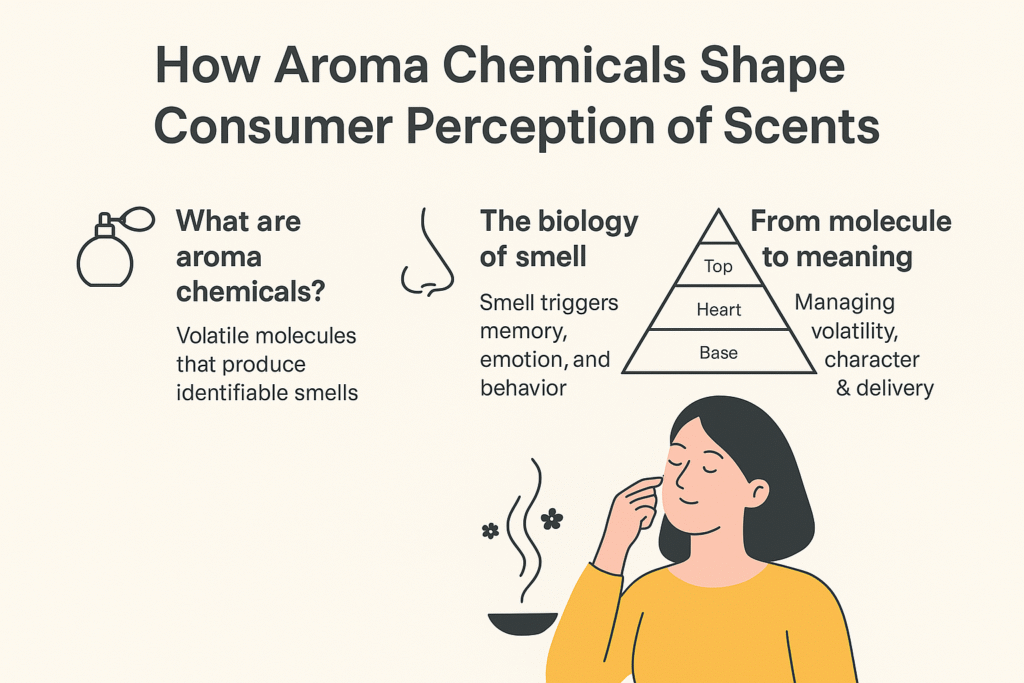
Introduction — why scent matters for brands
Scent is a powerful and often under-appreciated dimension of product experience. A well-designed fragrance can lift a routine task (washing dishes, doing laundry) into a small moment of pleasure, trigger memories that increase brand loyalty, and even influence shopping behavior. The molecules that create those effects are aroma chemicals—volatile compounds perfumers and flavorists assemble into accords.
This article explains how aroma chemicals interact with human biology and psychology to shape perception, then translates that knowledge into actionable guidance for product teams: how to design fragrances that fit context, meet regulatory requirements and deliver measurable business outcomes.
1. What are aroma chemicals?
An aroma chemical is a volatile organic compound that produces an identifiable smell when it reaches olfactory receptors in the nose. Aroma chemicals fall into three practical categories:
- Natural — extracted from plants, flowers, fruits or resins (essential oils, absolutes).
- Nature-identical — synthetically produced molecules that are chemically identical to natural compounds (e.g., synthetic vanillin).
- Novel synthetics — engineered compounds not found in nature, designed for specific olfactive properties (e.g., Iso E Super).
Perfumers blend dozens to hundreds of aroma chemicals to create a product’s olfactive signature. Each molecule contributes distinct qualities—freshness, floralcy, warmth, or persistence—depending on its chemistry and volatility.
2. The biology of smell — why scent hits emotion fast
Olfaction is neurologically unique. Odorant molecules bind to receptor proteins on olfactory sensory neurons; those neurons send signals directly to the olfactory bulb and from there to limbic structures such as the amygdala and hippocampus—brain centers tightly linked to emotion and memory. This direct pathway helps explain why scents often evoke vivid, emotionally charged memories (the “Proust effect”). Scientific work on olfactory receptors (Buck & Axel) and subsequent neuroscience confirms the tight coupling between smell, memory and emotion.
A landmark psychophysical study also showed that humans can discriminate an enormous number of distinct odor mixtures—on the order of trillions—highlighting how subtle chemical differences can produce distinct perceptual outcomes.
Implications for brands: because scent links directly to emotion and memory, the right aroma chemicals can create strong associative bonds when used consistently across product touchpoints (product, packaging, retail environment).
3. From molecule to meaning — three technical levers
When designing for perception, formulators manipulate three main variables:
3.1 Volatility profile (top / heart / base notes)
- Top notes (high volatility) form the immediate impression. Examples: citral, limonene.
- Heart notes (moderate volatility) define the product’s personality. Examples: linalool, geraniol.
- Base notes (low volatility) provide persistence and depth. Examples: ambroxan, vanillin.
Controlling volatility determines how a fragrance unfolds over time and how consumers experience it during use.
3.2 Molecular character (odor quality)
Aroma chemicals belong to chemical families with predictable odor qualities (terpenes → citrus/green; esters → fruity; aldehydes → fresh/soapy; lactones → creamy/gourmand). Selecting molecules with the desired semantic associations enables designers to steer consumer interpretations (e.g., “clean,” “luxurious,” “calming”).
3.3 Delivery system & matrix interaction
The product matrix (aqueous cleaner, alcohol spray, emulsified lotion, detergent powder) and delivery mechanism (spray, microcapsule, bead, foam) affect how molecules are released and perceived. Many aroma chemicals bind to skin or fabric or oxidize in certain conditions—so in-matrix testing is essential.
4. How scent triggers memory, mood and behavior
Because olfactory signals intersect the limbic system, scents often carry strong emotional valence. Multiple studies show odor-evoked memories are more emotional and vivid than memories evoked by other senses—this gives designers a direct lever to influence mood and brand associations.
Behavioral research shows ambient and product scents can alter consumer evaluations and choices. For example, pleasant and congruent scents tend to increase dwell time in retail settings, raise perceived product value, and sometimes increase purchase likelihood—provided the scent matches the context and is not intrusive.
Key takeaways:
- Scent congruency matters: an incongruent scent (e.g., gourmand notes in a glass cleaner) can reduce perceived effectiveness.
- Intensity matters: too strong is aversive; too weak is forgettable. Optimal intensity depends on context and product.
5. Practical design patterns linked to consumer perception
Below are common fragrance archetypes and the aroma chemical strategies behind them.
5.1 “Clean / Fresh” (cleanliness, energy)
- Typical molecules: limonene, citral, aldehydes, light aquatic notes (calone).
- Use cases: kitchen cleaners, hand soaps, laundry.
5.2 “Comfort / Home” (warmth, nostalgia)
- Typical molecules: vanillin, benzoin, tonka, soft musks.
- Use cases: fabric softeners, candles, home sprays.
5.3 “Luxury / Sophistication” (elegance, status)
- Typical molecules: high-grade naturals (jasmine absolute, rose), oud accords, ambroxan, sandalwood analogs.
- Use cases: premium detergents, fine fragrances, hospitality scents.
5.4 “Wellness / Function” (relaxation, sleep, focus)
- Typical molecules: lavender (linalool), bergamot (Bergapten-free for safety), chamomile derivatives.
- Use cases: sleep sprays, rest-focused laundry lines, stress-relief air mists.
Designers combine molecules to achieve both semantic goals (how a scent is described) and hedonic goals (how a scent feels).
6. Cultural and contextual modifiers — perception is not universal
Scent associations are culturally mediated. A note prized in one region may be unappealing in another (e.g., durian, certain balsamic resins). Market research and localized sensory panels are vital for global launches.
Contextual framing also shapes perception. The same aroma used in a hotel lobby vs. a cleaning spray will be interpreted differently because of expectations attached to the environment.
7. Measurement: testing perception and business outcomes
To validate that aroma chemicals produce the desired perception, use a layered testing approach:
- Analytical chemistry: GC-MS profiling ensures formula consistency and identifies major constituents.
- Trained sensory panels: provide descriptive profiling, intensity mapping, and stability feedback.
- Consumer acceptability testing: measures liking, purchase intent and emotional response in target demographics.
- Field experiments: A/B tests in retail or online settings to capture behavioral metrics (dwell time, conversion lift).
These steps help translate sensory design into measurable business metrics.
8. Safety, regulation and ethical design
Working responsibly with aroma chemicals requires adherence to regulatory frameworks:
- IFRA (International Fragrance Association) issues global usage guidelines and allergen restrictions for fragrance ingredients.
- REACH (EU) regulates chemical registration and safety in European markets.
- FEMA & FDA oversee flavor ingredient use and safety in foods and beverages in the U.S.
Best practices: use IFRA-compliant materials, declare necessary allergens, perform stability and skin-safety testing, and avoid oxidizable molecules in unstable matrices.
9. Sustainability & sourcing — perception extends beyond smell
Consumers increasingly value sustainability and ethical sourcing. Aroma chemicals sourced via destructive harvesting of rare plants can negatively affect brand perception and supply security. Alternatives include:
- Nature-identical or synthetic substitutes for endangered naturals.
- Biotechnological production (precision fermentation) for high-value molecules with improved environmental profiles.
- Upcycling agricultural residues (e.g., citrus peel) into usable aroma feedstocks.
Transparent supply chains and sustainability claims (with documentation) strengthen perception and brand trust.
10. Emerging trends that affect perception design
- Biotech aroma molecules: offer consistent, sustainable notes that can replicate prized naturals.
- Personalization: AI-driven scent recommendation and small-batch personalization let brands align scent to individual preferences.
- Controlled-release technologies: microencapsulation and wear-activated beads make scent persistence part of the perceived product benefit.
- Multisensory branding: integrating scent with sound, texture and visual identity to create stronger memory traces.
These innovations let brands fine-tune how aroma chemicals shape perception at scale.
11. A practical checklist for teams that design scent experiences
- Define the desired emotional outcome (energize, relax, luxury).
- Select molecules whose olfactive character maps to that outcome.
- Ensure scent congruency with product use and category norms.
- Run in-matrix stability tests and sensory panels in target markets.
- Validate regulatory compliance (IFRA, REACH, FDA/FEMA as applicable).
- Consider sustainability & supply risk when choosing naturals vs synthetics.
- Pilot in market with A/B tests to measure behavioral impact.
12. Conclusion — scent is science, but perception is cultural
Aroma chemicals are the tools that let brands translate strategic emotional goals into perceptible experiences. They operate at the intersection of chemistry, neuroscience, psychology and culture. The most effective designs combine molecular knowledge (what smells like what), delivery science (how and when molecules are released), regulatory diligence, and cultural insight. When those elements come together, scent becomes a durable and measurable asset—a sensory signature that shapes perception, behavior and brand value.
References & further reading
- Buck, L. & Axel, R. “A novel multigene family may encode odorant receptors.” Cell, 1991. https://www.cell.com/cell/fulltext/0092-8674(91)90418-X
- Bushdid, C. et al. “Humans can discriminate more than 1 trillion olfactory stimuli.” Science, 2014. https://www.science.org/doi/10.1126/science.1250361
- Herz, R. S. “The role of odor evoked memory in psychological and physiological functioning.” Chemical Senses / Neuroscience Reviews. (review summaries available on PubMed) https://www.ncbi.nlm.nih.gov/pmc/articles/PMC4261697/
- Morrin, M. & Ratneshwar, S. “The impact of ambient scent on evaluation, attention, and memory for familiar and unfamiliar brands.” Journal of Business Research, 2000. https://www.sciencedirect.com/science/article/abs/pii/S0148296300000414
- IFRA — International Fragrance Association (standards & guidance). https://ifrafragrance.org
- ECHA — European Chemicals Agency (REACH). https://echa.europa.eu