Oud Fragrance

What Is Oud Fragrance? Origins, Scent Profile & Why It’s So Expensive

🌿 What Is Oud Fragrance? Origins, Scent Profile & Why It’s So ExpensiveOud Fragrance

🧭 Introduction: Oud — The Liquid Gold of Perfumery

If you’ve ever browsed high-end perfumes or niche fragrances, chances are you’ve come across the word “oud.” Revered as one of the most luxurious and mysterious scent ingredients in the world, oud fragrance is often called the “liquid gold” of the perfume world. But what exactly is it? Why does it command such high prices? And what does it smell like?

Let’s dive deep into the world of oud.


🌳 What Is Oud?

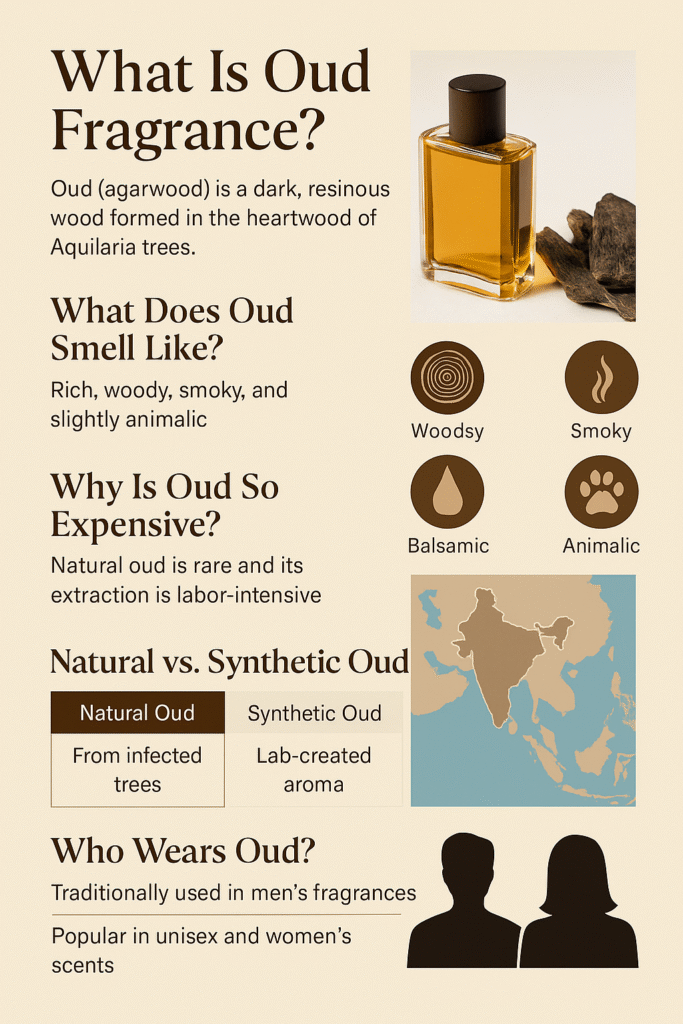
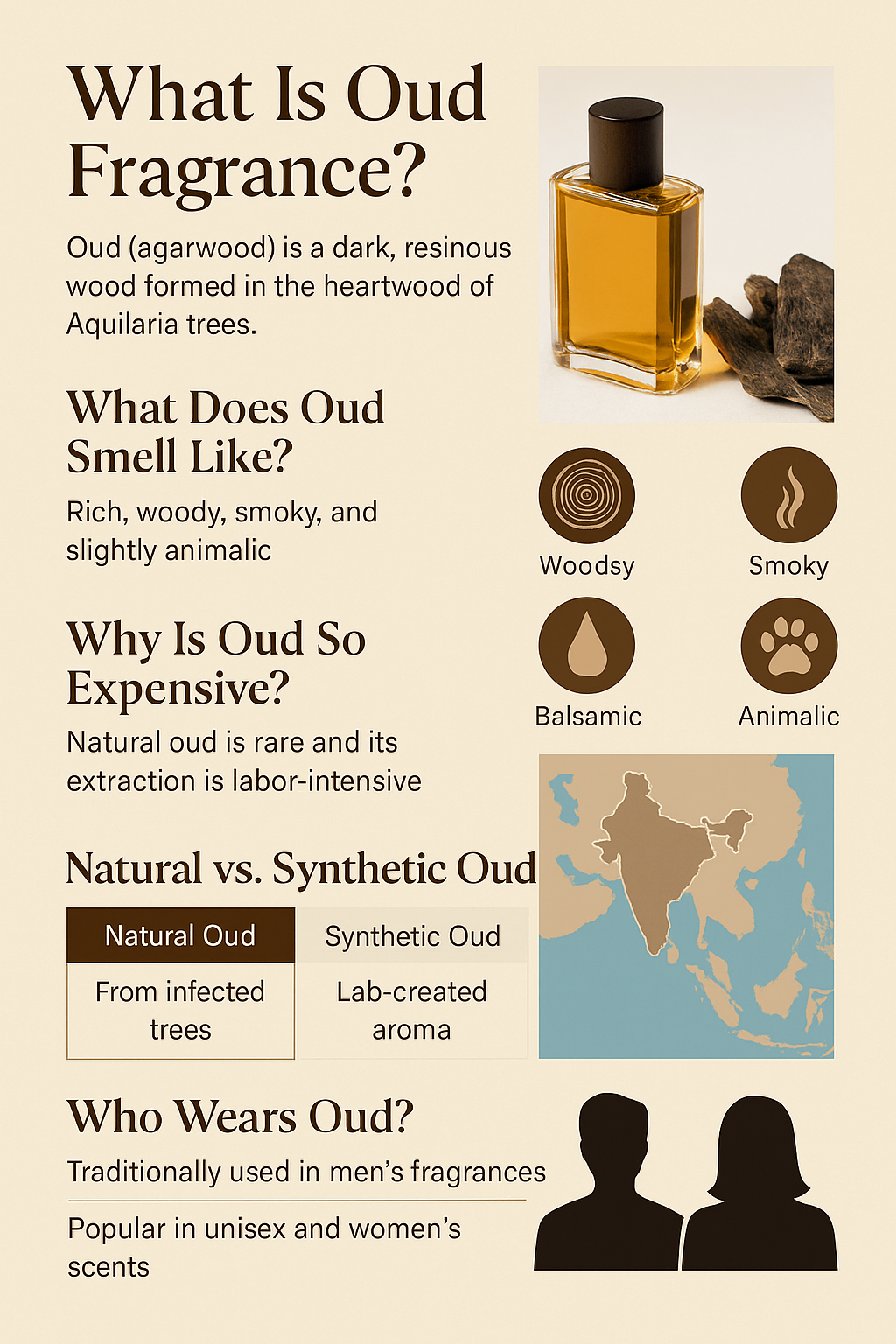
Oud (also known as agarwood or aloeswood) is a dark, resinous wood formed when the Aquilaria tree becomes infected by a specific type of mold (Phialophora parasitica). In defense, the tree produces a rich resin to protect itself — this resin-saturated wood is what we know as oud.

🗺️ Oud is primarily produced in:

  • India
  • Laos
  • Cambodia
  • Malaysia
  • Vietnam
  • Middle Eastern countries (as a cultural favorite)

Oud has been prized for centuries in Middle Eastern, Indian, Japanese, and Chinese cultures — used in incense, traditional ceremonies, and later, luxury perfumery.


👃 What Does Oud Smell Like?

Oud’s aroma is complex, intense, and deeply captivating — a bold statement in any perfume composition.

Key scent notes:

  • Smoky
  • Woody
  • Animalic (leather-like)
  • Earthy
  • Sweet balsamic undertones

No two oud oils smell exactly the same. Depending on the tree species, age, region, and extraction method, oud can range from medicinal and dry to sweet and smooth. The result is a multi-dimensional scent that lingers on the skin for hours.


💰 Why Is Oud So Expensive?

Oud is one of the most expensive raw materials used in perfumery — sometimes costing more than gold by weight. Here’s why:

  1. Rarity – Only about 2% of Aquilaria trees naturally produce oud resin.
  2. Time – It can take years for the infected wood to develop.
  3. Manual Harvesting – Extraction is labor-intensive and must be done with precision.
  4. Conservation – Overharvesting has led to restrictions. Aquilaria trees are now protected under CITES (Convention on International Trade in Endangered Species).

As a result, natural oud oil is often reserved for ultra-premium fragrances, making it a status symbol in both Eastern and Western perfume markets.


🧪 Natural vs Synthetic Oud: What’s the Difference?

Attribute Natural Oud Synthetic Oud
Source Resin from Aquilaria trees Lab-created aroma molecules
Price Extremely high Affordable
Scent Rich, complex, multi-faceted Clean, linear, replicable
Availability Rare, limited harvest Mass-producible
Sustainability Overharvesting risk Eco-friendlier alternative

Synthetic oud, while not as nuanced, allows perfumers to replicate the oud experience without the environmental and ethical costs — and at a much more accessible price point.


👫 Who Wears Oud? Is It for Men or Women?

Traditionally, oud has been associated with Middle Eastern men’s perfumery, thanks to its strong, bold, and mystical character. But in modern fragrance design, oud is widely used in gender-neutral and women’s scents too.

Popular pairings:

  • Rose + Oud – sensual and romantic
  • Oud + Vanilla – creamy and addictive
  • Leather + Oud – dark and powerful

Whether you’re into niche blends or mainstream luxury houses, oud is now a unisex signature for depth and elegance.


🧴 Top Oud Fragrances to Explore

💎 High-End Luxury:

  • Tom Ford Oud Wood – smooth, Westernized oud with spice and amber
  • Amouage Interlude Man – rich, incense-laden oud powerhouse

🛍️ Designer Picks:

  • Dior Oud Ispahan – floral-oud masterpiece with rose
  • Versace Oud Noir – bold and woody with an oriental twist

💰 Affordable Options:

  • Al Haramain Amber Oud – strong projection, Eastern style
  • Armaf Club de Nuit Intense Oud – budget-friendly beast-mode oud

✅ Should You Try Oud?

Absolutely — if you’re ready for something bold, mysterious, and unforgettable.

For oud beginners, we recommend:

  • Start with blended fragrances where oud is one of the supporting notes.
  • Try samples first — oud is powerful and may not suit everyone’s taste.
  • Layer it sparingly to appreciate its full dry-down evolution.

Oud isn’t just a scent — it’s an experience, a heritage, and a luxury. Whether you’re drawn to its ancient roots or modern prestige, oud invites you into a world of olfactory richness few other ingredients can match.


✨ Final Words

Oud fragrance represents the perfect union of nature, culture, and art. While it may not be for everyone, its richness and depth have earned it a loyal following around the globe.

Next time you see “Oud” on a fragrance label, you’ll know: it’s not just another note. It’s a legend.
Similar Posts

  • The Evolution of Fragrances: Tracing the Aromatic Journey Through Time

    The world of fragrances has experienced a remarkable transformation over the centuries, evolving from ancient rituals to sophisticated products in the modern beauty industry. This article explores the rich history and dynamic changes in the art of perfumery, reflecting cultural, technological, and artistic shifts. Ancient Beginnings and Royal Decrees Fragrances date back to ancient civilizations…

  • Exploring the World of Aroma Chemicals

    Exploring the World of Aroma Chemicals Aroma chemicals are everywhere, yet often go unnoticed. They are the unsung heroes behind the scents and flavors we love. These compounds are crucial in creating fragrances and flavors in countless products. From perfumes to food, they play a vital role. Aroma chemicals can be natural or synthetic. Synthetic versions are more common due to their consistency and cost-effectiveness. The fragrance industry relies heavily on these chemicals. They ensure that scents are long-lasting and consistent across products. Flavoring agents, another type of aroma chemical, enhance the taste of food and beverages. They make our favorite treats even more enjoyable. The history of aroma chemicals is rich and fascinating. Ancient civilizations used natural extracts for scenting, laying the groundwork for modern perfumery. Today, the balance between natural and synthetic ingredients is key. This balance creates unique fragrance profiles that captivate our senses. As we explore the world of aroma chemicals, we uncover their impact on our daily lives. They shape our experiences and evoke emotions, making them indispensable.   What Are Aroma Chemicals? Aroma chemicals are specialized compounds used in creating scents and flavors. They are the building blocks of fragrance and flavor industries, essential in many products. These compounds can be derived from both natural and synthetic sources. Natural aroma compounds are extracted from plants or animal products, while synthetic ones are manufactured in labs. Synthetic aroma chemicals offer several advantages. They provide consistency, purity, and often a more cost-effective solution than their natural counterparts. Aroma chemicals are utilized in various applications. This includes perfumes, cosmetics, food products, and even cleaning supplies. They are selected based on their ability to enhance the user experience. Common uses of aroma chemicals include: Perfumes: creating distinctive and lasting scents. Food and beverages: enhancing flavors. Household products: masking odors. Cosmetics: adding pleasant fragrances. The science behind aroma chemicals is complex, involving intricate molecule interactions. This fascinating chemistry allows them to mimic natural scents effectively. A key aspect of their success lies in their ability to evoke emotions and trigger memories. This emotional connection is why aroma chemicals are so effective in marketing.   The History and Evolution of Aroma Chemicals The use of aroma chemicals can be traced back to ancient civilizations. Early societies used natural extracts for incense and personal scenting. During the Renaissance, advances in distillation improved the extraction of aromatic compounds. This period saw the rise of perfumery in Europe, laying the groundwork for modern developments. The 19th century marked a significant shift. Synthetic production techniques expanded the palette of available scents. This innovation revolutionized the industry, leading to mass-market fragrances. In the 20th century, chemistry and technology advanced further. New methods allowed for complex fragrance compositions, combining both natural and synthetic ingredients. Key milestones in aroma chemicals’ evolution include: Ancient times: Use of natural extracts. Renaissance: Improved distillation techniques. 19th century: Introduction of synthetic aroma compounds. 20th century: Complex fragrance formulations. The evolution of aroma chemicals reflects broader trends in science and technology. It has continually adapted to consumer preferences and industry demands. Today, the focus is on sustainability and innovation. Efforts are underway to create eco-friendly processes and new, sustainable aroma compounds. by Emile Mbunzama (https://unsplash.com/@emilembunzama) Natural vs. Synthetic Aroma Chemicals Aroma chemicals can be either natural or synthetic. Each type offers unique attributes and advantages in fragrance and flavor production. Natural aroma compounds are derived from plant and animal sources. Essential oils and extracts provide natural scent profiles. These compounds are often favored for their purity and aromatic qualities. Synthetic aroma chemicals, however, are created in laboratories. They replicate both familiar and novel scents. This method allows for cost-effective production and greater scent variety. Choosing between natural and synthetic aromas involves several considerations. Factors include cost, availability, scent longevity, and consumer preferences. Many products today blend both types for optimal results. Key differences between natural and synthetic aroma chemicals include: Natural: Sourced from plants and animals. Synthetic: Lab-created, often more consistent and durable. Scent Profile: Natural for purity, synthetic for variety. Cost: Natural can be pricier; synthetic is more economical. Availability: Natural sources can be limited. The balance between these two forms of aroma chemicals is crucial. It influences fragrance formulation and appeals to diverse consumer needs. Ultimately, the choice depends on the desired product attributes and market trends. Both natural and synthetic types continue to play vital roles in the industry. by Ela De Pure (https://unsplash.com/@eladepure) Key Types of Fragrance Compounds and Flavoring Agents Fragrance compounds are essential elements in perfumery and flavoring. They provide unique scent and taste profiles, enhancing product appeal. Esters are a common type of fragrance compound. They offer fruity and floral scents. Widely used in perfumes, they provide fresh, sweet aromas. Aldehydes are another vital group. They contribute to fresh and citrusy scents. Found in many household and personal care products, they bring a lively aroma. Ketones are notable for their versatility. They range from sweet to woody scents. Ketones add depth and complexity to many fragrances and flavors….

  • Revolutionizing Beverages with Mango Juice Powder Flavour in Southeast Asia: Spotlight on Thailand’s Market

    Unleash the sweet, succulent essence of tropical mangoes with our Mango Juice Powder Flavour. Designed for beverage manufacturers, this innovative solution infuses your products with the vibrant flavors of fresh mango juice, perfect for capturing the tropical zest of Southeast Asia. 1. Applications in Beverage Manufacturing Our Mango Juice Powder Flavour is specially formulated to…

  • Importance of flavors in the food industry

    Importance of flavors in the food industry Introduction With the rapid development of the food industry, people have put forward higher requirements for the flavor, taste and overall sensory experience of food. In this process, flavors, as an important food additive, have played an irreplaceable role in improving food flavor, enhancing appetite, extending food shelf…

Fikr bildirish