The Relationship Between Essential Oils and Fragrance Compounds: A Complete Guide
The Relationship Between Essential Oils and Fragrance Compounds: A Complete Guide
Quick Summary: Essential oils are natural volatile extracts from plants that offer a sense of authenticity and complexity. Fragrance compounds (commonly referred to as fragrances or flavors), on the other hand, are carefully crafted blends of natural and/or synthetic ingredients designed for consistency, stability, and regulatory compliance. Essential oils are often used as part of a fragrance formulation, but they are not interchangeable.
Definitions: What Are Essential Oils and Fragrance Compounds?
Essential Oils
Essential oils are extracted from flowers, leaves, peels, resins, and other plant parts using distillation, cold pressing, or solvent extraction. They are complex mixtures of natural molecules such as monoterpenes, sesquiterpenes, alcohols, and esters. Their olfactory profiles are rich and layered, but their batch variability and sensitivity to oxidation and light make them less stable for industrial use.
Fragrance Compounds (Fragrances or Flavors)
Fragrance compounds are formulated products composed of natural extracts, synthetic aroma chemicals, carriers, antioxidants, and sometimes encapsulation systems. They are designed to meet specific performance requirements: long-lasting scent, compatibility with product bases, regulatory compliance (e.g., IFRA, EU, FDA), and cost-effectiveness.
Quick Differentiation
Use essential oils when the story of natural origin is critical and the product matrix is mild. Use fragrance compounds—or a blend of both—when stability, reproducibility, and performance under heat, pH stress, or oxidation are essential. FY can provide ratio and application suggestions based on your specific product base.
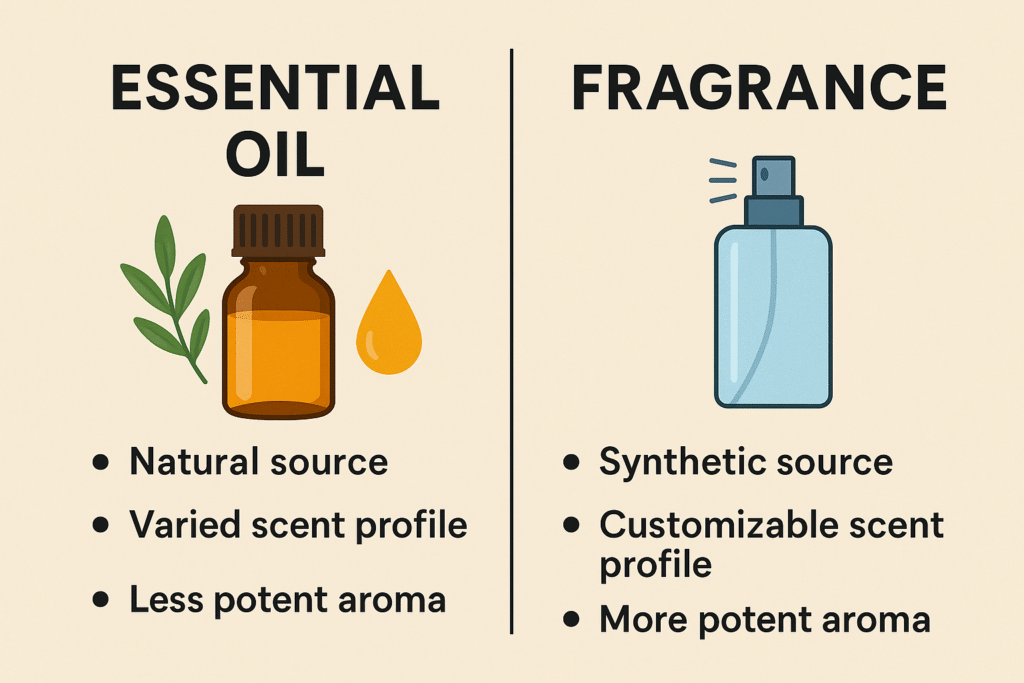
Key Differences: A Side-by-Side Comparison
Understanding the structural differences between essential oils and fragrance compounds helps ensure better formulation and regulatory decisions.
| Criteria | Essential Oils | Fragrance Compounds | Notes |
|---|---|---|---|
| Source & Supply | Single botanical, seasonal variations | Blend of natural and synthetic, stable sourcing | Ideal for scalable manufacturing |
| Stability | Sensitive to oxidation, light, and heat | Enhanced with stabilizers and carriers | Ideal for industrial processing |
| Cost & Consistency | High variability in cost and quality | Predictable cost and quality | Easier to meet commercial KPIs |
| Regulatory Compliance | Contains natural allergens | Designed to meet IFRA/EU/FDA | Allows for early compliance control |
| Sensory Performance | Natural, complex, limited retention | Tunable top/middle/base notes and longevity | Versatile across product categories |
Fragrance compounds dominate industrial use due to their enhanced performance, cost efficiency, and formulation flexibility.
How Essential Oils and Fragrances Work Together
Essential Oils as “Notes” in Formulas
Essential oils serve as olfactive highlights—especially for top notes—but require support from stabilizing elements due to their volatility and allergen content.
Synthetic Ingredients as Builders
Synthetic aroma chemicals help re-create natural smells with greater accuracy and flexibility. They offer control over longevity, cost, and compatibility.
Examples
- Lavender Accord: Natural lavender essential oil + linalool + linalyl acetate = consistent and lasting aroma.
- Citrus Accord: Cold-pressed lemon oil + citral + decanal = brighter, more stable citrus note.
FY supports hybrid formulations, balancing the authentic feel of essential oils with the performance of modern aromatic systems.
Application Scenarios: Where Each Works Best
Home & Personal Care (e.g., Laundry Detergents, Shampoos)
High pH, surfactant systems, or drying cycles challenge fragrance retention. Use fragrance compounds as the base with microcapsule or solid carriers. Add a small portion of essential oil to enrich the natural feel.
Air Care (e.g., Air Fresheners, Car Diffusers)
Requires diffusion and sustained presence. Essential oils may give a natural top note but need synthetic supports for performance longevity.
Food & Oral Care (e.g., Citrus Beverages, Toothpaste)
For citrus beverages, acidity and oxidation risk must be mitigated via distilled/terpeneless oils and antioxidant systems. For oral care, use peppermint oil + cooling agents (e.g., WS-23) to create a dynamic cooling sensation.
| Condition | Temp | pH | Goal | Recommended Strategy |
|---|---|---|---|---|
| Fabric Softener | Med–High | Alkaline | Long-lasting scent | Synthetic backbone + encapsulated top note + small amount of EO |
| Shampoo | Medium | Neutral | Fresh top note | EO for freshness + surfactant-resistant molecules |
| Citrus Drink | High | Acidic | Realistic taste | Distilled oil + antioxidant + flavor stabilizer |
| Toothpaste | Low–Med | Neutral | Cooling + refreshing | Peppermint EO + synthetic cooling agents |
A Step-by-Step Framework for Choosing Between Essential Oils and Fragrances
- User Experience Goals: Is natural origin the priority, or is fragrance performance and lasting effect more important?
- Base Matrix & Process Stress: Consider heat, pH, oxidation, packaging, and storage.
- Regulatory Constraints: IFRA class, allergen disclosure, halal/vegan/child-safe labeling.
- Cost & Supply Chain: Fixed budget? Need consistency across batches? Seasonal sourcing risk?
- Sustainability Story: Bio-based, upcycled, and low-carbon options are growing in demand.
Formulation Principles & Testing
Top–Heart–Base Design
Top note attracts attention, heart note stabilizes identity, base note ensures longevity. Use antioxidants and light stabilizers to preserve integrity.
Encapsulation & Controlled Release
Microencapsulation or carrier embedding ensures stability in tough matrices and timed release during usage. FY offers multiple controlled-release profiles.
Validation & Lab Testing
From lab scale to pilot batch, validate scent curve (via sensory panel), physical properties (pH, viscosity, color), and chemical stability (GC-MS). FY’s technical service team supports GC-MS analysis and accelerated aging tests.
Compliance & Quality Assurance
Stay ahead of IFRA categories, EU cosmetic standards, and FDA flavor guidelines. Consider allergens, usage limits, and labeling obligations.
FY holds IFRA, ISO, and Halal certifications. We maintain batch-to-batch traceability and provide full documentation for formulation compliance.
Supplier Selection & Collaboration
Define application scenario, regulatory needs, and key KPIs. Request sample packs, documentation, and mockup formulas for evaluation.
FY provides:
- 3 free samples per project
- GC-MS reports upon request
- Custom formulation support
- Fast development & scale-up
[CTA Button: Request Samples] [CTA Button: Book a Consultation]
Market Trends: What’s Coming Next?
1. Bio-Synthetic Molecules
Fermentation-derived aroma molecules are reducing reliance on seasonal botanicals and improving carbon footprint.
2. Upcycled Raw Materials
Essential oils and isolates from fruit juice or wood processing byproducts are gaining traction in fragrance sustainability.
3. Advanced Encapsulation
New shell materials and multi-stage delivery profiles will enable better fit with textile care and oral care use cases.
4. AI-Driven Fragrance Development
AI and sensory databases are helping create optimized formulas balancing performance, cost, compliance, and preference.
Final Thoughts & Next Steps
Use application needs as the core reference when deciding between essential oils, fragrance compounds, or a blend. Leverage FY’s free sample program and formulation consultation to ensure optimal results in cost, compliance, and scent impact.
[Request Samples] [Talk to Our Experts]
FAQ
- What’s the key difference between essential oils and fragrance compounds?
Essential oils are single-source, natural extracts. Fragrance compounds are engineered blends for consistency and performance. - Why are fragrance compounds more common in industrial products?
They offer better stability, regulatory alignment, and batch-to-batch reproducibility. - What are IFRA restrictions for using essential oils?
Each oil has limits depending on IFRA category and allergen profile. Always request IFRA assessments. - What are the risks of using essential oils in food or beverages?
Stability under heat and acid is a challenge; emulsification and oxidation control are key. - Can I mix peppermint oil with synthetic cooling agents?
Yes—this hybrid model is effective in oral care and confectionery. - How do I improve scent retention in detergents?
Use base fixatives, microencapsulation, and slow-release boosters. - Are essential oils allergenic?
Some contain natural allergens; these must be declared and/or minimized. - Is fragrance the same as artificial additives?
Not necessarily. Fragrances can be natural, synthetic, or a blend—what matters is compliance. - How can I assess a supplier’s consistency?
Ask for GC-MS reports, COAs, and test across multiple batches. - Are encapsulated fragrances environmentally friendly?
Depends on the capsule material. Look for biodegradable and IFRA-compliant options. - How does bio-synthesis differ from natural extraction?
Bio-synthesis offers consistency and traceability with lower environmental risk. - What should I check for Halal, vegan, or child-safe labels?
Ingredient origin and processing must align with certification rules; FY provides full documentation.