The Role of Aroma Chemicals in Household Products Manufacturing
The Role of Aroma Chemicals in Household Products Manufacturing
Introduction — scent is product experience
Scent is more than decoration. In household products—laundry detergents, fabric softeners, surface cleaners, air fresheners and dishwashing liquids—fragrance is a powerful driver of perceived cleanliness, emotional response and repeat purchase. Aroma chemicals are the molecular ingredients that create those scent experiences. They determine the initial bright “top” impression, the fuller “heart” presence, and the lingering “base” trail consumers remember.
For manufacturers, aroma chemicals are therefore not an afterthought: they are strategic formulation tools that influence product performance, branding, regulatory compliance and supply-chain resilience. This guide explains what aroma chemicals are, why household products rely on them, how they are chosen and formulated, relevant safety and regulatory considerations, and how partners like FY Fragrance Solutions support manufacturers from concept to scaled supply.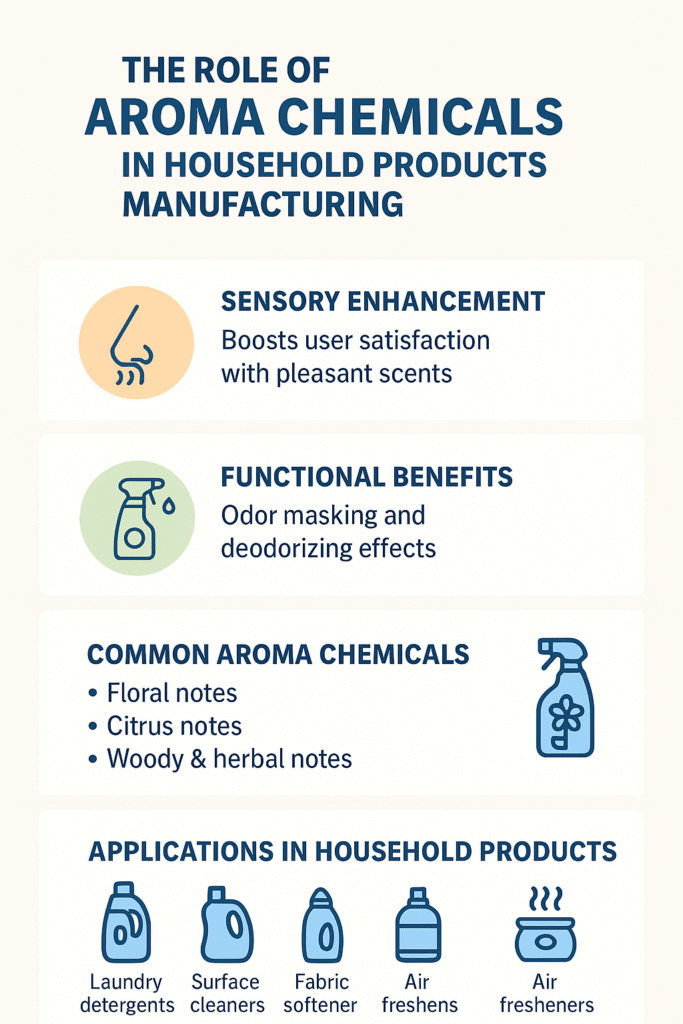
1. What are aroma chemicals?
An aroma chemical is any discrete molecule or fraction that has a characteristic smell at room temperature. These include both single molecules (e.g., linalool, limonene, vanillin) and complex natural fractions (essential oils, absolutes). Aroma chemicals can be:
- Natural — extracted from botanicals (steam distillates, absolutes, cold-pressed oils).
- Nature-identical — synthetically produced but chemically the same as a natural molecule.
- Synthetic/Novel — lab-created molecules not found in nature, designed for specific olfactive properties, stability or cost-effectiveness.
In household products, aroma chemicals are blended into fragrance accords and further adapted for the product matrix (surfactant systems, alcohol bases, powders). Choosing the right aroma chemicals requires balancing olfactive goals with technical constraints like volatility, oxidation propensity and matrix compatibility.
2. Why household products use aroma chemicals — three core roles
2.1 Sensory enhancement and emotional cues
Scent strongly affects perceived cleanliness and comfort. A citrus-scented kitchen cleaner signals freshness; a lavender-scented fabric softener signals calm and softness. Aroma chemicals deliver those emotional cues, helping brands build sensory signatures that consumers associate with effectiveness and brand identity.
2.2 Functional roles: odor-masking and deodorization
Beyond pleasantness, some aroma chemicals actively mask malodors or interact synergistically with deodorizing agents. For example, aldehydic and citrus top notes can neutralize cooking or smoke odors in the short term, while woody or musky base notes provide a persistent “clean” impression. Certain aroma actives can also pair with antimicrobial technologies to deliver a perceived or real improvement in indoor air quality.
2.3 Commercial differentiation & loyalty
Signature scents are brand assets. A consistent aroma across a detergent line or a chain of hospitality products reinforces recognition and loyalty. Aroma chemicals enable reproducible signature scents at scale—critical for retail brands and private-label manufacturers.
3. Common aroma chemical families used in household formulations
Different chemical families bring distinct olfactive and performance traits. Typical classes include:
- Terpenes (e.g., limonene) — bright citrus notes; widely used in kitchen and surface cleaners.
- Alcohols (e.g., linalool, geraniol) — floral, fresh; common in fabric care and body products.
- Esters (e.g., ethyl acetate) — fruity, sweet; used for cheerful top notes.
- Aldehydes (e.g., citral) — green, citrusy; strong impact at low concentration.
- Ketones & lactones (e.g., ionones, γ-decalactone) — provide powdery, fruity and creamy nuances.
- Musk and amber analogs (e.g., ambroxan, synthetic musks) — base notes for persistence and warmth.
Manufacturers often blend molecules from multiple families to create accords suited to the application (e.g., top-note heavy accords for sprays, base-weighted accords for fabric softeners).
4. Formulation & manufacturing considerations
4.1 Volatility and scent life
Volatility dictates whether an aroma chemical acts as a top, heart or base note. Highly volatile molecules evaporate quickly and give initial impact; low-volatility molecules remain longer and anchor the scent. For laundry detergents and softeners, formulators may emphasize base notes (or use microencapsulation) to prolong scent on fabric after washing.
4.2 Matrix compatibility
Aroma chemicals must be compatible with cleaning ingredients: surfactants, builders, enzymes, solvents, preservatives. Some molecules degrade in alkaline conditions or react in the presence of oxidizers. Compatibility testing—thermal, pH, UV and surfactant stability—is essential before launch.
4.3 Delivery technologies
Delivery systems extend scent life and control release:
- Microencapsulation (wear- or friction-activated) for fabric softeners and dryer sheets.
- Encapsulation in polymer beads for in-wash scent boosters.
- Polymeric emulsions for water-based sprays and cleaners.
Choice of delivery affects perceived longevity and product aesthetics.
4.4 Manufacturing scale-up
Fragrance concentrates must be produced reproducibly with stable raw material sourcing. Supply reliability, batch consistency and correct storage/handling are operational priorities. Professional fragrance houses and ingredient suppliers (e.g., FY) help ensure technical specifications and supply continuity.
5. Regulatory & safety landscape
Safety and compliance are non-negotiable in household product manufacturing.
5.1 Key regulatory frameworks
- IFRA (International Fragrance Association): issues usage limits and restrictions for fragrance ingredients based on toxicology.
- REACH (EU): registration and control of chemical substances in the EU.
- Local food and consumer safety authorities: may affect odor masking agents or additive approvals in certain markets.
Manufacturers must adhere to labeling rules—some jurisdictions require disclosure of certain allergens or provide “fragrance” as an INCI term. Consulting IFRA guidance and maintaining Safety Data Sheets (SDS) and Certificates of Analysis (COA) for each aroma chemical is standard practice.
5.2 Allergen management
Many common aroma chemicals (natural terpenes, some esters) can oxidize to allergenic products. Brands targeting sensitive-skin consumers often adopt low-allergen or hypoallergenic fragrance strategies, validated by patch testing and clinical data.
6. Sustainability & sourcing challenges
Sustainability shapes procurement decisions:
- Natural vs synthetic trade-offs: naturals carry authenticity but may present supply risk and environmental strain (e.g., endangered woods). Synthetics, especially fermentation-derived molecules, can reduce ecological pressure while maintaining olfactive performance.
- Traceability & certification: certified sourcing (organic, fair-trade) and traceability are increasingly valued.
- Upcycling: extracting limonene and other compounds from citrus-processing waste is an emerging circular solution.
FY partners with vetted suppliers and biotech firms to expand sustainable aroma chemical portfolios, offering fermentation-based and upcycled options where feasible.
7. Trends shaping aroma choices in household products
7.1 Functional & wellness-driven scents
Consumers ask for calming or energizing sensory cues—lavender or bergamot for relaxation; citrus or green tea for invigoration. Building functional narratives around scent (e.g., “calm linen”) is growing.
7.2 Transparency & reduced allergens
Regulatory scrutiny and consumer demand push toward clearer ingredient information and allergen-reduced formulations.
7.3 Eco-conscious molecules
Bio-based, low-carbon-footprint aroma chemicals and biodegradable fixatives are in demand.
7.4 Smart release & personalization
Microencapsulation and intelligent release technologies enable tailored sensory experiences—longer scent retention in clothing, short bursts in sprays, or wear-triggered releases.
FY actively monitors these trends and integrates them into new-product development, helping brands adopt the right aroma strategies for consumer expectations.
8. Choosing aroma chemicals — practical decision framework
When selecting aroma chemicals or a fragrance partner, manufacturers should follow a systematic approach:
- Define product objective — immediate freshness, long-lasting scent, odor masking, or brand signature.
- Map technical constraints — matrix chemistry, processing temperature, pH, storage.
- Identify regulatory markets — adjust ingredient lists to IFRA/REACH and local requirements.
- Set sustainability criteria — natural vs nature-identical vs synthetic, traceability needs.
- Prototype & sensory test in matrix — lab-only testing is insufficient; field trials reveal real-world behavior.
- Evaluate supply & cost — MOQ, lead times, alternative sourcing strategies.
- Document & certify — obtain SDS, COA, IFRA certificates, and any sustainability claims.
Working with a technical supplier like FY Fragrance Solutions streamlines this process: FY provides formulation guidance, compatibility testing, regulatory documentation and flexible supply for launch and scale.
9. Case studies — practical applications
Case A: Long-lasting fabric softener
Goal: durable “fresh linen” scent post-wash. Approach: combine green/aldehydic top notes with musky/amber base, encapsulate base-rich fraction for fabric adhesion, validate wash-fastness and skin safety.
Case B: Kitchen surface cleaner
Goal: immediate odor removal and fresh impression. Approach: citrus-heavy top notes (limonene, citral) blended with an aldehydic clean note; employ antioxidant stabilizers to limit terpene oxidation and ensure shelf life.
Case C: Air freshener spray
Goal: instant impact and safe indoor use. Approach: volatile top notes for first spray, middle florals for body, light bases to avoid heavy scent build-up; choose low-odor carrier solvents and comply with indoor VOC regulations.
FY supports such workflows with tailored sample packs, stability/compatibility testing and scaling plans to commercial production.
10. Partnering with a fragrance house — what FY provides
Manufacturers benefit most when fragrance partners offer end-to-end services. Typical FY offerings include:
- Custom fragrance development: briefs, concepting, and accords aligned to brand identity.
- Technical adaptation: optimizing fragrances for surfactant systems, alcohol sprays, powders or encapsulated beads.
- Regulatory support: IFRA guidance, labeling recommendations and regional compliance.
- Sustainable sourcing: alternatives for critical naturals, fermentation-derived molecules, upcycled sources.
- Sampling & scale-up: graduated sample sizes through to production MOQs, with QA/QC and logistics.
The right partner reduces development time, mitigates compliance risk and improves the chance of commercial success.
Conclusion — aroma chemicals are strategic ingredients
Aroma chemicals are far more than pleasant extras; they are strategic ingredients that influence sensory performance, consumer perception and commercial outcomes. By understanding volatility, matrix compatibility, safety limits and sustainability impacts, manufacturers can design household products that delight consumers and meet operational constraints.
If you’re planning a new household product or reformulating an existing line, partner with technical fragrance experts who understand both olfactive design and manufacturing realities. FY Fragrance Solutions provides formulation expertise, regulatory guidance, sustainable sourcing options and scalable supply so your next product smells as good in market as it does in the lab.
FAQ — quick answers for product teams
Q1. Are aroma chemicals safe for household products?
Yes—when selected and used within regulatory guidelines (IFRA, REACH) and validated by safety testing. Both natural and synthetic aroma chemicals are commonly used in compliant formulations.
Q2. Do natural aroma chemicals perform better than synthetics?
Not categorically. Naturals offer complex character and marketing appeal, while synthetics offer consistency, stability and novel olfactive options. Most successful formulations use a blend.
Q3. How can I make scent last longer on fabrics?
Consider base-rich molecules, microencapsulation, and delivery systems designed to adhere to fibers and release scent with friction or heat.
Q4. What documentation should suppliers provide?
Request Safety Data Sheets (SDS), Certificates of Analysis (COA), IFRA certificates and any sustainability/traceability documentation for natural ingredients.
Q5. How does FY help manufacturers launch fragrant products?
FY offers custom fragrance development, compatibility testing, regulatory support and scalable supply, tailored to household product requirements and regional regulations.